
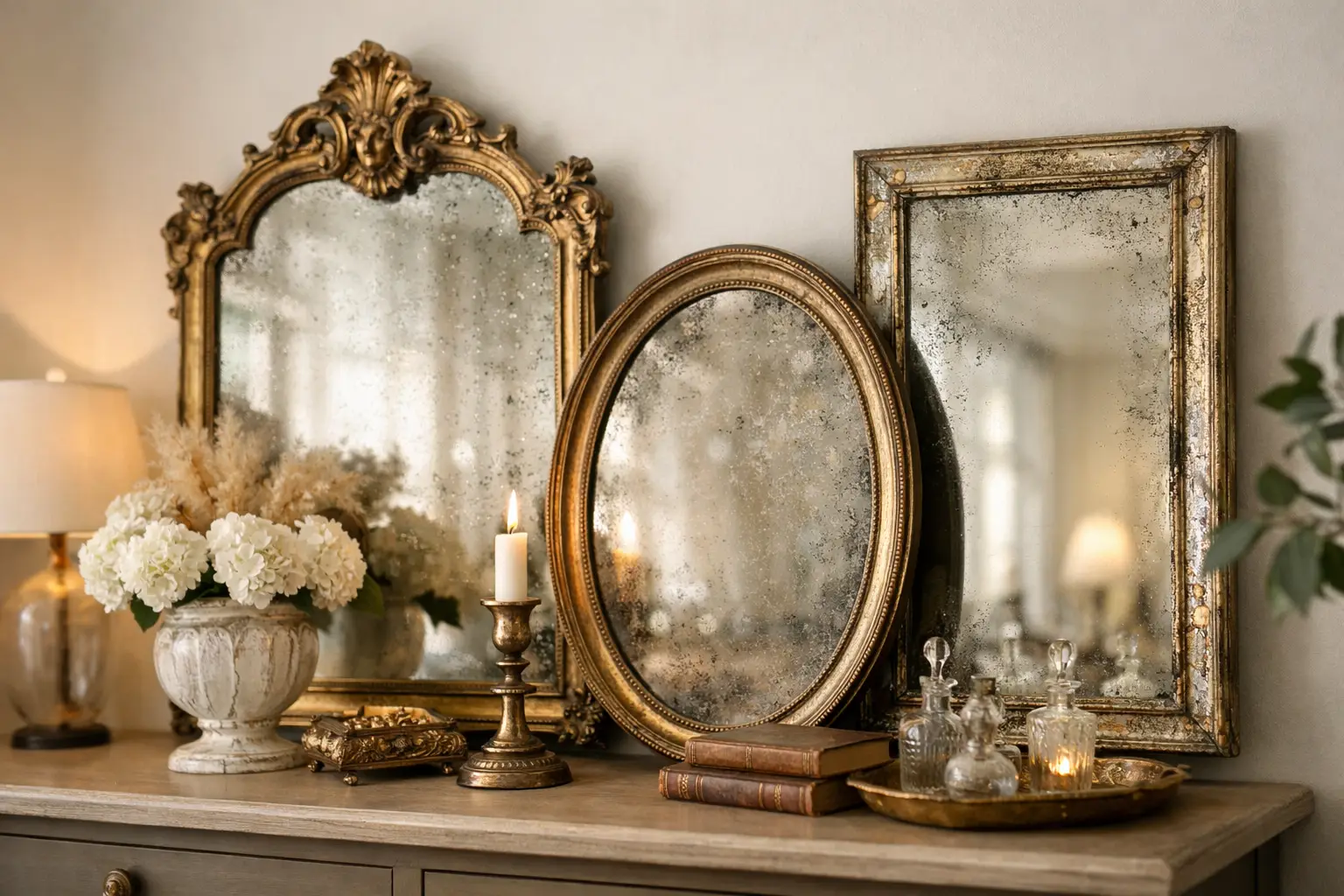
An antique mirror should do more than reflect a room. It should alter its atmosphere: catching the low glow of a Murano glass lamp, extending a view toward a garden, or giving a pared-back wall the depth that new finishes rarely possess. Knowing how to style antique mirrors begins with seeing them as objects of architecture and decoration at once. Their frame, glass, age marks, and scale all shape the composition.
The most compelling interiors do not treat an old mirror as a generic finishing touch. A carved giltwood trumeau, a Venetian etched mirror, and a restrained Mid-Century brass mirror each ask for a different relationship with the room. Style comes from honoring that distinction while allowing a piece to feel lived with rather than staged.
Start with the mirror’s visual language
Before choosing a wall, identify what gives the mirror presence. An ornate 19th-century giltwood frame has a strong silhouette and a warm, textured surface. It can carry a room with plaster walls, walnut furniture, velvet, and antique bronze. A Venetian example may bring a cooler, more luminous quality through beveled plates, engraved details, or delicate floral elements. Italian modernist mirrors, often in brass, teak, rattan, or sculptural glass, tend to work through line and proportion rather than ornament.
This is not about enforcing a strict period room. In fact, a mirror is often most persuasive when it creates a considered tension. An elaborate Louis Philippe mirror above a clean-lined travertine console gives the stone a sense of softness. A minimal 1950s brass mirror can sharpen the profile of an older chest. The connection should be visible, whether through material, color, or geometry.
Pay attention to patina. Foxing in old glass, tiny losses to gilding, oxidation in brass, and small irregularities in the frame are not defects to conceal automatically. They are part of the object’s visual memory. If the reflective surface is heavily distressed, position it where it will read as atmosphere rather than where a crisp reflection is essential, such as directly above a bathroom vanity.
How to style antique mirrors above a mantel
Above a mantel, the mirror becomes a vertical counterweight to the hearth. The first decision is scale. A small mirror floating over a wide mantel usually looks tentative, while one that is too wide can make the fireplace feel compressed. As a starting point, choose a mirror roughly two-thirds to three-quarters the width of the mantel opening or shelf. This is guidance, not a rule: a tall, narrow mirror can be exceptional over a slender chimney breast.
Leave enough breathing room for the frame to register. A highly ornamented gilded mirror generally needs an uncluttered mantel below it. One low ceramic vessel, a pair of sculptural candlesticks, or a single branch in a substantial vase is often enough. Filling every inch with objects reduces both the mirror and the architecture to visual noise.
For a more layered arrangement, lean a large mirror against the wall rather than hanging it. This suits a deep mantel and an informal salon-like space, particularly when the mirror is paired with a small painting or a compact table lamp. The approach is less formal, but it still requires care: secure the mirror discreetly to the wall, especially in households with children or pets.
A dark frame can be remarkably effective over pale stone or limewash. Conversely, gilding gains authority against deep olive, tobacco, oxblood, charcoal, or midnight blue. Do not select a wall color solely to make the mirror “pop.” Choose a color that gives the room a coherent depth, then let the mirror establish its own light.
Use reflection as a design material
What an antique mirror reflects matters as much as how it looks front-on. A mirror opposite an empty hallway, a television, or a cluttered storage wall will faithfully multiply the least interesting part of the room. Stand at the intended placement and look at the sightline before committing to hardware.
The best reflections are usually layered and slightly oblique. Place a mirror to catch the side of a window rather than facing it head-on if direct light creates glare. Angle it toward a chandelier, an art wall, a foliage-filled terrace, or the warm pool of a floor lamp. In a dining room, an antique mirror positioned to reflect candlelight can make an evening table feel more expansive without becoming theatrical.
Aged mercury glass and foxed surfaces are especially beautiful in low or indirect light. They diffuse reflections, turning a lamp, a bouquet, or a row of glasses into a softened image. This makes them ideal for dining rooms, entry halls, bedrooms, and spaces where mood is more important than utility.
Create contrast without losing coherence
The old rule that antique mirrors belong only with antique furniture produces predictable rooms. A richer approach uses contrast deliberately. A Baroque-inspired gilt frame can bring needed movement to a contemporary interior of linen sofas and quiet oak. A sleek, rectangular 1960s mirror can give a traditional room a useful interruption of line.
The key is to repeat one element elsewhere. If the mirror has warm gilding, echo it in a brass lamp base, a bronze sculpture, or the fine edge of a picture frame. If it is Venetian glass, introduce another reflective or translucent material nearby: a Murano vase, a polished lacquer box, or a glass pendant. Repetition should be subtle. Two or three points of connection are enough to make different eras feel intentional.
Avoid matching every finish too closely. A room of identical gold tones can look newly assembled rather than collected. A softened antique gilt frame beside darker bronze, aged brass, or blackened iron has more depth. The same principle applies to wood: walnut, oak, and ebonized finishes can coexist when each has a distinct role.
Give a large mirror room to breathe
A floor-standing antique mirror changes the scale of an entire room, particularly in an entry, dressing room, bedroom, or dining area. Its function is partly practical, but its real value is spatial. A tall mirror can draw the eye upward, brighten a dim corner, and introduce the grandeur of an old apartment into a newer interior.
Place it where its height feels useful rather than accidental. Beside a tall bookcase, near the end of a dining room, or on a wall perpendicular to a window are strong choices. In a bedroom, a full-length mirror should reflect a pleasing part of the space, such as the bed’s textile composition or an upholstered chair, not the open door to a closet.
Leaning a large mirror on the floor lends softness, but a very heavy antique frame must still be secured. For hanging, use hardware rated well above the piece’s actual weight and account for the construction of the wall. Plaster, masonry, and drywall demand different fixings. With a valuable mirror, professional installation is part of good stewardship, not an unnecessary precaution.
Think beyond the living room
An entry hall is one of the most natural settings for an antique mirror. It offers a final glance before leaving while establishing an immediate sense of identity. Above a narrow console, choose a vertical mirror with enough presence to hold its own against coats, doors, and architectural transitions. A pair of small wall lights nearby can give the frame a gentle evening glow.
In a powder room, the mirror can be the room’s defining decorative gesture. This is where a more expressive frame, Venetian glass, or unusual silhouette earns its place. The trade-off is moisture. Protect vulnerable wood, gesso, and metal surfaces from persistent steam, and make sure the room is properly ventilated.
A dining room invites more scale and drama. One oversized mirror can open a compact room, while a collection of smaller antique mirrors can create a salon wall above a sideboard. Keep a shared thread among the pieces, such as similar gilding, oval forms, or a common range of aged glass. Random assortment is not the same as collected character.
Pair antique mirrors with art and lighting
A mirror does not always need to occupy the center of a wall. It can sit beside a painting, above a low sculpture, or within a carefully measured arrangement of art. This works best when the mirror is visually quieter than the artwork, or when both share a clear dialogue in color and scale. A small, highly decorative mirror next to a delicate drawing can feel jewel-like; next to a large, intense canvas, it may simply disappear.
Lighting should reveal the frame without flattening the glass. Side lighting from sconces is usually more flattering than a hard spotlight directly overhead. For giltwood, warm bulbs emphasize texture and softness. For mirrored or glass-framed pieces, a slightly diffused light source prevents harsh reflections and keeps the surface legible.
The final measure is restraint. An antique mirror already carries material richness, history, and reflected movement. Give it a setting that allows those qualities to emerge, then let the changing light of the day do the rest.