
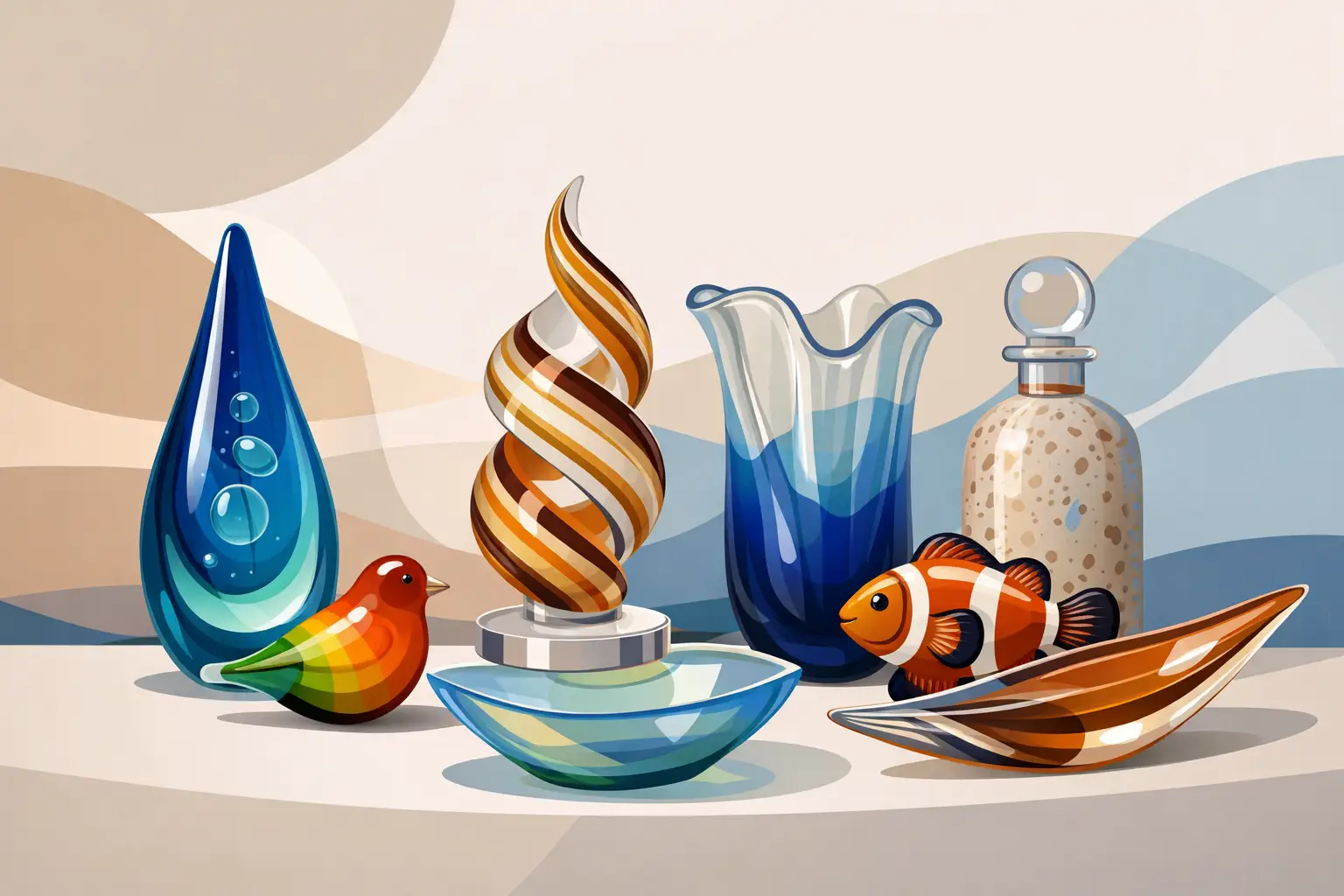
A room can be technically well furnished and still feel anonymous. The best Murano glass decor pieces solve that problem quickly because they do more than fill space – they introduce color, light, craftsmanship, and a distinctly Italian sense of presence.
Murano glass has long occupied a rare position in decorative arts. It is collectible, but not only for collectors. It is ornamental, yet often functional. And unlike many decorative accents that disappear into a scheme, Murano tends to set the visual rhythm of a room. The right piece can sharpen a minimalist interior, soften a severe modernist space, or give a layered vintage setting its focal point.
What makes the best Murano glass decor pieces stand out
Not every Murano object has the same decorative role. Some are defined by technique – sommerso, pulegoso, lattimo, aventurine. Others stand out for silhouette, scale, or period character. The strongest pieces usually balance at least three qualities: a confident form, a color story with depth, and enough craftsmanship to remain compelling even when the room around them changes.
That last point matters. A good Murano piece should not depend on a passing trend. A handblown vase with deep amethyst casing, a pair of textured sconces, or a sculptural bowl with controlled asymmetry can move across interiors more easily than people expect. The context may shift from Mid-Century to contemporary, from eclectic to Art Deco-inflected, but the object keeps its authority.
There is also a difference between pieces that are simply decorative and those that are spatially transformative. A small dish may add refinement to a console. A floor lamp in Murano glass can alter the entire atmosphere of a room. Knowing which category you are buying for helps narrow the field.
The best Murano glass decor pieces for a refined interior
Sculptural vases
If one category defines Murano’s decorative power most clearly, it is the vase. Not because it is the safest choice, but because it shows the breadth of the glassmaking tradition so completely. Tall baluster forms, biomorphic silhouettes, flared necks, folded rims, and substantial sommerso bodies all create different effects.
A vase works well when you want one object to carry a surface. On a pedestal, console, or dining table, it does not require much support. Flowers are optional. In many interiors, especially those with strong architectural furniture, an empty Murano vase reads more convincingly as sculpture.
The trade-off is scale. Small vases can get visually lost unless grouped with intention. Large examples offer more impact, but they ask for breathing room. If the room is already busy with patterned textiles, mixed woods, and art, a quieter vase in smoke, amber, or transparent gray can be more effective than a highly saturated piece.
Decorative bowls and centerpieces
Murano bowls are often underestimated because buyers treat them as tabletop accessories rather than compositional anchors. In reality, a substantial centerpiece can organize a dining table, sideboard, or coffee table better than several smaller objects.
The appeal here lies in surface and profile. Ruffled edges, bullicante textures, thick submerged colors, or iridescent finishes catch light from every angle. These pieces are particularly useful in rooms where you want decorative richness without introducing another lamp or figurative object.
They are also among the easier categories to place. A bowl can be grand but still practical. It can hold nothing at all and remain complete. For interiors that already contain strong vertical elements such as bookcases, mirrors, or floor lamps, a low Murano centerpiece creates contrast and balance.
Table lamps in Murano glass
Among the best Murano glass decor pieces, table lamps offer the rare combination of utility and atmosphere. They belong to the category of decor that earns its place twice – as sculpture by day and light source by night.
This is where period sensitivity matters. A mushroom lamp in opaline glass speaks a different language than a segmented Mid-Century form with brass details. Neither is universally better. It depends on the interior. If your room is restrained and contemporary, a softer, rounded lamp can introduce warmth. In a more collected interior with vintage furniture and layered materials, a sharper silhouette may hold its own more convincingly.
Murano table lamps also reward attention to proportion. A lamp that is too small looks incidental. Too large, and it dominates a side table in an awkward way. Ideally, it should feel integrated with the furniture while still carrying enough visual weight to justify Murano craftsmanship.
Chandeliers and pendant lighting
If the goal is impact, few choices rival Murano lighting. Chandeliers and pendants have a larger decorative reach than almost any other object because they affect the room from the center outward. They are seen from below, across, and at distance. They shape mood as much as style.
Classic multi-arm chandeliers with floral details create a more formal and historic effect. Mid-Century Murano pendants, often with cleaner geometry and richer colored glass, feel more architectural. One is not inherently more versatile than the other. It depends on ceiling height, furniture style, and how much drama the room can absorb.
This is also the category where restraint matters most. A highly elaborate chandelier in a room already full of decorative signals can feel overcommitted. In contrast, a well-scaled pendant with distinctive glass quality can make a stronger statement precisely because it leaves visual space around it.
Wall sconces
Wall lighting is often chosen late, which is why it so often feels secondary. Murano sconces deserve earlier consideration. They frame mirrors, animate hallways, and bring softness to dining rooms, bedrooms, and entry spaces without occupying floor area.
For many interiors, sconces are the most intelligent way to introduce Murano glass when a chandelier would be too assertive. A pair offers symmetry and architectural order. A single sculptural sconce in a compact room can work almost like wall-mounted art.
Textured translucent glass is especially effective here because it diffuses light while maintaining surface interest. The result is decorative but not fussy. In homes where every object is expected to justify itself, that balance is valuable.
Figurines and sculptural objects
Not every Murano acquisition needs to be large. Smaller sculptural pieces – birds, fish, abstract forms, shells, or purely organic studies – can bring character to shelves, desks, and intimate corners of a room.
This category is more dependent on editing. One exceptional object reads as intentional. Several average ones can start to feel like souvenir collecting. The best examples have clarity of line, convincing weight, and a color palette that supports the room rather than interrupting it.
These pieces are especially effective in bookcases and layered vignettes where you want a moment of luminosity among paper, wood, and metal. They are less about dominance and more about precision.
How to choose the best Murano glass decor pieces for your space
Start with the room’s need, not only the object’s beauty. Some spaces need a focal point. Others need reflected light, softness, or a finishing note on a horizontal surface. When the function is clear, the category usually follows.
Then consider how Murano glass will interact with existing materials. In a room with walnut, brass, and cream upholstery, amber, smoke, or milky white tones often feel natural. In a sharper contemporary setting with stone, black metal, and neutral walls, cobalt, ruby, or acid green can introduce a more deliberate contrast.
Period also matters, though not in a rigid way. A 1950s Murano lamp can sit beautifully with contemporary furniture if the proportions are right. A more ornate chandelier can work in a pared-back room if it is allowed to be the singular decorative gesture. Good interiors are rarely built from strict matching. They are built from tension handled with control.
Authenticity, condition, and why they matter
Murano glass is one of those categories where authenticity is not only about provenance. It is also about visual intelligence. Genuine pieces tend to show a level of command in the glass itself – cleaner transitions, more assured shaping, richer color layering, better weight, and greater nuance in how light moves through the material.
Condition deserves equal attention. Minor wear may be acceptable in vintage examples, especially on bases or metal mounts. Structural cracks, unstable fittings, or poor restorations are another matter. With lighting, rewiring and hardware should be evaluated carefully. With vases and bowls, the integrity of rims and edges makes a visible difference.
This is where a curated source becomes valuable. For buyers who care about authenticity, decorative impact, and stylistic coherence, selection is part of the service. That curatorial lens is precisely why specialized boutiques such as Sound Of Vintage Italy remain relevant in a market crowded with generic decorative inventory.
Why Murano endures
The staying power of Murano glass has less to do with nostalgia than with presence. These are objects made to catch the eye without begging for it. They carry craft, but they also carry confidence.
The right Murano piece does not merely decorate a room. It sharpens its identity. If you choose well, you are not adding ornament for its own sake. You are placing one decisive object where atmosphere, memory, and form can do their work.