
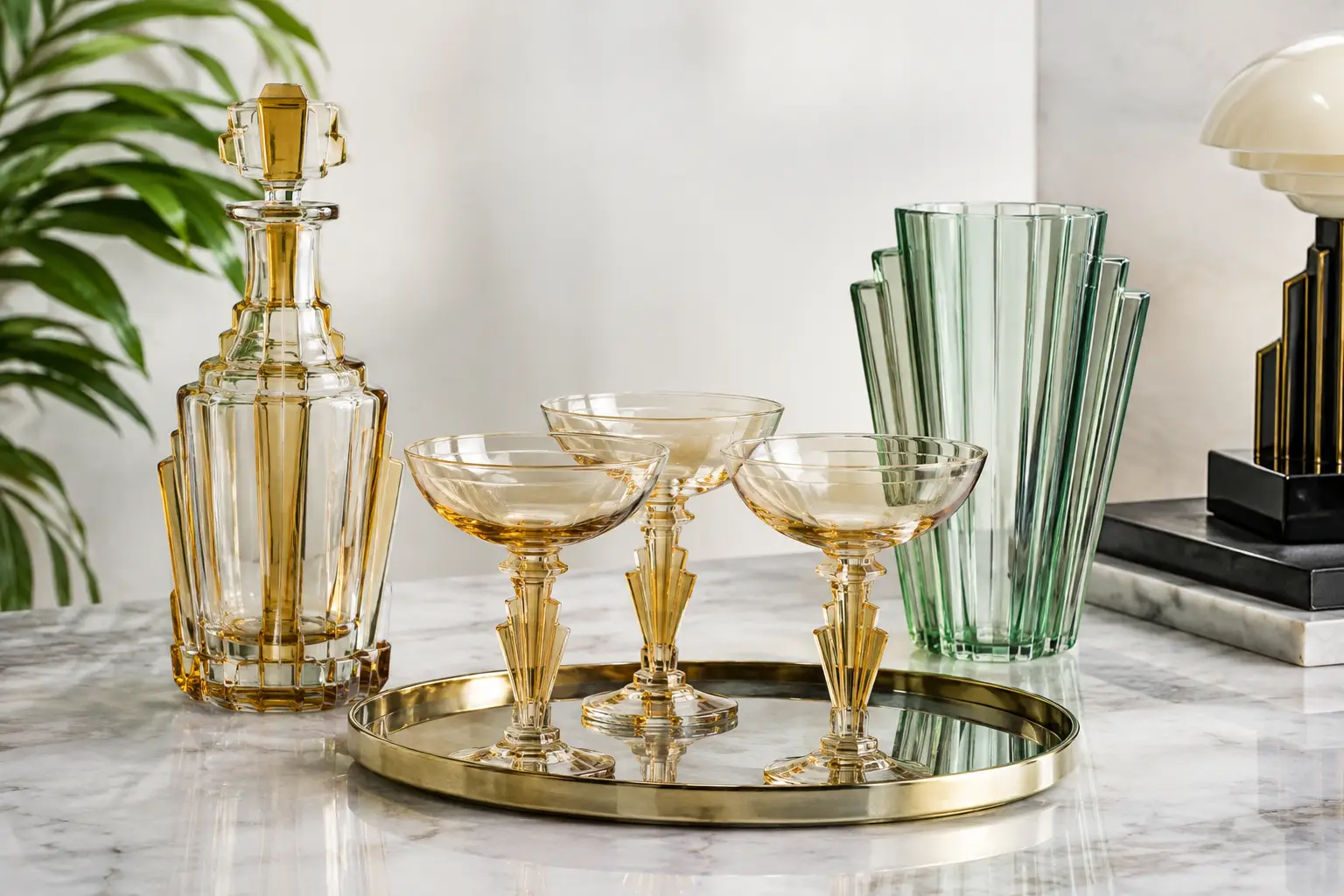
A pressed-glass bowl can hold the same flowers as any contemporary vessel, yet an Art Deco example changes the entire composition of a room. Its value lies in the deliberate silhouette: a fan, a stepped edge, a stylized gazelle, or a wash of opalescent light that feels sculptural even when empty. This guide to Art Deco glassware is designed for collectors and interiors with an eye for objects that carry both decorative presence and design history.
What Defines Art Deco Glassware?
Art Deco glassware belongs broadly to the period between the 1920s and late 1930s, when design moved away from the flowing asymmetry of Art Nouveau toward geometry, speed, architecture, and controlled ornament. It was an international language, but its expression differed from Paris to Venice, Prague, and the United States.
The most recognizable pieces favor symmetry and strong graphic rhythm. Sunbursts, chevrons, fans, stepped profiles, fluting, and stylized botanical motifs recur across bowls, vases, lampshades, perfume bottles, figurines, and tableware. Even softer forms tend to feel edited rather than naturalistic.
Glass gave the period a particularly expressive material. It could be molded into relief, frosted to resemble stone, tinted in smoky amber or deep cobalt, or layered with bubbles and metallic inclusions. A piece may be modest in scale yet command attention through its interaction with light.
Art Deco versus Art Nouveau
Confusing the two is easy when a piece is decorative, but the distinction matters. Art Nouveau glass usually favors sinuous stems, insects, irises, and fluid, organic movement. Art Deco favors a more disciplined visual order: a nude figure becomes streamlined, a flower becomes a radial motif, and a vase reads almost like a miniature skyscraper.
There are transitional works, particularly from the 1910s and early 1920s, where the boundary is less clean. In those cases, the quality of the form, the documented maker, and the date of production matter more than forcing a neat category.
A Guide to Art Deco Glassware by Material and Finish
The character of vintage glass is often revealed before the maker’s mark is found. Learn to look at surface, weight, translucency, and the way a form was produced.
Pressed or molded glass was central to the period. Molten glass was pressed into a mold, allowing crisp relief patterns and repeatable production. Lalique and Sabino made exceptional use of this technique, particularly in frosted and opalescent objects. Molded does not mean inferior: a well-designed pressed-glass vase can be one of the defining objects in a collection.
Frosted glass has a satin, softly diffused surface. It may be entirely matte or combined with clear, polished areas that sharpen the relief. This contrast creates drama under low lighting and explains why frosted pieces work especially well on a console, bar, or bedside table.
Opalescent glass shifts between milky blue, pale amber, and warm ivory depending on the light. It is one of the most evocative finishes associated with French Art Deco. True opalescence has depth and changing tonal character; it should not be mistaken for a flat, opaque white coating.
Cased and colored glass consists of one layer of glass encased within another. Deep green, amethyst, ruby, smoke, and amber were all used to give functional objects a more architectural presence. Look for clarity of color and a finish that suits the form rather than overwhelms it.
Enameled, painted, or gilt decoration can be compelling, particularly on cocktail wares and vanity objects. However, applied decoration requires close inspection. Wear at the rim and handling points is expected; extensive loss can alter both the visual balance and the collectible value.
Makers Worth Knowing
A maker’s name can provide useful context, but it should never replace close looking. Many fine Art Deco objects were made by workshops whose marks are faint, partial, or absent, and unmarked pieces deserve evaluation on their own quality.
René Lalique is associated with sculptural molded glass, frequently frosted or opalescent, featuring female figures, birds, fish, and stylized foliage. His work often balances relief decoration with clarity of silhouette. Sabino is admired for luminous opalescent glass, including vases, bowls, lamps, and figurative subjects with a softer, more atmospheric finish.
Daum produced important Art Deco glass, from refined cameo works to modernist vessels, while French firms such as Verlys and Etling created accessible yet highly decorative molded pieces. In Central Europe, Bohemian glassmakers explored rich color, cutting, engraving, and sharply geometric profiles. Italian glass, including Murano production of the era, offers a different sensibility: often more chromatic, technically inventive, and closely tied to the evolving language of modern Italian design.
Signatures may be wheel-engraved, acid-etched, molded, or placed on a label that has long since disappeared. A signature should be consistent with the object and its period. It is wise to treat an unusually prominent mark, or one that appears too fresh against a worn base, with caution.
How to Assess Authenticity and Condition
The most satisfying acquisition is not always the rarest or most expensive piece. It is the object whose condition, provenance, scale, and visual authority align with how it will be lived with. For collectors, condition is part of the object’s story, but some condition issues are far more consequential than others.
Begin at the rim, corners, handles, and projecting details. These are the areas most vulnerable to chips and nicks. Run a fingertip carefully around the edge and inspect under direct light. Small flea bites can be acceptable on a century-old utility piece, particularly if they are difficult to see in display, but a prominent chip on a crisp geometric rim materially changes the object.
Then examine the base. A light wear pattern from age is normal. Deep scratches, a suspiciously ground-down pontil, or an overly polished area may indicate concealment of damage. Look through transparent glass from different angles for internal fractures, cloudiness, or stress lines. Cloudiness can result from long-term water exposure and is difficult, sometimes impossible, to reverse safely.
For lamps, confirm whether the glass is original to the fixture and whether later electrical work has been carried out professionally. Rewiring is often sensible for modern use, but a replacement shade or altered mounting should be disclosed and considered in the price.
Provenance can range from a documented collection history to a credible specialist attribution. It does not need to be elaborate to be useful. Clear photographs, precise measurements, details of damage, and a transparent description of restoration are signs of a serious seller.
Choosing Pieces That Belong Together
A collection does not need to reproduce a 1930s room. In fact, Art Deco glass often appears strongest when given room to breathe among contemporary furniture, Italian modernist lighting, or a single antique mirror. The period’s geometry creates a welcome counterpoint to softer upholstery and natural materials.
Start with a purpose. A low bowl or coupe can anchor a dining table; a pair of small vases can bring order to a mantel; a sculptural centerpiece can hold its own on a credenza. If the object will be used daily, prioritize a stable base, a comfortable scale, and condition that supports use. If it is intended as a focal point, rarity and silhouette may matter more than practicality.
Color should be considered in relation to light, not only to upholstery. Opalescent glass is responsive and changes through the day. Amber and smoked tones bring warmth to walnut, brass, and dark lacquer. Clear frosted glass is quieter but can become striking against painted walls or stone. A single highly colored piece often has more presence than a crowded group of competing hues.
Pairs are desirable, but not mandatory. Matching vases create ceremony and symmetry; a single exceptional bowl can be more persuasive than two average examples. The same applies to maker names. Build around quality, condition, and a coherent visual point of view rather than accumulating labels.
Care That Preserves the Surface
Art Deco glass should be washed by hand in lukewarm water with a small amount of mild soap, then dried with a soft, lint-free cloth. Avoid dishwashers, abrasive pads, and sudden changes in temperature. Frosted surfaces are especially prone to collecting residue, while gilt or enamel decoration can be damaged by scrubbing.
Do not leave water standing in a vase for long periods, especially if the interior has existing haze. For display, keep glass away from constant direct sun, which can stress delicate finishes and fade certain painted details. When storing, wrap each piece separately and never stack bowls without a protective layer between them.
The best Art Deco glassware does more than reflect light. It gives a room rhythm, material contrast, and a quiet sense of occasion. Choose the piece that continues to hold your eye after the maker’s name and the price have receded – that is often where a lasting collection begins.