
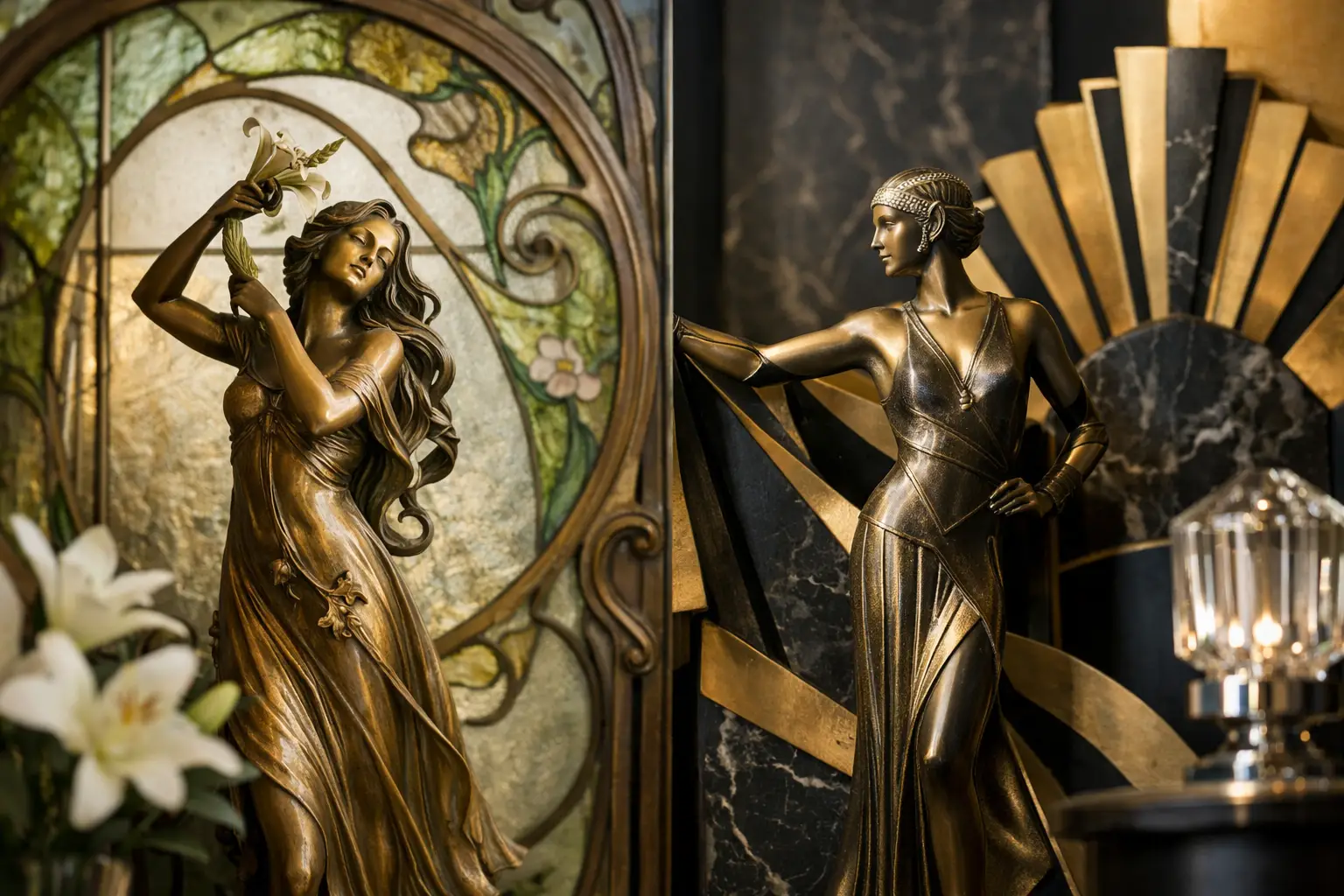
A curved bronze lamp with iris details and a stepped chrome side table may both feel glamorous, but they do not speak the same design language. Art Nouveau vs Art Deco is one of the most common style comparisons in interiors and collecting, especially when a piece is visually striking yet difficult to place. Knowing the difference changes how you buy, how you decorate, and how you read an object’s cultural value.
For collectors and design-led buyers, this distinction is not academic. It affects proportion, material choices, the mood of a room, and often the long-term relevance of a piece within a curated interior. Art Nouveau and Art Deco are both highly recognizable, but they emerge from different moments, different ideals, and different ideas of beauty.
Art Nouveau vs Art Deco: the essential difference
If Art Nouveau looks to nature, Art Deco looks to geometry. That is the fastest way to separate them.
Art Nouveau developed at the end of the 19th century and into the early 20th, roughly from the 1890s to the 1910s. Its lines are sinuous, asymmetrical, and often inspired by vines, flowers, insects, and the female form. It favors movement, ornament, and a kind of refined sensuality. Even when a piece is functional, it rarely feels severe.
Art Deco arrived later, reaching its clearest expression in the 1920s and 1930s. It is more structured, more urban, and more confident in its embrace of modernity. You see symmetry, stepped forms, sharp silhouettes, bold contrasts, and luxurious materials handled with discipline. Where Art Nouveau curves, Art Deco often frames. Where Nouveau suggests growth and fluidity, Deco suggests rhythm and control.
This is why the two styles can occasionally be confused by non-specialists. Both can be decorative, luxurious, and collectible. But the source of that beauty is different. Nouveau ornament feels organic. Deco ornament feels engineered.
The historical mood behind each style
Art Nouveau emerged in reaction to industrial standardization and historic imitation. Designers, architects, and makers wanted to create a total style that felt new, expressive, and artistically integrated. Furniture, glass, lighting, jewelry, and architecture were conceived as part of a unified visual world. Craft mattered deeply. So did line.
This gives Art Nouveau its emotional temperature. It is intimate, poetic, and often richly detailed. The style does not simply decorate a surface. It tends to animate it.
Art Deco belongs to a different cultural atmosphere. It reflects the machine age, international luxury, travel, cinema, fashion, and the polished optimism between the wars. It is modern, but not austere. It appreciates craftsmanship, yet it presents it through precision, glamour, and visual authority rather than through botanical softness.
That difference in attitude still matters in contemporary interiors. Nouveau introduces atmosphere and romance. Deco introduces structure and drama.
How to recognize Art Nouveau
The clearest signs of Art Nouveau are line and motif. Look for whiplash curves, elongated stems, leaves, lilies, dragonflies, peacocks, or flowing female profiles. Shapes often seem to grow rather than to be assembled. Legs on a table may taper like plant forms. Metalwork may curl as if it were drawn by hand.
Materials also help. Art Nouveau often appears in carved wood, patinated bronze, enamel, stained or iridescent glass, and decorative surfaces where craftsmanship is visible. In lighting, shades may resemble petals or blossoms. In mirrors and furniture, frames can feel almost alive, with contours that resist rigid symmetry.
Color tends to support this softer sensibility. Muted greens, amber, cream, dusty rose, and natural wood tones are common. Even when a piece is ornate, it often carries a sense of delicacy rather than weight.
For buyers, authenticity in Art Nouveau often lies in the quality of line. A strong piece feels fluid and resolved, not merely embellished. Decorative excess without elegance usually signals a later imitation or a less sophisticated interpretation.
How to recognize Art Deco
Art Deco is easier to identify once you train your eye to look for geometry. Sunbursts, zigzags, chevrons, stepped profiles, fan shapes, and clean verticals are classic signals. Symmetry is common. So is contrast.
Materials are central to the Deco effect. Chrome, brass, lacquer, mirrored finishes, exotic woods, marble, smoked glass, shagreen, and polished stone all belong comfortably to the style. A Deco object often feels composed to catch light cleanly and assert its silhouette from across a room.
In furniture, proportions are usually bolder and more architectural than in Art Nouveau. A sideboard may have rounded corners but still read as controlled and monumental. A lamp may be sculptural, yet its composition remains balanced. In mirrors and accessories, the frame often becomes a graphic statement.
Color can range from black, ivory, silver, and gold to richer jewel tones, but it is usually handled with more contrast and confidence than in Nouveau. Art Deco is not shy. Even its restraint tends to feel theatrical.
Art Nouveau vs Art Deco in furniture and lighting
Furniture and lighting are often where the distinction becomes most practical.
An Art Nouveau chair tends to emphasize flowing continuity. Its back, arms, and legs may feel like one uninterrupted gesture. Decoration is integrated into structure. The object invites close looking.
An Art Deco chair is more likely to rely on profile, balance, and material presence. It may have a curved back, but the curve is usually controlled by symmetry and volume rather than by botanical movement. The effect is less lyrical, more composed.
Lighting reveals the contrast even more clearly. An Art Nouveau lamp often diffuses atmosphere through floral glass, organic bronze mounts, or naturally inspired silhouettes. It warms a room with softness. An Art Deco lamp tends to sharpen the space. Think stepped bases, geometric shades, chrome or brass detailing, and a stronger interplay between light and polished surface.
For an interior designer or collector, this matters because each style changes the room around it. Nouveau tends to soften architecture. Deco tends to define it.
Which style works better in a contemporary interior?
It depends on what the room needs.
Art Nouveau works beautifully when the space feels too rigid, too minimal, or too dependent on straight lines. A single organic mirror, floral lamp, or sculptural occasional table can add tension in the best sense. It introduces movement and refinement without requiring a fully period room. It also pairs well with natural materials, muted palettes, and interiors that lean toward collected elegance.
Art Deco often integrates more easily into urban and contemporary spaces because its geometry speaks naturally to modern architecture. A Deco console, bar cart, chandelier, or pair of sconces can anchor a room quickly. It delivers visual confidence and a sense of finish.
The trade-off is mood. Nouveau is more atmospheric but can become sentimental if overdone. Deco is more graphic but can feel cold if every surface is glossy and every line is sharp. The strongest interiors usually avoid total obedience to either style. They borrow one excellent piece and let it lead.
Why collectors are drawn to one over the other
Collectors who prefer Art Nouveau are often responding to artistry of line and hand-finished detail. They value pieces that feel individual, expressive, and slightly elusive. There is often an emotional charge to Nouveau objects, especially in bronze, glass, and decorative woodwork.
Collectors who gravitate toward Art Deco usually appreciate clarity, rarity of material, and strong visual identity. Deco reads instantly. It photographs well, stages well, and holds its own in ambitious interiors. That makes it particularly desirable for buyers who want statement pieces with lasting decorative force.
Neither preference is more refined than the other. It is a question of visual instinct. Some rooms ask for a whispering curve. Others need a lacquered edge.
Art Nouveau vs Art Deco: how to buy with a sharper eye
When evaluating a piece, do not stop at the headline style label. Ask what is actually driving the design. Is the beauty coming from natural line, asymmetry, and decorative fluidity? Or from geometry, symmetry, and material contrast? That answer usually clarifies the period language immediately.
Also pay attention to proportion and finish. Good Art Nouveau should feel alive, not cluttered. Good Art Deco should feel bold, not blunt. In both cases, quality reveals itself in resolution. The lines meet where they should. The ornament belongs. The object feels intentional from every angle.
For buyers sourcing furniture, mirrors, lighting, or decorative objects through a curated platform such as Sound Of Vintage Italy, this distinction helps refine search and sharpen desire. You stop browsing vaguely for something elegant and start recognizing what kind of elegance actually belongs in your space.
A well-chosen Art Nouveau or Art Deco piece does more than fill a room. It establishes a point of view. The better you understand that point of view, the more confidently you can live with objects that keep their presence year after year.