
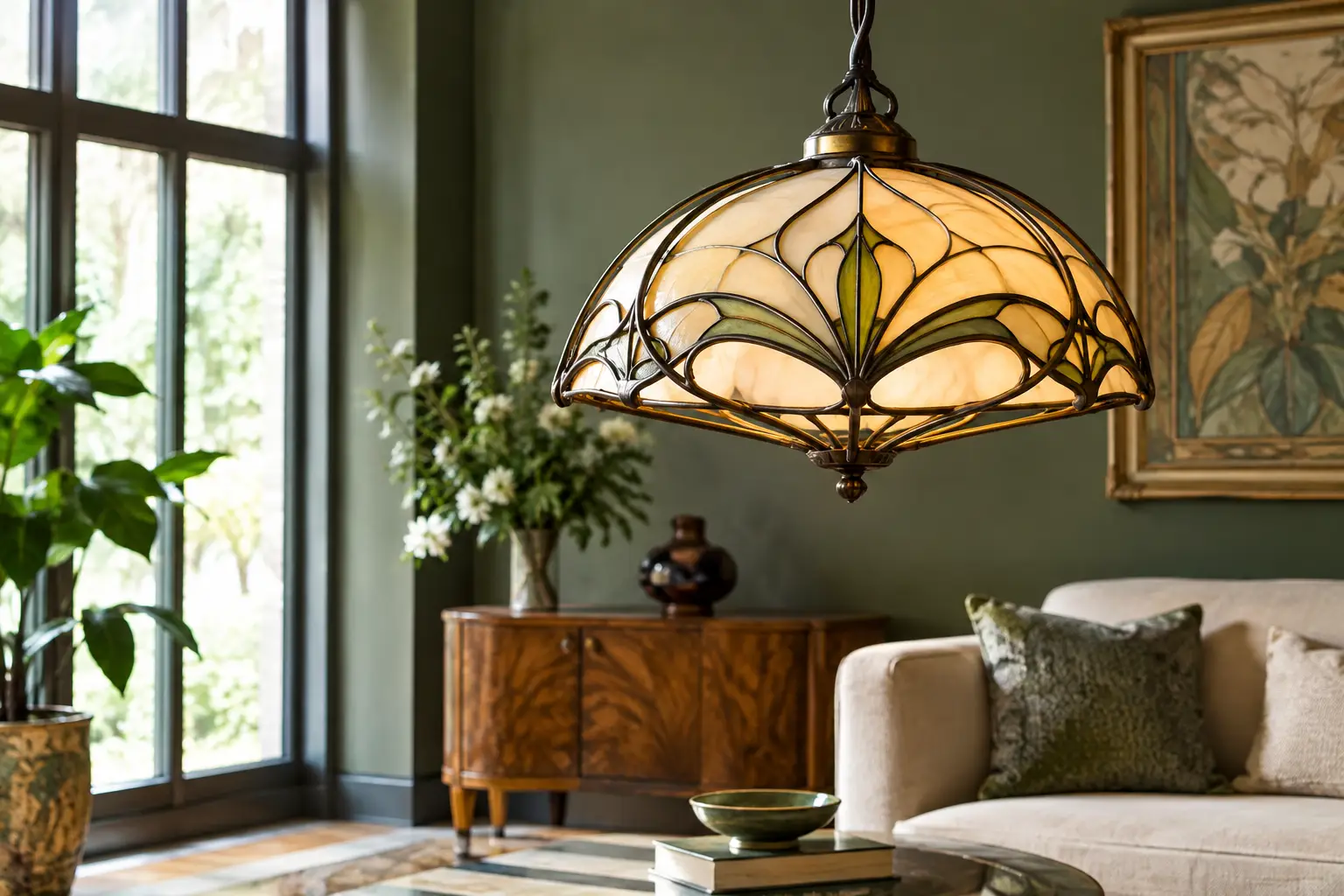
A room can be beautifully furnished and still feel incomplete until the light has a point of view. The best Art Nouveau lighting does more than brighten a corner or table: it introduces movement, material richness, and the unmistakable sense that an interior has been assembled rather than merely decorated. A leaded-glass shade, a patinated bronze stem, or a floral silhouette can bring a composed room into focus.
For collectors and design-minded homeowners, Art Nouveau lighting remains compelling because it sits between function and sculpture. Its forms are decorative, but rarely static. Stems rise like vines, shades open like blossoms, and metalwork seems to follow the quiet logic of nature. The right piece does not need to dominate an interior. It simply gives the eye somewhere meaningful to rest.
What Defines the Best Art Nouveau Lighting?
Art Nouveau emerged at the turn of the 20th century as a response to historical revival styles and industrial uniformity. In lighting, the movement favored fluid lines, botanical motifs, female figures, insects, and an almost architectural attention to craftsmanship. French, Belgian, Austrian, and Italian interpretations each developed their own character, from richly modeled bronzes to more geometric Secessionist forms.
The best examples have visual coherence. The base, stem, shade, and hardware should appear designed as one object rather than assembled from unrelated decorative elements. A lamp with a lily-form shade and a stem that echoes the curve of a stalk has that essential unity. By contrast, a generic stained-glass shade placed on a recent base may be attractive, but it does not necessarily carry the same historical or collectible interest.
Materials matter as much as silhouette. Look for hand-worked bronze, brass with a convincing aged patina, wrought iron, blown or molded glass, and carefully constructed leaded shades. Authentic period pieces often reveal minor variations that industrial reproduction smooths away: a soft irregularity in glass, hand-finished texture in the metal, or a shade whose color deepens when illuminated.
Choosing the Right Art Nouveau Light for Each Room
A lighting piece should be considered at its intended scale, both when switched on and off. Art Nouveau is expressive, so proportion is particularly important. A small lamp can become a jewel on a writing desk; an oversized chandelier needs enough surrounding space to retain its elegance.
Table Lamps: The Most Versatile Starting Point
An Art Nouveau table lamp is often the most approachable way to introduce the style. It works naturally on a library table, console, nightstand, or sideboard, where its decorative detail can be seen at close range. Floral glass shades in amber, ivory, green, or soft rose create a warm and intimate pool of light, especially in rooms with wood, velvet, leather, or antique mirrors.
For a more restrained interior, choose a lamp with a simple opaline or lightly mottled glass shade and a slender bronze base. The style remains present, but it reads as refinement rather than theme. This is an effective choice for a contemporary apartment where one historical object can establish depth without turning the room into a period setting.
Pendants and Chandeliers: A Sculptural Center
A pendant or chandelier carries greater visual responsibility. In a dining room, entry hall, or room with a high ceiling, it can act as the central gesture of the space. Look for designs with articulated arms, glass tulip shades, sinuous metalwork, or a strong botanical rhythm. The fixture should retain its presence during the day, when its unlit profile becomes part of the room’s composition.
Consider the practical trade-off before choosing an elaborate chandelier. Multi-shade fixtures provide generous ambient light, but they demand ceiling height and careful installation. A single pendant can be more effective above a round dining table or in a narrow entry, where a dramatic fixture might otherwise feel crowded. If the room is already rich in pattern, a cleaner Art Nouveau form in brass and opaque glass will usually age better than an exceptionally ornate piece.
Wall Sconces: Light With Architectural Presence
Wall sconces are especially valuable in interiors that need atmosphere without losing surface space. Positioned beside a fireplace, mirror, bed, or hallway artwork, they create layers of illumination and make a room feel considered after sunset. Art Nouveau sconces with frosted glass, hammered metal, or stylized foliage offer a softer alternative to sharp, minimal wall lighting.
They are also among the most effective formats for pairing different eras. A pair of early 20th-century sconces can bring warmth to an Art Deco cabinet, a mid-century console, or an Italian modernist mirror. The connection is not strict historical matching. It is the shared value of material, line, and singular presence.
How to Recognize Quality and Authenticity
Age alone does not make a lighting piece desirable. Condition, provenance, workmanship, and design integrity all affect value. Period lighting should be assessed with the same attention given to furniture or decorative glass.
Start with the construction. Metal components should feel substantial and logically joined. On a genuine older fixture, the fit between elements may show hand-finishing, while casts can retain crisp but not overly uniform detail. Examine glass shades for cracks, chips, repairs, and discoloration. Small signs of age may be acceptable and even expected, but damage around the fitter edge deserves special attention because it can affect both stability and value.
Marks and signatures can be useful, particularly on French or Austrian pieces, but they are not the sole proof of quality. Many fine objects were produced by workshops that are difficult to identify today. A well-made unsigned lamp with original glass and convincing period hardware can be more compelling than a heavily altered signed example.
Electrical components require a practical assessment. Original wiring has historical interest, but it may not be suitable for daily use. Rewiring by a qualified professional is often the responsible choice, particularly for fixtures intended for an American home. Ask whether sockets, switches, plugs, and mounting hardware have been updated, and confirm that a ceiling fixture can be safely installed for its weight. Preservation is valuable, but safety and usability should not be treated as secondary concerns.
Pairing Art Nouveau With a Collected Interior
The most successful rooms do not recreate a museum display. They allow a significant object to converse with pieces from different decades. Art Nouveau lighting is particularly adaptable because its organic lines soften more structured furniture and architectural materials.
In a room with mid-century furniture, a floral bronze lamp can interrupt the clean geometry with a welcome note of sensuality. Near Murano glass, an opaline or iridescent shade can create a subtle dialogue between two traditions of light and craftsmanship. In an Art Deco interior, choose more disciplined Art Nouveau forms, perhaps with linear metalwork or pale glass, so the transition feels intentional rather than competitive.
Color temperature makes a real difference. Very cool LEDs can flatten the depth of colored glass and make bronze appear harsh. Warm bulbs, generally in the 2200K to 2700K range, better reveal amber, green, and opalescent shades while preserving the intimate character that these pieces were designed to create. Dimmable bulbs offer even more control, particularly in dining rooms and bedrooms.
When a Reproduction Makes Sense
There is no need to treat every reproduction as a poor substitute. A well-executed reproduction can be useful when a room needs the Art Nouveau vocabulary at a specific scale, when a fixture must meet demanding technical requirements, or when the budget is better reserved for one exceptional vintage object elsewhere.
The distinction is simply worth understanding. Reproductions generally offer convenience, consistency, and easier replacement of components. Original or period lighting offers individuality, material history, and the subtle irregularity that makes an object feel irreplaceable. For a collector, that difference is often the point. For a hospitality project or a large renovation, the practical advantages of reproduction may carry more weight.
A thoughtful purchase begins with the room, not the label. Choose the fixture that gives the space warmth, rhythm, and a sense of memory. Whether it is a delicate table lamp, a pair of sculptural sconces, or a chandelier with the presence of a suspended garden, Art Nouveau lighting is at its best when it makes an interior feel distinctly its own.