
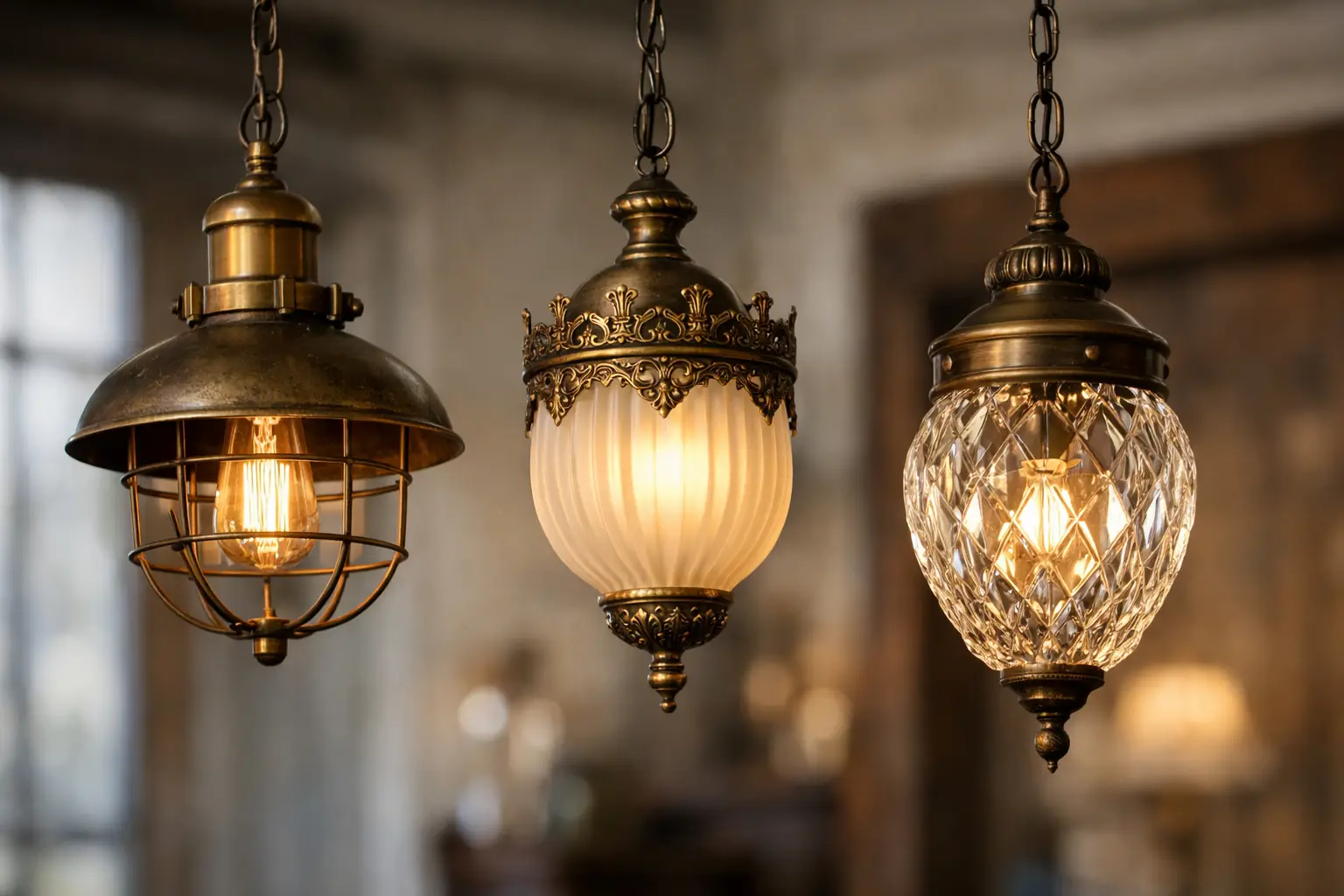
A pendant light is never merely overhead illumination. Suspended at eye level, it becomes part architecture, part sculpture, defining the center of a dining table, entrance hall, kitchen island, or reading corner. The most compelling antique pendant light styles carry this visual authority with the added depth of material, craftsmanship, and period language.
For collectors and design-led interiors, the distinction matters. An authentic fixture may show the hand of a glassmaker, the rigor of an early electrical workshop, or the ambition of a decorative movement. Its patina is not an effect applied afterward. It is evidence of age, use, and survival. Choosing well begins with understanding what each style contributes to a room.
Antique Pendant Light Styles and Their Character
The term “antique” is often used broadly in lighting. Strictly speaking, it generally refers to objects over one hundred years old, while vintage commonly describes later 20th-century pieces. In the market, however, the categories often overlap. What matters most is accurate attribution, condition, material, and whether the fixture has retained its original visual integrity.
Art Nouveau: fluid lines and botanical detail
Art Nouveau pendants, most often associated with the late 19th century through the early 1910s, favor movement over symmetry. Think opaline glass shades with softly flared profiles, brass fittings, floral ornament, and sinuous metalwork inspired by stems, leaves, and vines.
These lights suit interiors that can accommodate romance without becoming overly decorative. Above a round table, in a period entryway, or alongside carved wood and veined stone, an Art Nouveau pendant introduces warmth and delicacy. The trade-off is scale: intricate floral metalwork can feel visually crowded in a very compact or sharply minimalist space. A single, beautifully proportioned example is usually stronger than a cluster competing with other ornate elements.
Art Deco: geometry with a theatrical edge
Art Deco pendant lighting is defined by composure, contrast, and geometry. From the 1920s and 1930s, look for stepped forms, faceted or frosted glass, chrome or nickel details, and palettes of ivory, black, amber, or deep smoked glass. Some examples have the vertical momentum of a skyscraper; others bring a quieter glamour through prismatic panels and finely etched shades.
An Art Deco pendant has the rare ability to make a room feel ordered and expressive at once. It works especially well in a foyer, over a cocktail table, or as a focal point in a dressing room. Pair it with lacquered surfaces, dark timber, marble, or streamlined upholstery, but leave enough negative space around it. The style depends on silhouette, and a crowded ceiling line diminishes its effect.
Early industrial: honest materials, purposeful forms
Industrial pendant lights were designed for factories, workshops, warehouses, stations, and institutional spaces. Their appeal lies in their directness: enamelled metal shades, pressed steel reflectors, perforated vents, porcelain fittings, and thick glass made to protect the bulb and direct useful light.
The best examples are not simply rough. Their construction is precise, often beautifully engineered, and shaped by function. Green, black, gray, and white enamel shades bring weight and graphic clarity; holophane or ribbed prismatic glass produces a more luminous, technical presence.
This family of antique pendant light styles works beyond loft interiors. A pair of small industrial pendants can sharpen a traditional kitchen, while a large factory shade can give a contemporary dining room needed gravity. Check the diameter carefully. Industrial fixtures were often made for generous ceiling heights and large work areas, so a piece that feels commanding in a showroom can overwhelm a narrow apartment table.
Murano glass: light shaped by the hand
Italian glass pendants occupy a distinct place in decorative lighting because the shade itself is the central event. Murano examples may be softly opaline, richly colored, latticino-striped, bubbled, iridescent, or worked with gold leaf. Each technique alters the way the fixture receives and disperses light.
A hand-blown Murano pendant brings softness where metal and stone dominate. A milk-white globe diffuses illumination with restraint, while a sculptural amber or cobalt form creates a concentrated note of color. For an interior with neutral walls and restrained furniture, this can be the element that prevents the composition from becoming anonymous.
Authenticity should not be assumed from a label alone. Examine the quality of the glass, the refinement of the form, the compatibility of fittings with the period, and available provenance. Small variations in thickness, bubbles, or surface movement are often part of handmade production, not defects. By contrast, cracks, unstable mounts, and poorly adapted hardware require professional assessment before installation.
Mid-century Italian modernism: sculptural restraint
Not every historically significant pendant is antique in the strict sense, but mid-century Italian lighting belongs in the same collecting conversation. From the 1950s through the 1970s, designers explored brass, lacquered aluminum, spun metal, acrylic, and expressive glass with a confidence that remains remarkably current.
The forms range from disciplined cone shades and satellite-like assemblies to organic glass elements and dramatic multi-arm compositions. Their strength is visual economy: even a complex fixture usually has a clear structural idea. In a room with contemporary furniture, a mid-century pendant can establish period character without imposing a fully nostalgic atmosphere.
For this reason, these pieces are particularly useful in layered interiors. They relate naturally to travertine, walnut, chrome, and textured upholstery, but can also create an intelligent tension above an antique console or within a classical room. The question is less whether every object shares an era and more whether each one has enough presence to hold its place.
How to Choose an Antique Pendant Light
Begin with the position of the fixture, not just its photograph. Over a dining table, the pendant should provide visual intimacy without interrupting sightlines across the room. In an entryway, it must read from below and from a distance. Above a kitchen island, repetition can be effective, but only if the shades are modest enough not to create visual clutter.
Material changes both mood and performance. Frosted glass gives a calm, diffuse glow. Clear or prismatic glass is brighter and more exposed. Metal shades direct illumination downward, which can be ideal over a table but less useful as the sole source of ambient light. A decorative pendant often benefits from layered lighting nearby, such as wall sconces or a table lamp, rather than being asked to illuminate every corner.
Originality also requires a balanced view. Original canopies, chains, galleries, and shade holders are desirable, but electrical components should be evaluated for present-day safety. Rewiring is often necessary and does not diminish the decorative value of a period fixture when carried out carefully. What should be avoided is a casual conversion that erases the original mounting logic or introduces fittings that look visibly unrelated to the piece.
Condition is equally nuanced. Gentle age to brass, minor wear to enamel, and slight irregularity in hand-blown glass can add credibility and depth. Structural cracks, missing glass panels, severe corrosion, or altered proportions are different matters. Restoration may be appropriate, but it should be reflected in the price and understood as part of the object’s history.
Creating a Room Around One Exceptional Fixture
A well-chosen pendant does not need a themed room to make sense. An Art Deco glass fixture can animate a quiet plaster ceiling and a contemporary oval table. An industrial enamel shade can bring discipline to a kitchen with painted cabinetry. A Murano piece can introduce color into a restrained bedroom where art, textiles, and furniture have been kept intentionally spare.
The strongest interiors allow contrast, then repeat one or two visual cues. If the pendant has warm brass, echo that temperature in a picture frame, a door handle, or the base of a lamp. If the glass is pale opaline, let it speak to a ceramic vessel or the softness of linen. This is enough to create a relationship without turning the room into a period set.
At Sound Of Vintage Italy, lighting is selected with this kind of visual dialogue in mind: not as a background utility, but as an object with provenance, material presence, and a lasting role in the room. The right pendant does more than brighten a surface. It gives an interior its point of view.