
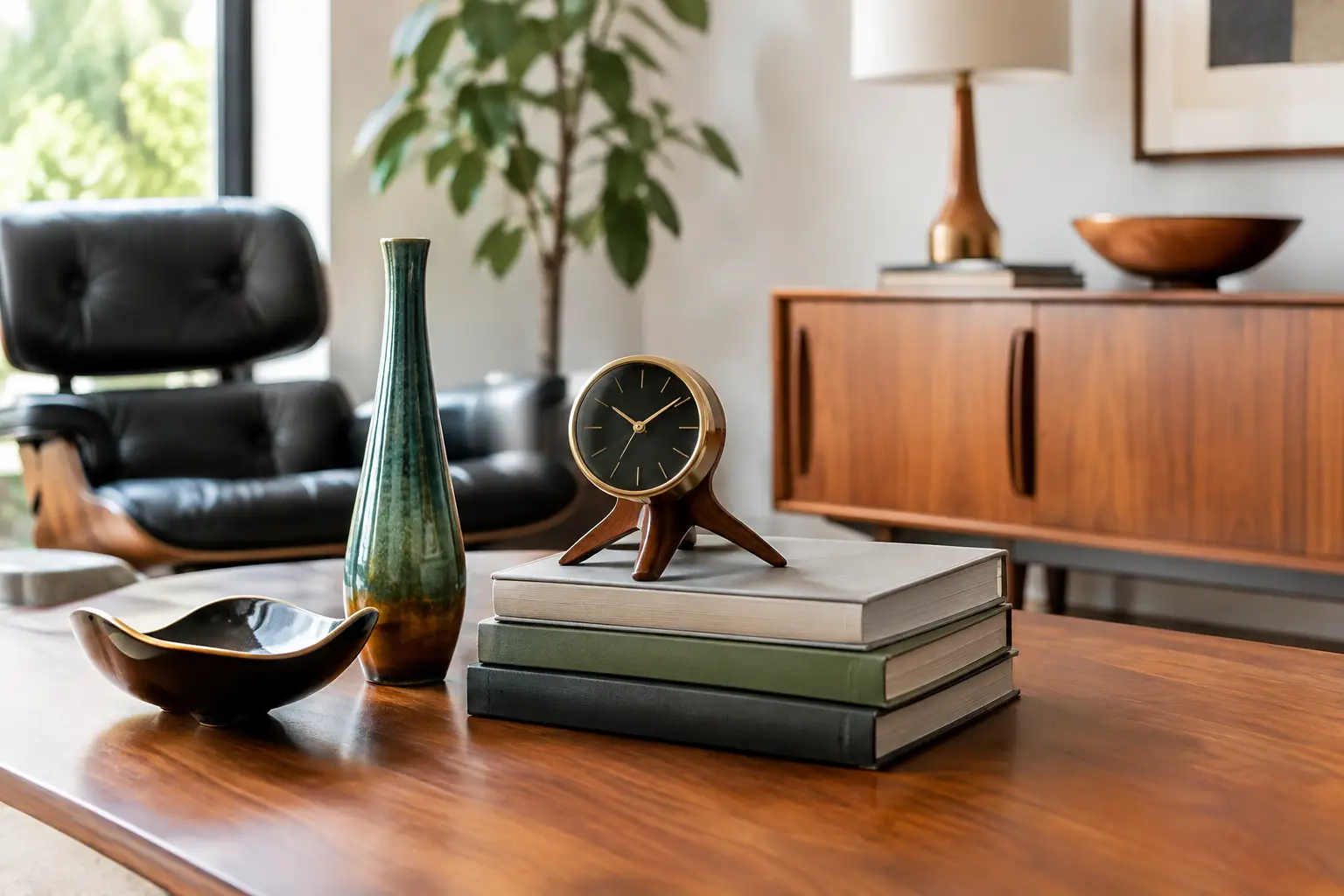
A Murano pendant with its original patina, a low Italian lounge chair with a beautifully resolved profile, a small brass object that changes the character of a shelf: mid century collecting begins with recognition. Not recognition of a famous name alone, but of proportion, material, construction, and the quiet confidence of an object made to last. The strongest collections are not assembled by chasing a single decade. They are built by selecting pieces that continue to hold visual and cultural weight.
For the collector, the mid-century period offers an unusually rich field. It includes disciplined Italian modernism, expressive postwar glass, sculptural lighting, Scandinavian restraint, American optimism, and the experimental forms that emerged as new materials entered the home. These objects can live naturally in a contemporary interior, but their relevance should not be mistaken for interchangeability. A well-chosen original is never merely a shortcut to a certain look.
Mid Century Collecting Starts With a Point of View
The term mid-century is used broadly, often describing objects made from the late 1940s through the 1960s, with some collectors extending the period into the 1970s. Its visual language is equally broad: clean lines, organic curves, warm woods, lacquered metal, colored glass, modular forms, and a new relationship between function and sculpture.
That breadth is precisely why a collection needs a point of view. One collector may be drawn to Italian lighting, where opaline glass, brass, and enameled metal create atmosphere as much as illumination. Another may focus on Murano glass, seeking unusual silhouettes, particular techniques, or works associated with a notable furnace or designer. A third may collect small furnishings and accessories that bring structure to a room without turning it into a period set.
A narrow focus can be useful at the beginning, but it should not become a rule for its own sake. Collecting only one maker can build depth and expertise. Collecting across categories can create a more personal interior. The deciding question is not whether every piece belongs to the same movement. It is whether each piece earns its place through design quality, condition, and dialogue with the others.
Learn to See Beyond the Label
A designer attribution can add historical interest and market value, yet an unsigned piece should not be dismissed automatically. Many workshops and manufacturers produced exceptional work without leaving a clear signature. Conversely, an attractive label does not excuse poor condition, altered construction, or a form that has lost its original clarity.
Start with the object itself. On furniture, look at the joinery, the thickness and cut of the veneer, the way a drawer meets its frame, and the balance of the legs or base. On lighting, examine the relationship between diffuser, stem, canopy, and hardware. A successful lamp feels resolved from every angle. Its details are not decorative additions but part of its structure.
Glass calls for an equally attentive eye. Handblown Murano glass often carries small irregularities, subtle shifts in thickness, or tiny bubbles that speak to its making. These are not necessarily defects. A sharp seam, an overly uniform surface, or a form that feels mechanically repeated may point to later production, though no single sign provides a final verdict. Labels, etched signatures, archival references, and knowledgeable provenance all matter.
Materials also reveal period and quality. Brass develops a warm, varied patina; it should not always be polished into anonymity. Original lacquer, aged chrome, and lightly weathered wood can contribute to a piece’s presence. There is a difference between honest age and neglect. The collector’s task is to understand that difference before restoration removes evidence of an object’s history.
Originality and restoration are not opposites
The idea that every original finish must remain untouched is too rigid. Wiring on vintage lighting may need replacement for safe use. Upholstery may be beyond preservation. Veneer may require careful stabilization. These interventions can be responsible when they respect the design and are disclosed clearly.
What deserves caution is restoration that erases character or changes the object beyond recognition. Replated metal, aggressively sanded wood, replacement shades with the wrong scale, and altered hardware can affect both visual integrity and collectibility. Before buying, ask what has been restored, what has been replaced, and whether original components are included. A sensitively restored piece may be the better choice for daily living; a highly original example may matter more to a collector focused on historical completeness. It depends on the role the object will play.
Build a Collection Through Contrast
Mid-century interiors become more convincing when they avoid uniformity. A room filled only with walnut, teak, and familiar silhouettes can feel like a showroom rather than a home. Contrast gives a collection its rhythm: a rigorous Italian floor lamp beside a softer upholstered chair, a translucent Murano vase against dark wood, or an Art Deco mirror that adds tension to a more streamlined composition.
Scale deserves as much attention as style. A dramatic chandelier can anchor a dining room, but its visual mass must suit the table, ceiling height, and surrounding furniture. A pair of table lamps can make a room feel composed, yet overly matched objects may reduce the sense of discovery. Smaller pieces matter here. An ashtray, a sculptural bowl, a framed design drawing, or a distinctive fashion accessory can carry the same collecting intelligence as a major furnishing when selected with restraint.
Color should be treated as material, not as decoration. Amber glass, green enamel, smoked chrome, and deep walnut create very different atmospheres. A collection becomes more sophisticated when its colors repeat quietly across categories rather than appearing as a literal theme. One warm brass detail may be enough to connect a mirror, a lamp, and a small object across a room.
Provenance Gives Objects Their Second Life
Provenance is not limited to celebrity ownership or museum-level documentation. It can include a maker’s mark, an original label, a known retailer, a family history, a period catalog, or a credible account of where the object was found. This information helps establish age and authorship, but it also gives the piece texture.
Keep records from the beginning. Photograph labels, signatures, and condition details before restoration. Save invoices, notes on dimensions, and any available information about materials or production. This habit protects the collection’s value and makes future decisions easier, whether you are insuring a piece, relocating, or eventually passing it on.
For lighting, documentation should also include electrical work. For glass, record existing chips, scratches, or internal marks so they are not confused with later damage. Transparency is part of connoisseurship. A piece does not need to be perfect to be desirable, but its condition should be understood rather than romanticized.
Buy Fewer Pieces, With More Intention
The most compelling collections rarely arrive all at once. They develop through comparison, patience, and a willingness to leave behind objects that are merely acceptable. That restraint becomes especially valuable in a market where mid-century style is widely reproduced. Reproductions can serve practical needs, but they should not be confused with originals that carry the decisions, materials, and workmanship of their period.
A useful buying standard is to ask three questions: Is the form distinctive? Is the condition appropriate to the price and intended use? Would the object still matter if its maker’s name were unknown? When the answer is yes to all three, the piece has a strong foundation.
Sound Of Vintage Italy approaches this field as a selection of objects with decorative authority rather than as a catalog of trends. That distinction matters. The right vintage piece does not need to announce its age loudly. It changes the room through line, light, surface, and the subtle assurance of something chosen well.
Let the collection remain alive to revision. A piece that once felt essential may eventually make way for one with greater presence or a more meaningful provenance. Leave visual space around the objects you keep. Mid-century collecting is most rewarding when every acquisition has room to be seen, used, and remembered.