
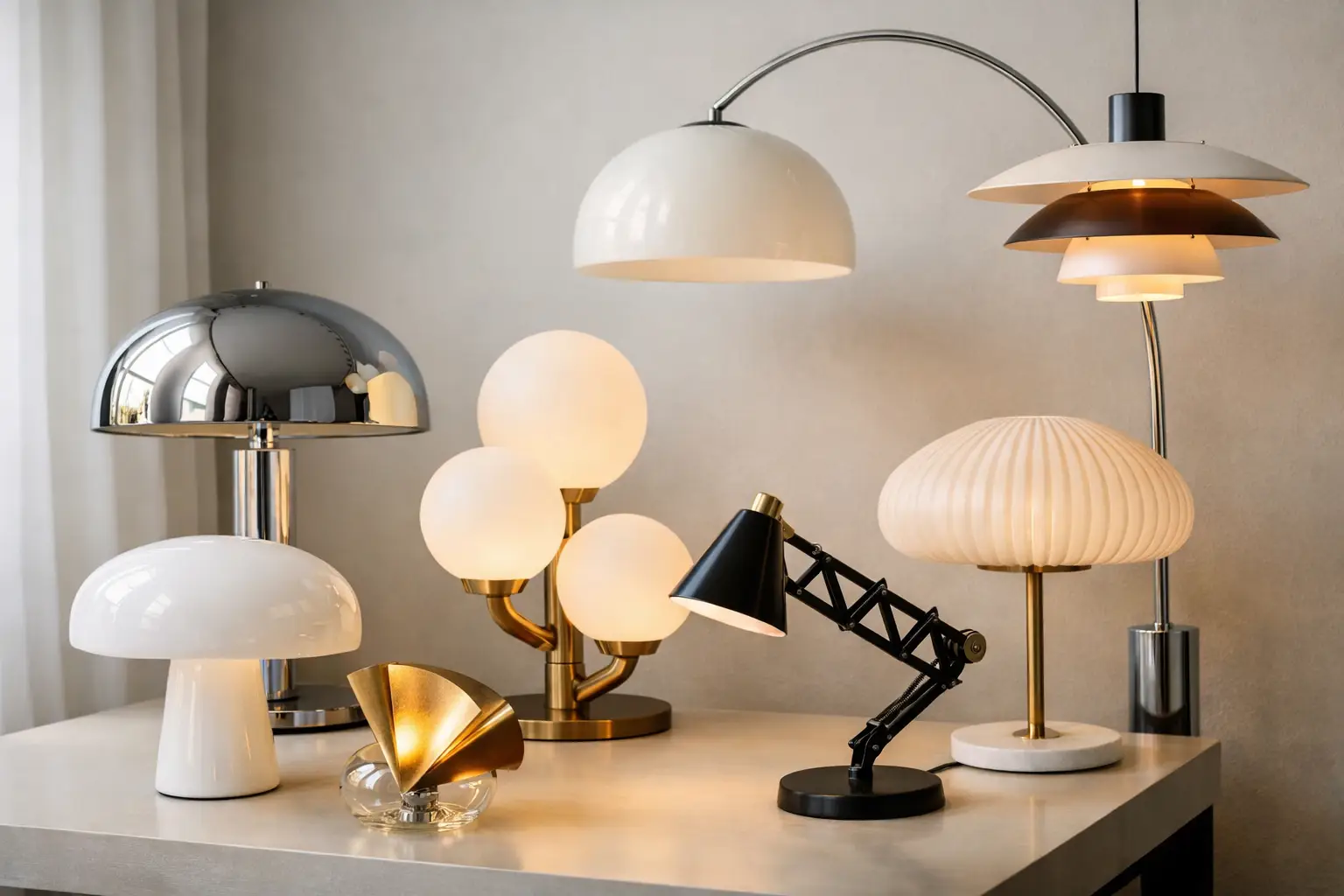
A lamp can establish the entire temperature of a room before a single chair is noticed. The best Italian design lamps do more than illuminate: they introduce a line, a material, a period, and often a small act of engineering into an interior. From the 1950s through the radical experiments of the 1970s, Italian lighting transformed domestic objects into sculptural presences.
For collectors, the appeal lies in more than a famous name. An original lamp may retain its aged lacquer, hand-worked Murano glass, period switch, or maker’s label. Those details carry value, but they also make a room feel less composed by formula. Choosing well means balancing iconic design with scale, condition, light quality, and the character of the space around it.
What Makes Italian Design Lamps So Distinctive?
Italian postwar lighting brought together industrial progress and decorative intelligence. Companies such as Flos, Artemide, Stilnovo, Oluce, FontanaArte, and Martinelli Luce worked with architects and designers who treated light as an architectural material. Marble bases, spun aluminum, chromed steel, opaline glass, acrylic, and Murano glass were not simply finishes. Each material shaped the way the lamp occupied space and diffused light.
There is also a useful tension in Italian design. A floor lamp may be technically precise yet theatrical. A small bedside lamp may have the visual force of a sculpture. This is why an Italian piece can sit convincingly in a restrained contemporary apartment, an Art Deco interior, or a layered home filled with antiques. It does not need a matching set to make sense.
12 Best Italian Design Lamps for a Collected Interior
The following designs are not interchangeable classics. Each suits a different proportion, mood, and use case, and each deserves attention in original vintage examples as well as authorized later editions.
1. Arco Floor Lamp by Achille and Pier Giacomo Castiglioni
Designed in 1962 for Flos, Arco remains one of the most intelligent answers to the absence of a ceiling outlet. Its long stainless-steel arch carries light over a table or seating area, while the Carrara marble base gives the piece visual and physical authority. The original form is remarkably functional, but it requires room. In a compact living room, its reach can feel intrusive rather than generous.
2. Taccia Lamp by Achille and Pier Giacomo Castiglioni
Taccia, designed for Flos in 1962, has the presence of a domestic monument. Light reflects upward into a large glass or acrylic diffuser, creating a soft, indirect glow. Its fluted metal base references classical columns without becoming literal. It is particularly compelling on a low cabinet, console, or large side table where its substantial silhouette can be seen from a distance.
3. Toio Floor Lamp by Achille and Pier Giacomo Castiglioni
Toio is a lesson in the elegance of exposed components. Created in 1962, it combines a transformer-like base, visible cable, telescopic stem, and an automotive headlamp. The result is industrial, playful, and unexpectedly refined. It gives directional light, not ambient softness, so it works best beside a reading chair or as a deliberate visual interruption in a polished interior.
4. Eclisse Table Lamp by Vico Magistretti
Vico Magistretti’s Eclisse for Artemide, introduced in 1965, is compact design with genuine conceptual clarity. A rotating inner shade partially covers the bulb, allowing the user to regulate the light as if creating an eclipse. Its small scale makes it ideal for a bedside table, bookshelf, or discreet desk. Original examples in strong period colors can be especially expressive, though wear to the lacquer should be expected and assessed honestly.
5. Atollo Table Lamp by Vico Magistretti
Atollo for Oluce, designed in 1977, reduces the lamp to a cylinder, cone, and hemisphere. That geometry gives it an almost archetypal calm. In metal, it feels graphic and polished; in opaline glass, it becomes softer and more atmospheric. Atollo is best treated as a focal object rather than a background lamp, particularly in larger sizes where its shade creates a clear architectural profile.
6. Nesso and Nessino by Giancarlo Mattioli
Designed in 1967 for Artemide, Nesso is one of the defining objects of the Space Age. Its molded plastic mushroom form casts light through four openings under the shade, producing a warm and theatrical pool of color. The smaller Nessino is easier to place, while the larger Nesso has stronger sculptural impact. Both are happiest in interiors that welcome color, gloss, and a little optimism from the late 1960s.
7. Pipistrello by Gae Aulenti
The Pipistrello lamp, designed by Gae Aulenti for Martinelli Luce in 1965, is recognizable for its four-part, wing-like shade. Its telescopic stem allows variation in height, making it unusually adaptable for a statement piece. The lamp can be elegant in white and dramatic in darker finishes, but its expressive silhouette should not compete with too many other highly decorative objects nearby.
8. Cobra Lamp by Elio Martinelli
Elio Martinelli’s Cobra, introduced in 1968, has a rotating molded resin body that allows the curved shade to direct light where it is needed. Closed, it reads as a compact futuristic object; opened, it becomes a functional table light. Vintage Cobras are prized for their form and color, but plastic surfaces deserve close inspection for fading, cracks, repairs, and uneven gloss.
9. Coupé Lamp by Joe Colombo
Joe Colombo designed the Coupé series for Oluce in 1967. Its adjustable metal shade and clean articulated structure make it one of the most useful Italian lighting designs for workspaces and reading corners. It is less ceremonial than Arco or Taccia, and that is exactly its strength. A Coupé brings period character without asking to dominate the room.
10. Luminator Floor Lamp by Pietro Chiesa
The Luminator, designed by Pietro Chiesa for FontanaArte in 1933, predates the postwar boom yet feels remarkably current. Three slender metal legs rise around an exposed central bulb, producing a spare, almost graphic composition. It suits interiors with Art Deco, rationalist, or early modern references. Because the bulb is visible, selecting a warm, visually pleasing bulb is part of owning the lamp.
11. Stilnovo Adjustable Floor and Table Lamps
Rather than a single model, the adjustable lamps produced by Stilnovo from the 1940s through the 1970s form a category worth seeking out. Brass joints, enameled shades, perforated details, and counterweighted arms give these pieces a precise, workshop-like beauty. They can be more individual than widely reproduced icons, but condition varies greatly. Original paint, shade interiors, and mechanical movement matter as much as the external silhouette.
12. Murano Glass Lamps of the Mid-Century Period
A Murano lamp brings a different kind of Italian design language into a room: less mechanical, more luminous and artisanal. Look for hand-blown opaline, pulegoso, lattimo, or textured glass, often paired with brass or chromed fittings. These pieces are especially effective where light itself should feel decorative, such as an entry, dining room, or bedroom. Attribution requires care, since many beautiful Murano examples were made by workshops rather than signed designers.
How to Choose the Best Italian Design Lamp for Your Space
Start with the role of the light. An Atollo or Taccia offers atmosphere and visual presence, while a Coupé or Toio is more useful for directed reading light. A chandelier or Murano pendant can define a dining room, but it must be hung at the right height and considered in relation to the table below it. Scale is not a minor detail: a lamp that is too small loses its authority, while an oversized icon can make a room feel staged.
Then consider material dialogue. Chrome and white acrylic sharpen a modern interior. Brass, smoked glass, and aged lacquer create warmth beside walnut, velvet, or antique wood. Murano glass offers softness that can counterbalance angular furniture. The most convincing rooms often combine these qualities rather than repeating one finish throughout.
Original Vintage, Reissue, or Later Production?
An authorized reissue can offer current electrical certification, readily available parts, and a pristine finish. It is often the sensible choice when a lamp will be used daily in a family room or hospitality setting. An original vintage piece offers patina, rarity, and historical specificity, but may require rewiring or careful restoration.
Before buying vintage, ask about provenance, manufacturer marks, alterations, and the condition of wiring, sockets, switches, and shades. Rewiring is not a defect when done professionally and sympathetically. Repainting, replacement shades, missing diffusers, or heavily polished metal may affect collector value, though they do not automatically diminish decorative value. The right decision depends on whether you are furnishing, collecting, or doing both.
A well-chosen Italian lamp should never feel like a decorative afterthought. Let it earn its place through proportion, material, and light. At Sound Of Vintage Italy, the most memorable pieces are those that retain this balance: objects with a recognizable history, a distinct silhouette, and enough presence to make an ordinary corner worth looking at again.