
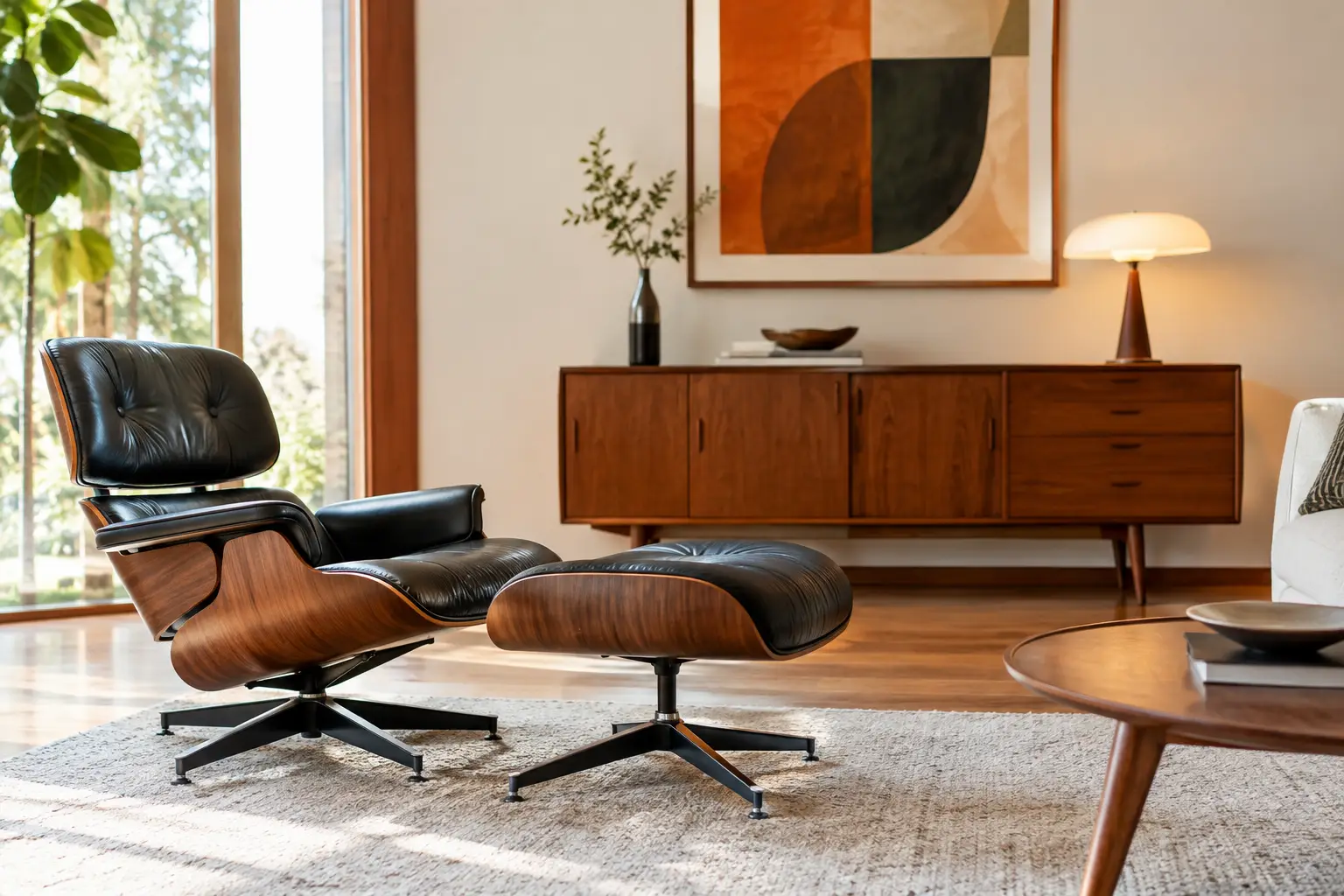
A low teak credenza, a sculptural Italian lamp, and a Murano glass pendant can make a room feel immediately composed. Yet the style they evoke is often treated as a single, neatly dated moment. When did mid century modern start? The most accurate answer is that it began taking shape in the 1930s, came into its own after World War II, and reached its most recognizable expression from the late 1940s through the 1960s.
That longer timeline matters to collectors. It helps distinguish a true period object from a later revival, and it reveals why Italian lighting, American case goods, Scandinavian seating, and French ceramics can belong in the same visual conversation without being interchangeable.
When Did Mid Century Modern Start?
Mid-century modern did not appear overnight in 1945. Its visual language was already forming before the war, shaped by European modernism, Bauhaus ideas, Art Deco streamlining, and new ways of making furniture for modern life. The closure of the Bauhaus in Germany in 1933 dispersed many of its artists, architects, and principles internationally. Clean geometry, functional planning, honest materials, and a rejection of unnecessary ornament traveled with them.
In the United States, designers began adapting these ideas to a more relaxed domestic setting during the 1930s and early 1940s. Furniture became lighter in profile. Bent plywood, tubular steel, molded forms, and experimental plastics offered new possibilities. The work of figures such as Alvar Aalto, Marcel Breuer, and later Charles and Ray Eames helped establish the vocabulary that would define the period.
Still, the years after World War II were the true catalyst. Returning families needed homes, schools, offices, and furnishings at an unprecedented scale. Architects and manufacturers responded with practical, forward-looking objects designed for brighter, less formal interiors. This is why many historians place the core mid-century modern period between roughly 1945 and 1969.
The label itself is more recent than the objects. Writer Cara Greenberg popularized the term “Mid-Century Modern” with her 1984 book of the same name. By then, the style had become recognizable as a distinct category, rather than simply the contemporary design of its original era.
The Conditions That Created the Style
Postwar optimism gave mid-century modern its particular energy. There was a belief that good design could improve daily life, not only through grand architecture but through the chair at a dining table, the light over a desk, or the storage in a compact home. The best pieces joined utility and visual clarity with a sense of ease.
New materials were central to the story. Plywood could be molded into gentle curves. Fiberglass and plastic enabled fluid silhouettes. Aluminum and steel made structures appear lighter. Walnut, teak, oak, and rosewood brought warmth back into rooms that might otherwise have felt overly technical. Glass and brass added reflection and refinement, especially in lighting.
This was not a style without luxury. A modest production chair and a rare handcrafted Italian chandelier may share a preference for clean form, but they were made for different markets and different interiors. Mid-century modern includes mass production, artisanal experimentation, and high design. The common thread is not price. It is a disciplined relationship between material, function, proportion, and form.
From Europe to America, With Italy as a Distinct Voice
The phrase mid-century modern is often used broadly, especially in the American market. In reality, its expression changed significantly by country. Scandinavian design favored pale woods, tactile restraint, and human-scale comfort. American modernism often embraced open-plan living, practical storage, and optimistic industrial materials. French work could be more sculptural and poetic.
Italy brought a particularly expressive interpretation to the period. Italian designers shared modernism’s interest in function and new technology, but they were rarely interested in austerity for its own sake. They introduced elegance, visual drama, and extraordinary craft into everyday objects.
From the 1940s through the 1960s, names such as Gio Ponti, Ico Parisi, Osvaldo Borsani, and the lighting designers associated with Milan helped define this approach. Slender brass structures, opaline globes, enameled metal, colored glass, and architectural shades transformed lighting into a focal point rather than a background necessity. A piece of Murano glass from the period may be modern in silhouette while remaining unmistakably rooted in Venetian technique.
For this reason, “Italian mid-century” is not merely a geographic variation. It often signals a different balance of qualities: more decorative confidence, a richer material palette, and a willingness to make a practical object feel theatrical. A Stilnovo-style floor lamp, for example, belongs to the same postwar design climate as an American task lamp, yet the two create entirely different atmospheres.
How to Recognize an Authentic Mid-Century Piece
Dating a piece requires more than spotting tapered legs or a brass detail. Those features have been reproduced so extensively that style alone is not proof of age. Provenance, construction, materials, condition, and manufacturer markings should be considered together.
Start with the object’s structure. Period furniture commonly shows thoughtful joinery, substantial veneer work, and materials appropriate to its date. A true teak cabinet from the 1950s or 1960s may show a warm, nuanced patina rather than a uniform factory finish. Drawer interiors, back panels, hardware, and the underside of a piece often reveal more than the front.
Lighting deserves especially close inspection. Original wiring may need professional updating for safe use, but the fixtures themselves can retain crucial evidence: stamped labels, old sockets, maker’s marks, original screws, or age-consistent oxidation on brass and metal. Rewiring is not automatically a flaw. It is often a necessary, responsible intervention, provided the original character of the lamp is respected.
With glass, slight variations are often part of the appeal. Hand-blown Murano pieces can show small bubbles, irregularities, pontil traces, or subtle differences in color and thickness. These are not defects to erase. They are signs of a process in which human skill remains visible.
Condition always involves a trade-off. An untouched surface may hold collector value, while a sensitive restoration can make an object more usable in a contemporary interior. A rare chair with original upholstery might be historically appealing but unsuitable for daily use. A reupholstered chair can be more practical, provided its frame, proportions, and documentation remain convincing. The right choice depends on whether the object is being acquired as a collectible, a functional furnishing, or both.
Why the Dates Still Matter in a Contemporary Interior
Knowing when mid-century modern began changes how a room is assembled. It discourages the common mistake of treating the style as a catalog of predictable shapes. A convincing interior does not need every object to be from 1955, nor should it rely on generic reproductions to signal a period.
Instead, begin with one piece that has real presence: a 1950s Italian pendant, a sculptural mirror, a walnut sideboard, or an expressive Murano vase. Let its scale and material guide the surrounding choices. Pair warm wood with lacquered metal, a restrained sofa with a vivid glass object, or a rigorous architectural lamp with an older decorative element. The result is more personal than a strictly period-correct room.
This approach also respects the historical breadth of the movement. Early modernist pieces can sit beautifully beside later 1960s designs, as long as the dialogue of line, material, and proportion is considered. A room gains depth when it has chronology rather than costume.
A Style That Was Always Looking Forward
Mid-century modern started as a response to change: new homes, new materials, shifting habits, and a desire for objects that felt appropriate to their time. Its lasting appeal comes from the fact that it never depended on excess. Even its most expressive Italian examples retain a clarity of intention.
For the collector, the most rewarding question is not simply whether an object looks mid-century. It is whether its design, construction, and history still communicate the intelligence of the moment that made it. That is where a vintage piece becomes more than decoration, and where a room begins to hold a point of view.