
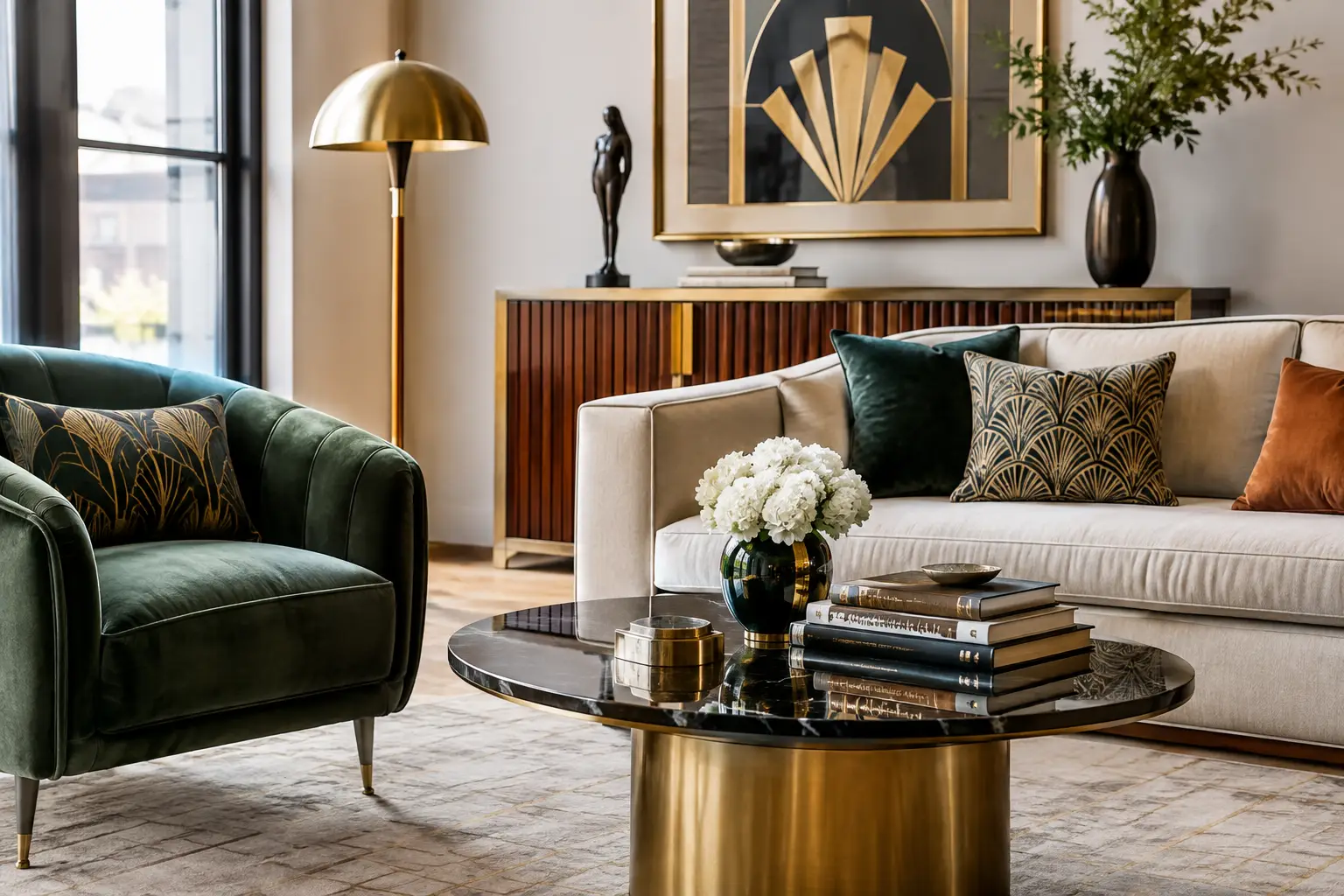
Art Deco is often reduced to black, gold, and a fan-shaped motif. That shorthand misses its real appeal. To understand how to style Art Deco, begin with its sense of composition: strong geometry, luxurious materials, precise silhouettes, and a controlled contrast between ornament and restraint. The most convincing rooms do not resemble period film sets. They use a small number of distinctive pieces to create atmosphere, rhythm, and visual authority.
For a contemporary home, Art Deco works best when it is treated as a language rather than a complete costume. A lacquered cabinet, a sculptural Murano glass lamp, or a stepped mirror can establish the mood without asking every object in the room to belong to the same decade. The result should feel collected, not themed.
How to Style Art Deco With a Clear Starting Point
Choose one architectural or decorative anchor before introducing smaller details. In a living room, this may be a curved sofa, a brass floor lamp, or an imposing mirror. In an entryway, it may be a console with a high-gloss surface and a geometric wall light. The anchor gives the room a center of gravity and prevents the style from becoming a collection of unrelated references.
Art Deco favors deliberate symmetry, but it does not demand rigid matching pairs. Two sconces framing a mirror create an immediate sense of order; a single dramatic chandelier above a dining table can do the same. What matters is the clarity of the arrangement. Give important objects room around them. Deco forms are strongest when their outline can be read at a glance.
Scale is equally important. A petite brass object on a large sideboard can disappear, while an oversized lamp in a narrow room can feel theatrical in the wrong way. Measure the visual weight as well as the dimensions. A dark wood cabinet, a mirrored screen, or an amber glass pendant can carry a room even when its footprint is modest.
Build the Palette Through Depth, Not Excess
A refined Art Deco palette is rarely flat. It relies on tonal depth: ink blue against warm ivory, oxblood with walnut, tobacco brown beside brass, or emerald accents against soft plaster. Black remains useful, especially in lacquer, ebonized wood, and metal, but it should define the composition rather than cover every surface.
Start with a quiet foundation such as cream, stone, taupe, soft gray, or deep charcoal. Then introduce one saturated color through upholstery, glass, or a rug. A third tone can appear in metal or wood. This limited palette allows high-shine details to feel intentional instead of decorative for their own sake.
Gold is not the only metal suited to the period. Aged brass brings warmth, while chrome and nickel offer a cooler, more metropolitan reading of the style. Combining metals can work beautifully, particularly in rooms assembled over time, but give one finish priority. If the lighting is polished chrome, a brass tray or picture frame may be enough contrast. Too many competing finishes can dilute the precision that makes Art Deco compelling.
Let materials do the decorating
The character of Art Deco lives in surfaces. Think veined marble, smoked glass, polished walnut, parchment, lacquer, velvet, shagreen, and mirrored panels. These materials offer richness even when the room remains sparsely furnished.
A single authentic object in a remarkable material is more persuasive than several imitations. For example, a Murano glass table lamp can bring color, light, and craftsmanship to a simple console. A vintage mirror with a beveled or etched frame can give depth to a plain wall. These pieces are not accessories added at the end; they are the elements that establish the room’s identity.
This is where provenance matters. Vintage and antique pieces often show subtle irregularities in glass, patina in metal, or variation in veneer. Those signs are not defects to conceal. They are evidence of material life and handwork, and they keep a polished interior from feeling generic.
Use Geometry With Restraint
Sunbursts, zigzags, stepped profiles, arches, chevrons, and radiating lines are familiar Art Deco signatures. They are powerful precisely because they are graphic. Repeating them on the rug, wallpaper, cushions, mirror, and lighting at once makes the room feel overdesigned.
Select one dominant geometric gesture. A fan-shaped headboard may be balanced by plain bedding and a pair of cylindrical bedside lamps. A stepped cocktail table can sit on a rug with a subtle border rather than a bold graphic pattern. When the architecture already offers arches, paneling, or strong moldings, let those forms lead and choose furnishings with cleaner lines.
Curves are essential to softening the style. A rounded club chair, a tambour-front cabinet, or an oval mirror offsets the angularity of lacquered furniture and linear metalwork. This tension between curve and line is one of the most enduring qualities of Deco interiors.
Make Lighting a Focal Point
Lighting is among the most direct ways to introduce Art Deco because it combines form, reflection, and atmosphere. Opaline glass, frosted globes, colored Murano elements, chrome arms, and brass details all speak naturally to the period without overwhelming a room.
Avoid relying on a single ceiling fixture. Art Deco interiors benefit from layered illumination: an overhead pendant for structure, wall sconces for symmetry and glow, and a table or floor lamp for intimacy. The effect is especially important in dining rooms, hallways, and bedrooms, where reflective surfaces become more expressive after dark.
Consider the light itself. Warm bulbs flatter brass, amber glass, walnut, and velvet. Very cool light can make these materials appear sterile, particularly when paired with chrome or mirrored furniture. If a vintage fixture requires rewiring, treat electrical safety as part of the acquisition process, not an afterthought. A beautiful original object should also be practical in daily use.
Combine Vintage Pieces With Contemporary Restraint
An all-period Art Deco interior can be extraordinary, but it requires space, knowledge, and a consistent collection. For most homes, mixing eras produces a more personal result. A clean-lined contemporary sofa can sit beside a 1930s side table. Minimal artwork can sharpen the profile of an ornate mirror. Modern plaster walls can make colored glass and polished metal feel even more vivid.
The key is to find a shared quality between pieces. It may be a repeated curve, the warmth of walnut, the sheen of brass, or a disciplined silhouette. Do not mix objects merely because they are old or expensive. A room gains coherence when every item contributes to the same visual conversation.
Sound Of Vintage Italy approaches this balance through selected objects with their own presence: lighting, decorative glass, mirrors, furniture, and personal accessories that carry distinct stylistic histories. In a well-composed setting, one such piece can alter the reading of an entire room.
Edit the decorative layer
Art Deco welcomes glamour, but glamour needs negative space. Keep tabletops and shelves edited. A sculptural vase, a pair of candlesticks, and a small box in lacquer or shagreen may be enough for a console. On a bar cart, choose a few beautiful glassware pieces rather than filling every level.
Artwork should be considered in the same way. Fashion illustration, architectural prints, abstract works with strong line work, and black-and-white photography can all support the mood. Choose frames with intention, but avoid turning every wall into a gallery of Deco references. One large piece usually has more effect than many small ones.
Room-by-Room Art Deco Decisions
In a living room, begin with seating and lighting. Velvet, bouclé, leather, and tailored upholstery provide a tactile foundation, while a mirrored or marble-topped table introduces reflection. Add a single substantial accent, such as a sculptural floor lamp or a geometric rug, then stop before the room loses its air.
In a dining room, the table should feel architectural. Dark wood, glass, stone, or a polished surface can work, depending on the room’s proportions. Above it, choose a chandelier with a clear silhouette. Upholstered dining chairs in a saturated fabric bring comfort and color, while a sideboard offers an opportunity for glass, brass, or a carefully chosen decorative object.
A bedroom calls for a softer interpretation. Use a curved headboard, rich curtains, bedside lamps with glass or metal bases, and a mirror with a strong profile. Rather than covering the bed in patterned textiles, let one luxurious textile take the lead. Velvet cushions, a silk shade, or a patterned throw can provide enough opulence.
The most memorable Art Deco rooms are not crowded with symbols of the era. They are built around a few objects with excellent proportion, real material presence, and enough space to be seen. Choose the piece that makes you pause, then allow the rest of the room to answer it.