
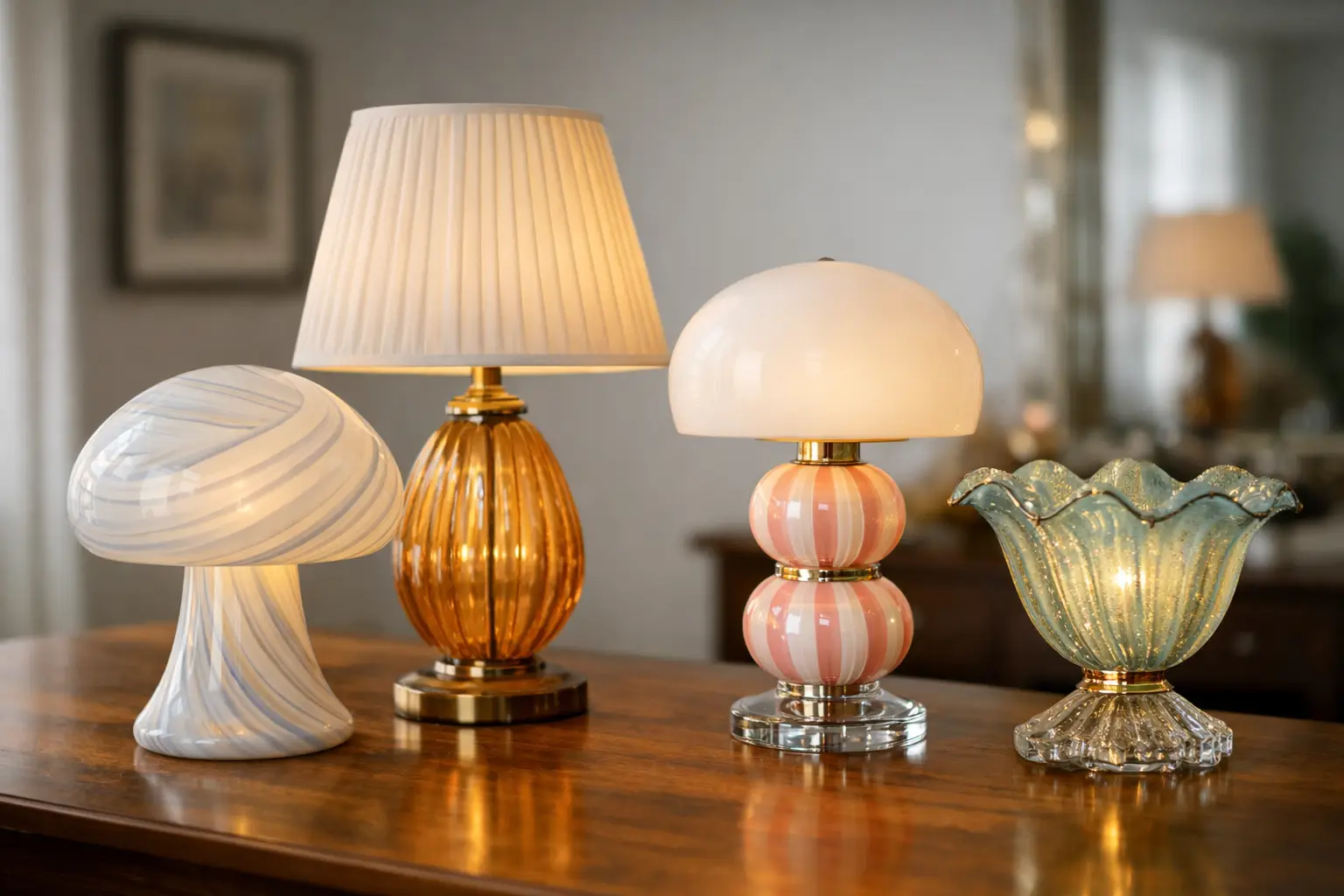
A vintage Murano table lamp does not behave like a neutral object. It sets the tone of a room before the furniture has a chance to speak. The best vintage Murano table lamps carry that rare mix of sculpture, light, and material presence that makes even a compact side table feel curated rather than merely furnished.
For collectors and design-led interiors, Murano table lighting sits in a category of its own. Venetian glassmaking brings together technical precision and expressive form, but not every lamp delivers the same visual weight. Some pieces are airy and architectural. Others are dense, luminous, and almost jewel-like. Knowing what makes one lamp merely attractive and another truly memorable is what separates browsing from collecting.
What makes the best vintage Murano table lamps stand out
The first distinction is not age alone. Vintage matters, but quality in Murano lighting is tied just as closely to execution, proportion, and the relationship between glass and light. A well-chosen lamp should be compelling even when switched off. Once illuminated, it should reveal depth in the glass rather than flatten into decoration.
The strongest examples tend to share a few traits. Their silhouettes are confident without being heavy-handed. The glass has variation, movement, and intention. The metal components, when present, support the design rather than competing with it. And perhaps most importantly, the lamp feels unmistakably tied to a moment in Italian design history while remaining easy to place in a contemporary interior.
This is why Murano continues to appeal across very different rooms. A softly opaline mushroom lamp can sit beautifully in a minimalist bedroom. A dramatic handblown piece with gold flecks or ribbed glass can anchor a richly layered living room. The category is broad, but the best pieces never feel generic.
The Murano styles collectors return to
Mushroom and dome silhouettes
Among the most sought-after forms, mushroom lamps remain a defining presence in vintage Murano lighting. Their appeal lies in balance. The rounded shade diffuses light with a calm, even glow, while the lower body keeps the overall shape compact and sculptural. In white opaline glass, they feel soft and architectural. In amber, smoked, or iridescent finishes, they become warmer and more atmospheric.
These lamps work especially well in bedrooms, reading corners, and hospitality-inspired interiors where ambient light matters as much as decoration. Their strength is versatility, though the most common forms can sometimes feel less individual than rarer designs. That is where glass quality and proportion become decisive.
Mid-century organic forms
Murano excelled in the mid-century period because glassmakers and designers embraced fluidity. Lamps from the 1950s through the 1970s often feature rounded bases, swelling contours, asymmetry, and a softness that contrasts beautifully with harder materials such as marble, walnut, or chrome.
These pieces are ideal for interiors that lean into Italian modernism, but they also sit comfortably in eclectic spaces. The reason is simple – organic Murano forms introduce movement. They keep a room from feeling too strict.
Textured and sculptural glass
Some of the best vintage Murano table lamps earn their place through surface treatment rather than outline alone. Pulegoso glass, with its dense field of bubbles, creates a cloudy, mineral quality that feels substantial and refined. Ribbed, twisted, or heavily worked glass catches light differently throughout the day, making the lamp dynamic even when unlit.
This kind of texture often appeals to buyers who want a lamp with decorative authority. The trade-off is that highly worked glass can dominate a smaller room. In a restrained interior, one sculptural lamp may be enough.
Gold flecks, inclusions, and dramatic finishes
Murano is rightly associated with visual richness. Gold flecks, aventurine effects, sommerso layering, and smoky tonal shifts can all give a lamp extraordinary depth. Used well, these techniques elevate a lamp from useful object to collectible design piece.
But this is where discernment matters. Rich finishes need strong form beneath them. If the silhouette is weak, decorative effects can read as excessive. The best examples feel composed, not theatrical.
Glass techniques that signal character and value
A serious look at vintage Murano lamps always comes back to technique. You do not need to be a glass historian to recognize quality, but knowing a few key methods helps explain why certain pieces feel more substantial than others.
Pulegoso glass is one of the most recognizable. Its intentionally bubbled surface diffuses light beautifully and gives the lamp a velvety opacity. It is particularly effective in rounded or compact forms where the texture can be appreciated at close range.
Sommerso, by contrast, relies on layers of differently colored glass submerged within each other. This creates depth and tonal complexity, especially visible around edges and curves. In table lamps, sommerso can produce an almost liquid sense of color that changes as the lamp is viewed from different angles.
Opaline glass offers a quieter kind of beauty. It is often chosen for interiors that value softness and restraint. A good opaline Murano lamp does not need elaborate ornament because the glow itself becomes the statement.
Aventurine and metallic inclusions bring sparkle and richness. They suit more decorative settings, particularly where the lamp is meant to interact with mirrors, lacquered surfaces, brass, or velvet. The effect can be stunning, though it depends on the room. In sparse environments, it may feel too formal. In layered interiors, it can be exactly right.
How to choose the right lamp for the room
Buying vintage Murano lighting is partly about style and partly about placement. A lamp that looks magnificent on a dealer’s table may feel oversized, dim, or visually disconnected at home if scale and atmosphere are not considered early.
For a bedside setting, softer profiles and diffused light usually perform best. Mushroom forms, opaline glass, and gently rounded silhouettes create a calm presence. In a living room, you can afford more drama – larger bases, more texture, deeper color, and pieces with a stronger sculptural identity.
A console or entry table is different again. Here, the lamp is often seen first as an object, then as a light source. Shape becomes critical. A lamp with a clear silhouette and strong material contrast tends to succeed in transitional spaces.
There is also the question of pairing. Some vintage Murano table lamps are at their best as a single statement piece. Others are more compelling as a pair, especially on nightstands or flanking a sofa. Matching pairs are naturally more difficult to source and often command greater attention from buyers who value symmetry.
What to check before buying vintage Murano
Authenticity in Murano is not always straightforward, particularly in a market where attribution can be optimistic. Labels, signatures, and documented provenance can help, but they are not present on every worthwhile piece. Condition, craftsmanship, and design coherence matter just as much.
Look closely at the glass for consistency and intentionality. Minor irregularities can be part of handblown production, but they should feel organic rather than careless. Check the base, fittings, and electrical components. Rewired lamps are common and often desirable for practical use, provided the work has been done properly.
Condition deserves a nuanced view. A small sign of age on metal hardware may be acceptable, even welcome, if the glass remains strong and the lamp presents well overall. Chips, cracks, and poorly matched replacement parts are different matters. With Murano, the integrity of the glass is central.
Scale should also be verified carefully. Vintage photographs can make a compact lamp appear monumental. Measurements are not a secondary detail. They determine whether the lamp reads as a jewel-like accent or disappears beside the furniture.
Why these lamps continue to matter
Murano table lamps have lasted because they sit at the intersection of decorative art and practical design. They are not simply nostalgic objects from the Italian mid-century period. They still answer a contemporary desire for interiors with identity, material richness, and visual memory.
That is why the category remains so compelling for collectors, designers, and private clients furnishing homes with intention. The best pieces do more than reference a famous tradition. They create atmosphere. They bring softness to hard architecture, depth to neutral palettes, and a sense of authorship to rooms that might otherwise feel complete but anonymous.
For those building an interior one piece at a time, this is often where the pleasure begins. A well-chosen Murano lamp does not just fill a surface. It changes the room around it, quietly but unmistakably.