
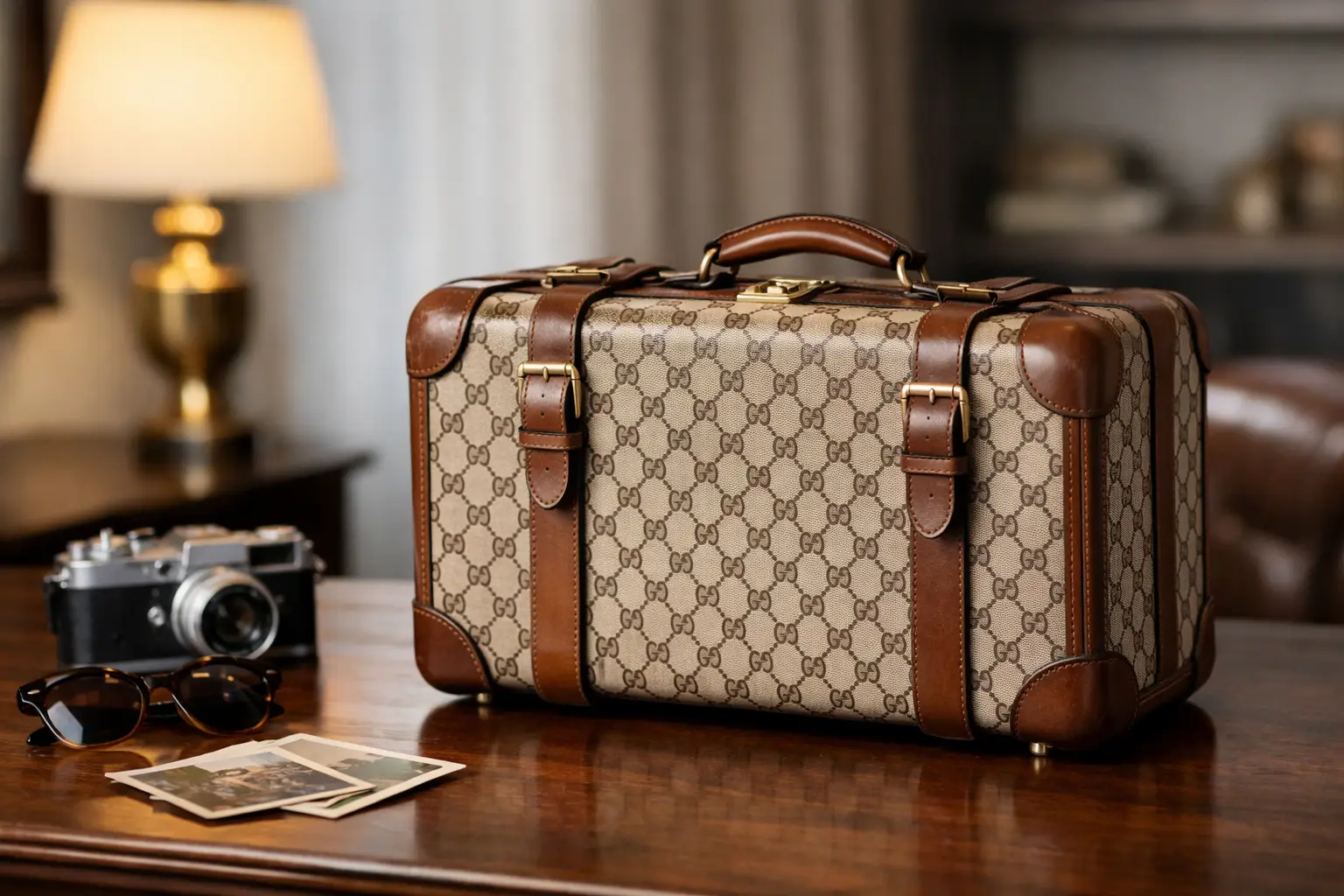
A vintage Gucci suitcase is rarely an anonymous piece of luggage. Whether it is covered in the house’s GG Supreme canvas, finished in brown leather, or detailed with the Web stripe, it carries a precise visual language that belongs as naturally beside a walnut credenza as it does in a dressing room. This Gucci vintage suitcase review looks beyond the recognizable monogram to assess what makes these cases desirable, what limits their practical use, and which examples deserve serious attention.
Gucci Vintage Suitcase Review: Design Before Utility
The appeal begins with proportion. Many Gucci suitcases produced from the 1960s through the 1980s have a compact, architectural presence: squared corners, leather trim, polished hardware, and a disciplined repetition of the monogram. Their design is unmistakably Italian in spirit, balancing graphic impact with a certain reserve.
The classic GG canvas is the most immediate identifier. Depending on the period, it may appear in beige and ebony, beige and brown, or a more unusual colorway. The material was designed to be durable, but age gives it a softer, less uniform character than a new bag. A well-preserved surface has a warm patina rather than a glossy, overly fresh appearance.
Leather examples can be even more compelling. Smooth or grained leather develops marks, darkening, and subtle variations that make the case feel personal rather than generic. The trade-off is that leather is more vulnerable to dryness, cracking, and distortion if it has been poorly stored. A monogram canvas suitcase may be easier to live with; a fine leather version often has stronger decorative presence.
Details matter considerably. The best pieces retain their original leather handles, zipper pulls, locks, corner protectors, and interior lining. Brass-toned hardware with a naturally softened finish is desirable. Excessively polished hardware, newly replaced handles, or bright modern-looking repairs do not automatically make a suitcase undesirable, but they should affect how it is valued and presented.
The Quality of Vintage Gucci Construction
Vintage luxury luggage was made for a different rhythm of travel. These cases were intended for cars, trains, hotel porters, and wardrobes, not baggage belts and overhead bins. Their construction generally feels substantial: reinforced corners, firm frames, dense canvas, and leatherwork that was built to age rather than be replaced after a few seasons.
That said, a Gucci suitcase is not indestructible. Adhesives, interior linings, and zipper tapes can deteriorate with time. Large cases are especially prone to stress around handles and hinges because of their weight. The most attractive example is not always the most practical one to carry.
For contemporary travel, a vintage Gucci suitcase is best considered an occasional companion rather than a workhorse. It may be suitable for a short car journey, a carefully handled weekend away, or stylish storage at a destination. It is less suited to checked airline luggage, where vintage leather and hardware can be exposed to damage that is difficult or impossible to reverse.
As an object for the home, however, its qualities become more persuasive. A suitcase can hold linens, photography books, seasonal textiles, or personal correspondence. It can also sit open on a dressing table or console, becoming a display piece in its own right. The interior – even when lightly marked by age – adds a private, intimate dimension that a purely decorative box rarely possesses.
The Interior Tells the Truth
Open the case before forming an opinion. Interiors often reveal more about a suitcase’s life than the exterior does. Original fabric linings, leather straps, pocket compartments, and stamped labels contribute to both authenticity and charm. A faint scent of age is common, but strong mildew, active mold, flaking material, or sticky deterioration requires careful consideration.
Water staining is another point to assess. A small, stable mark may be acceptable on a decorative object with honest age. Widespread staining, warped panels, or a lingering odor can make restoration expensive and uncertain. For collectors, condition should be judged as a whole: a suitcase with a few elegant signs of use is often more convincing than one that has been aggressively restored.
Authenticity: What to Examine Closely
The Gucci name makes authentication essential, particularly for monogram luggage. Vintage pieces do not always follow the exact codes, labels, or serial-number conventions found on recent accessories, so no single detail should be treated as absolute proof. The strongest assessment comes from examining the construction, materials, typography, and overall coherence together.
Start with the canvas. The GG pattern should feel integrated into the material, not printed with a flat or plastic-like effect. Alignment may vary at seams and corners, especially on older pieces, but the pattern should still appear intentional. The color should also be consistent with natural aging rather than looking artificially faded or strangely saturated.
Then consider the leather trim. Authentic vintage leather generally shows a believable progression of use: darker edges, softened handles, small scratches, and tonal variation. Perfectly matching new leather repairs can be functional, but they should be disclosed. Stitching should be neat and purposeful, while hardware should have appropriate weight and finishing.
Labels and stamps deserve close attention, yet they should not be examined in isolation. Letter forms, spacing, and the quality of embossing need to correspond to the era and model. A label that looks crisp but visually disconnected from the suitcase’s construction is a reason to pause. Provenance, original keys, protective covers, and period purchase documentation can add reassurance, though their absence is not unusual for luggage that has traveled through several decades.
When buying a collectible example, clear photographs of corners, handles, lining, locks, labels, and any flaws are more useful than a single dramatic image of the monogram. Condition transparency is part of the object’s value.
Which Vintage Gucci Suitcase Is Worth Buying?
The answer depends on whether the purchase is driven by collecting, decoration, or occasional use. For a collector, rarity and originality may justify a suitcase with visible patina. An unusual shape, a distinctive color combination, a complete lock and key set, or an early period detail can make a piece especially interesting.
For an interior, scale is often the deciding factor. A compact vanity case or train case is easy to place on a shelf, desk, or dressing table. A medium suitcase works beautifully stacked with art books or positioned beneath a console. Larger trunks have dramatic presence but require space and should not be acquired merely because they carry a prestigious name.
For use, choose structure over novelty. Test the handles, closures, and hinges where possible. Confirm that the frame sits flat and that the lid closes without force. A beautiful case with weakened handles may still be an excellent decorative acquisition, but it should not be loaded heavily.
The most satisfying purchase is often not the most pristine. It is the suitcase whose wear feels proportionate to its age and whose details remain intact. A few scuffs on leather corners can lend authority; peeling canvas, structural instability, or concealed repairs cannot.
Styling a Gucci Suitcase at Home
A vintage Gucci suitcase works best when it is given visual room. In a bedroom, place a smaller case on a low bench or at the foot of the bed, paired with tactile materials such as linen, walnut, or woven cane. In a living room, a larger suitcase can be used as a low occasional table if its surface is stable and protected with a tray.
Its graphic monogram also creates an intriguing contrast with Italian modern design. Next to a Murano glass lamp, a sculptural mirror, or a streamlined Mid-Century chair, the suitcase introduces fashion history without making the room feel like a boutique display. The key is restraint. One exceptional piece has more impact than a pile of branded objects.
At Sound Of Vintage Italy, this is the distinction that gives vintage accessories their place among furniture, lighting, and decorative arts: they are not simply fashion remnants. Chosen well, they contribute texture, provenance, and a recognizable point of view to an interior.
Care That Preserves Character
Keep a vintage suitcase away from direct sun, radiators, damp basements, and tightly sealed plastic storage. Leather benefits from a stable environment more than frequent intervention. Dust gently with a soft dry cloth, and avoid household cleaners, oils, or conditioners unless they are appropriate for the specific material and tested discreetly first.
Store the case empty or lightly filled with acid-free tissue to support its shape. If it is displayed closed, open it occasionally to allow air circulation. Never force a stiff zipper, lock, or hinge. The goal is not to make a vintage suitcase look new, but to preserve the material evidence that makes it singular.
A fine Gucci suitcase earns its place when its history is visible but its structure remains sound. Let the piece retain its quiet marks of travel, then place it where those marks can become part of the room’s story.