

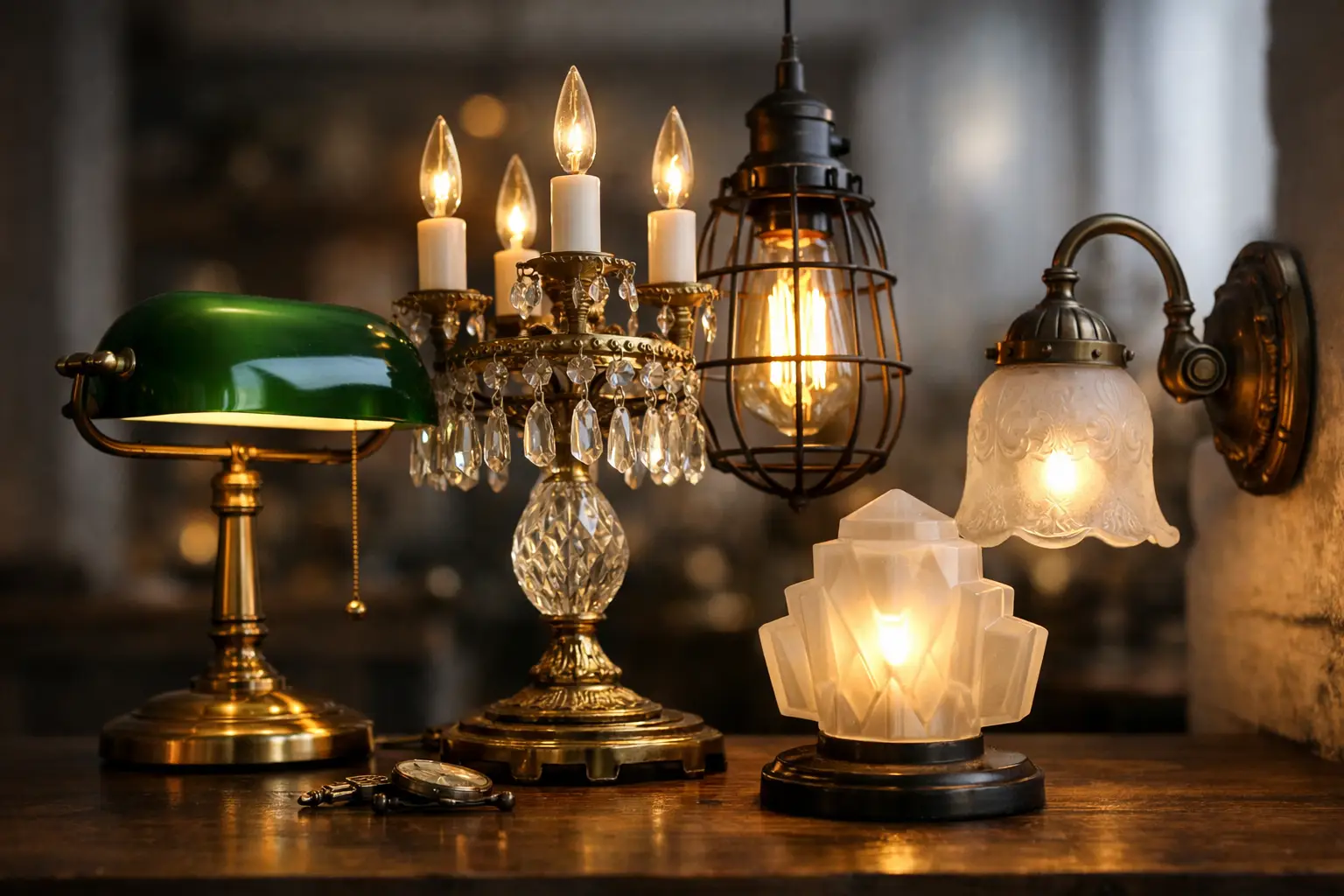
A chandelier can flood a room with light and still feel forgettable. A vintage fixture, by contrast, often does something rarer – it sets the rhythm of the space before it is even switched on. That is usually where the question begins: what makes vintage lighting valuable, beyond age alone?
The short answer is that value comes from a combination of design significance, authenticity, materials, condition, and desirability. But in the vintage lighting market, these factors do not operate in isolation. A Murano glass pendant, an Italian Mid-Century floor lamp, or an Art Deco wall sconce may command attention for very different reasons, and the highest value often lies where aesthetics, provenance, and scarcity meet.
What makes vintage lighting valuable in the market
Age matters, but far less than many first-time buyers assume. Not every old lamp is valuable, and not every valuable lamp is especially old. The market responds to pieces that represent a clear design language, a strong decorative presence, and a level of craftsmanship that is difficult to reproduce convincingly today.
A well-composed vintage light carries visual authority even when unlit. Proportion, silhouette, patina, and material depth all contribute to that effect. This is why certain categories remain consistently sought after: Italian modernist fixtures, Murano glass chandeliers, brass and opaline table lamps, sculptural floor lamps from the 1950s through the 1970s, and selected Art Nouveau or Art Deco pieces. They are not simply functional objects. They are spatial anchors.
The market also rewards recognizability. Buyers tend to assign stronger value to lighting that can be placed within a known period, movement, or production context. A fixture that clearly reads as Mid-Century Italian, or one that shows the hand of Venetian glassmaking, is easier to position culturally and commercially than a generic old lamp with no distinct identity.
Designer, maker, and origin
One of the strongest drivers of value is attribution. When a piece can be tied to a respected designer, workshop, or manufacturer, its position changes immediately. This is true across categories, from major names in Italian design to renowned Murano furnaces and historic European producers.
Attribution matters because it provides a framework for quality and collectability. A lamp linked to a known maker is easier to compare, document, and place within design history. Even when the designer is not famous to the general public, a recognizable manufacturer can still elevate value because informed buyers understand what that name represents in terms of production standards, materials, and aesthetic consistency.
Origin also plays a central role. Italian lighting has a particularly strong place in the vintage market because it combines technical sophistication with decorative confidence. Venetian glass, Milanese modernism, and the broader Italian approach to proportion and material contrast continue to hold international appeal. In practical terms, country of origin often influences both demand and price, especially when the object reflects a specific regional craft tradition.
That said, attribution should be handled carefully. Labels, stamps, old invoices, and catalog references are useful, but the absence of a mark does not automatically mean a piece lacks value. Some exceptional fixtures survive without documentation. In those cases, construction quality, design coherence, and material evidence become even more important.
Materials that hold value over time
Vintage lighting often reveals its quality first through materials. Solid brass, hand-blown Murano glass, carved wood, polished chrome, opaline glass, alabaster, and finely worked metal each age in a distinct way. They develop surface character rather than simply wearing out.
This is one answer to what makes vintage lighting valuable: material presence that improves with time. Handcrafted glass has irregularity, depth, and luminosity that machine-made imitations rarely match. Older brass tends to acquire a softer, more complex finish. Even signs of use can add to the visual credibility of the piece when they read as patina rather than neglect.
Murano glass deserves special attention because it occupies a unique position between decorative art and functional lighting. Its value is not based only on beauty, but on technique. Pulegoso textures, lattimo, sommerso effects, and sculptural forms are tied to a tradition of glassmaking that collectors and designers continue to prize. In these cases, the material is not just a component. It is the identity of the object.
Still, expensive materials do not guarantee high value on their own. A heavy brass lamp with clumsy proportions may be less desirable than a more modest fixture with perfect line and period integrity. Material quality must work together with design quality.
Condition, restoration, and originality
Condition has a direct effect on value, but the subject is nuanced. In vintage lighting, original condition is often appreciated, especially when wear is honest and the piece remains structurally sound. Minor oxidation, light surface marks, or age-consistent patina can be preferable to aggressive polishing or over-restoration.
What collectors and design-conscious buyers usually want is integrity. Original glass elements, correct hardware, period-consistent finishes, and an intact overall composition tend to support stronger value. Replaced parts do not always ruin a piece, but they should be appropriate and clearly understood.
Electrical rewiring is a good example of how value works in practice. Safe, professionally updated wiring is often necessary and generally accepted, especially for fixtures meant to be used rather than displayed. It can make a piece more viable in contemporary interiors. By contrast, repainting a lamp base in a color that was never part of its original character may reduce both aesthetic credibility and market appeal.
Damage affects categories differently. A tiny sign of age on a brass stem may be acceptable. A chip on Murano glass, a crack in alabaster, or a broken sculptural element usually has a more serious impact. The more the value depends on the purity of the material or form, the less forgiving the market tends to be.
Rarity and desirability are not the same thing
A common misconception is that rarity automatically creates value. It can, but only if buyers actually want the piece. Some fixtures are rare because few were made. Others are rare because few people kept them. The first can be exciting. The second is not always a selling point.
Desirability depends on how a piece fits current collecting and design preferences while still holding long-term character. Lighting with strong sculptural form, usable scale, and adaptable style often performs well because it appeals to both collectors and interior designers. A dramatic pair of wall sconces or a chandelier with real architectural presence can be easier to place in a serious interior than a highly eccentric object with limited decorative flexibility.
This is why certain vintage lights remain valuable across decades. They are rare enough to feel special, but desirable enough to remain in active demand. The balance matters.
Scale, function, and decorative impact
Lighting lives in a room differently from furniture or small accessories. It affects atmosphere, movement, and perception of volume. For that reason, value is often tied to decorative impact as much as historical merit.
A fixture can be modest in size and still feel important if its design is precise. Likewise, a monumental chandelier may carry strong value because it becomes the central visual statement of an entry, dining room, or hospitality setting. Pieces that combine practical function with an unmistakable silhouette tend to have broader appeal.
Function should not be overlooked. Buyers are often willing to invest more in lighting that can still perform in everyday use. A pair of bedside lamps, a reading floor lamp, or a dining fixture with balanced illumination may attract stronger interest than a beautiful but awkward piece that is difficult to install or live with. Decorative and practical value often reinforce one another.
Provenance and the story behind the object
Provenance can elevate a piece from attractive to compelling. When vintage lighting comes with a traceable history – a documented maker, an original catalog appearance, a notable former interior, or a clear geographic origin – buyers gain confidence, and confidence often translates into value.
This does not mean every object needs a dramatic backstory. Sometimes provenance is simply clarity. Knowing that a chandelier was produced in Italy in the 1960s, or that a lamp belongs to a known Murano production line, gives the piece context. Context helps distinguish a collectible object from a decorative approximation.
For a curated retailer such as Sound Of Vintage Italy, this is part of the appeal: selection is not only about style, but about recognizing which objects carry enough identity to justify their place in a refined interior and in a serious collection.
What makes vintage lighting valuable to collectors and designers
Collectors and interior designers do not always buy for the same reason, but their interests often overlap. Collectors may focus more closely on maker, period, rarity, and originality. Designers may prioritize form, scale, finish, and how a piece interacts with architecture and furnishings. The most valuable fixtures usually satisfy both perspectives.
That overlap explains why certain lights remain consistently relevant. They can be read as collectible design objects, yet they also solve a decorative problem beautifully. A well-chosen vintage lamp does not merely illuminate a corner. It gives the room a point of view.
If you are assessing a piece, look beyond age and ask better questions. Is the design distinctive? Are the materials substantial and well-worked? Is the condition honest? Can the maker or origin be identified? Does the piece hold its own aesthetically in a contemporary interior? Those are the questions that separate a simple old fixture from one with lasting worth.
The most valuable vintage lighting is rarely just about nostalgia. It is about presence, authorship, and the quiet authority of an object made with conviction. When a piece has those qualities, its value is felt before it is calculated.
Sorry, the comment form is closed at this time.