

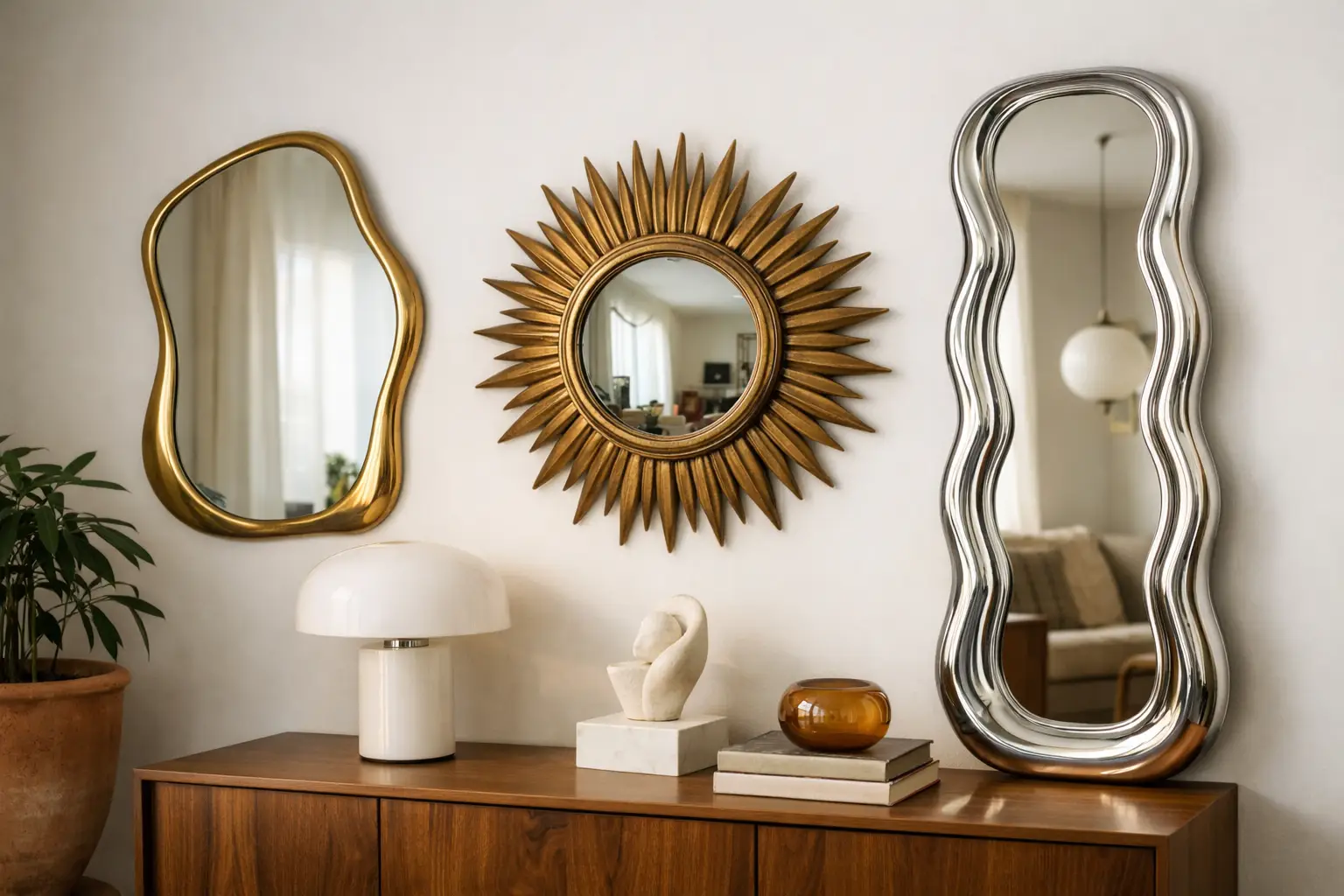
A well-placed mirror can do more than reflect a room. In the right piece, it can set the tempo of an interior, sharpen its architecture, or introduce a decorative tension that feels collected rather than styled. That is why Italian design vintage mirrors remain so desirable: they carry proportion, material intelligence, and visual confidence in a way that few decorative objects can match.
In Italian interiors, the mirror has rarely been treated as a purely functional object. It has often been conceived as a decorative surface, a sculptural frame, or even a quiet focal point capable of changing the balance of an entire room. This is especially true in vintage Italian design, where craftsmanship, silhouette, and finish tend to work together with unusual precision.
Why Italian design vintage mirrors stand apart
The appeal begins with composition. Italian makers have long understood that a mirror is never only glass. It is brass with patina, carved wood with a softened edge, Murano glass with light trapped inside it, or chromed metal that brings a cleaner modernist line. The frame is not an accessory to the reflective surface. It is the object.
That distinction matters in rooms where every element is expected to carry its own visual weight. A French gilt mirror may lean ornamental. A Scandinavian mirror may be restrained to the point of disappearance. Italian design often occupies the richer middle ground – decorative, yes, but rarely passive.
There is also a strong range within the category. Some pieces are rooted in Mid-Century geometry, with angular brass frames and disciplined proportions. Others move toward Hollywood Regency drama, with smoked glass, layered borders, and a certain theatrical elegance. Then there are Murano examples, where the mirror becomes almost luminous before it reflects anything at all.
The materials that define the category
When evaluating vintage Italian mirrors, materials tell you almost everything about character.
Brass and gilt metal
Brass-framed Italian mirrors from the 1950s through the 1970s often age beautifully. The finish can develop warmth rather than wear, which is one reason collectors and designers continue to favor them. A slightly darkened brass frame tends to flatter both classic and contemporary interiors because it introduces richness without becoming too polished.
The trade-off is maintenance and expectation. A mirror with original patina has more atmosphere, but it may not suit buyers looking for a factory-clean finish. In many cases, preserving that lived-in surface is the better choice.
Murano glass
Murano glass mirrors sit in a category of their own. Their value is not only decorative but cultural, tied to Venetian glassmaking and to a long tradition of refined ornament. Floral details, etched elements, translucent pieces, and hand-worked borders create a mirror that behaves almost like a light fixture.
These are rarely subtle objects, but subtlety is not always the point. In an entry hall, powder room, or above a fireplace, a Murano mirror can bring a room into focus instantly. It works especially well where surrounding furniture is edited and the mirror is allowed to hold the visual center.
Wood, carved or lacquered
Italian carved wood mirrors can move from neoclassical restraint to more expressive decorative styles. Lacquered frames, painted finishes, and hand-carved details often give these pieces a softer architectural presence than metal or glass. They are particularly effective in rooms that need texture rather than shine.
Chrome and smoked glass
For interiors leaning toward late modernism, chrome and smoked glass examples offer a sharper edge. These mirrors often feel more urban, more graphic, and more aligned with 1970s Italian sophistication. They suit interiors with stone, leather, darker woods, or minimal upholstery, where a brighter Murano piece might feel too ornate.
Choosing the right Italian vintage mirror for the room
A strong mirror should answer the room before it answers the trend.
In an entryway, scale matters first. A tall vertical mirror can elongate a compact space and immediately establish a sense of arrival. If the space is narrow, a slim brass or smoked-glass frame usually performs better than a deeply decorative silhouette, which can make the area feel crowded.
In a living room, placement becomes more nuanced. Above a mantel, an Italian mirror can act as an architectural anchor, but only if the proportions are right. Too small, and it looks incidental. Too large, and it can dominate the composition in a way that flattens nearby furniture. Sunburst forms, Murano frames, and sculptural gilt pieces work well here because they are meant to be seen from a distance.
For bedrooms, the tone often shifts. Softer forms, rounded corners, and warmer finishes tend to feel more composed than overtly dramatic designs. This is where curved brass, carved wood, or lightly etched glass can be especially effective. The mirror should support the room’s mood, not interrupt it.
Bathrooms present an interesting case. Vintage Italian mirrors can create a remarkable contrast against stone, plaster, or clean tile, but this is also the room where practicality matters most. Moisture, installation requirements, and the fragility of certain Murano details need to be considered honestly. The most beautiful choice is not always the most sensible one for daily use.
What collectors and designers look for
Condition is never a minor detail in this category. Foxing in the glass can be desirable if it is light and even, adding atmosphere without compromising function. Structural weakness in the frame is another matter. Decorative losses, unstable corners, or later repairs can affect both value and longevity.
Originality is equally important. Replaced mirror plates are common and not automatically problematic, especially when restoration has been handled carefully. But originality in the frame, finish, and decorative elements remains central. A vintage Italian mirror with intact details usually holds far more interest than one that has been over-restored into something generic.
Provenance, attributed makers, and recognizable design language also shape desirability. Certain pieces clearly reflect the sensibility of Italian design houses and artisans associated with Mid-Century luxury, Venetian craftsmanship, or postwar decorative modernism. Even when a mirror is unattributed, its line, material, and execution can reveal whether it belongs to that world or merely imitates it.
How to style Italian design vintage mirrors without overworking the room
The mistake is usually not choosing a mirror with personality. The mistake is surrounding it with too many competing statements.
If the mirror is Murano, keep adjacent accessories tighter in palette and fewer in number. If the mirror has a strong brass frame, let that finish repeat subtly elsewhere through a lamp base, picture frame, or side table detail. Repetition creates cohesion, but too much matching drains the room of depth.
Italian vintage mirrors also perform beautifully against contrast. A highly decorative frame on a restrained plaster wall feels intentional. A clean-lined chrome mirror above an antique console can sharpen the entire vignette. The point is not historical purity. It is visual balance.
This is where a curated approach matters more than a themed one. Rooms built entirely around a single period can become predictable. A better interior often comes from tension – Mid-Century mirror, older chest, contemporary sofa, and one exceptional Murano light. Each object keeps its identity.
For buyers who want that balance without spending months sourcing, a tightly edited specialist selection makes a real difference. Sound Of Vintage Italy speaks to that kind of search: less noise, more definition, and pieces chosen for presence rather than volume.
Italian design vintage mirrors as collectible objects
Some categories of vintage become popular because they are easy to place. Others become collectible because they remain visually persuasive over time. Italian mirrors belong to the second group.
They appeal to decorators because they solve aesthetic problems – adding light, scale, rhythm, and surface. They appeal to collectors because they often preserve regional craftsmanship, distinctive materials, and period-specific design language. That overlap is what keeps demand steady.
Not every piece needs to be rare to be worth owning. Sometimes the right mirror is simply the one with correct proportions, beautiful patina, and enough character to hold a wall on its own. Rarity matters, but so does conviction.
A vintage Italian mirror should never feel like filler. It should feel selected, as though the room changed direction the moment it arrived. That is the lasting pleasure of the category: not just reflection, but presence.
Sorry, the comment form is closed at this time.