

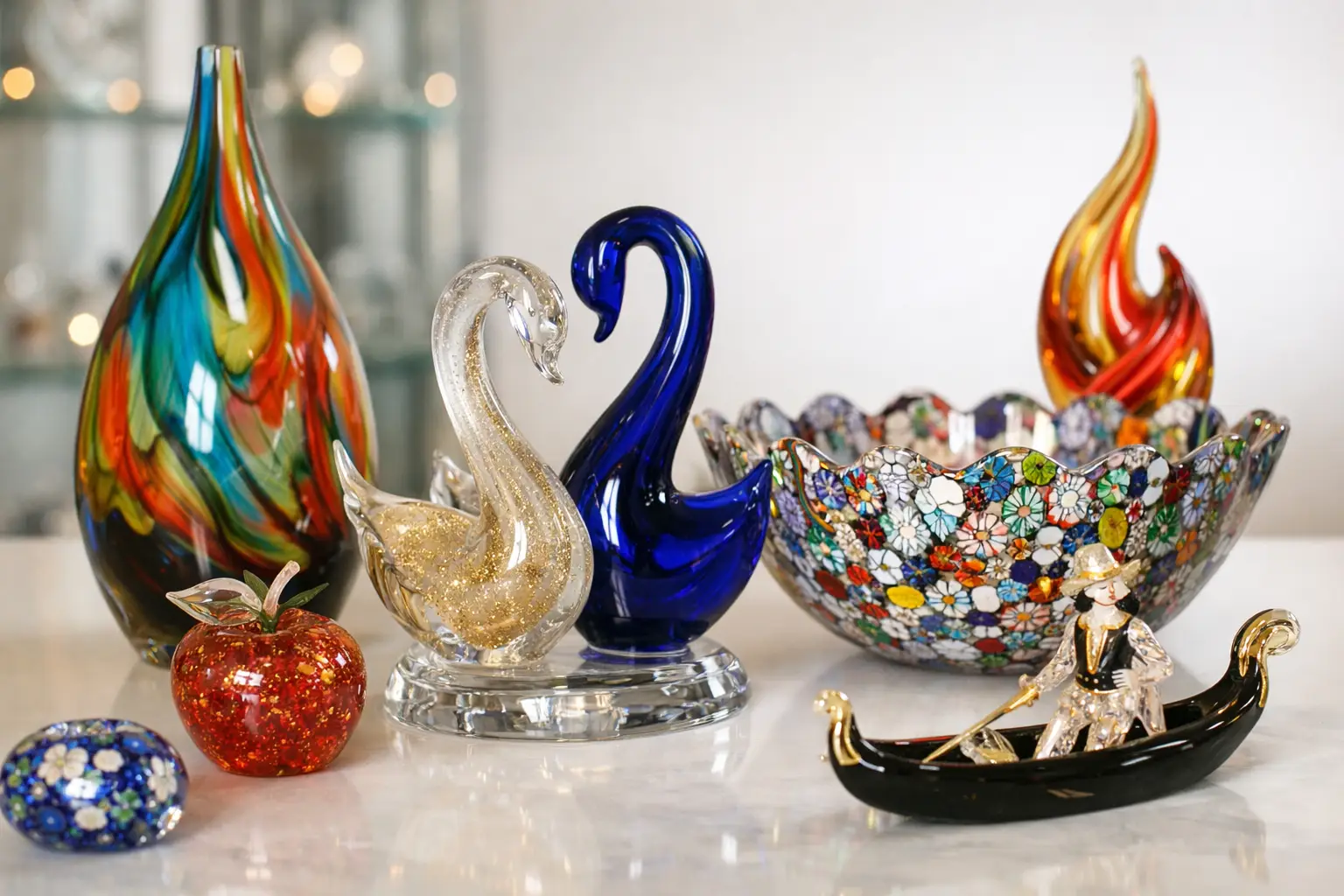
A single Murano piece can change the temperature of a room. Not literally, of course – but visually, absolutely. A sculptural Sommerso vase on a console, a Venetian handblown bowl catching afternoon light, or a pair of mid-century sconces in pulegoso glass can shift an interior from well furnished to unmistakably authored. That is where a guide to collectible Murano glass becomes useful: not at the level of souvenir shopping, but at the level where design, technique, period, and provenance begin to matter.
Murano glass attracts different kinds of buyers. Some want color and atmosphere. Some collect by furnace, designer, or decade. Others simply know that certain objects possess a density of presence that newer decorative glass rarely achieves. The challenge is that Murano is both a place and a tradition, not a single style. That makes the category rich, but it also means discernment is everything.
Why collectible Murano glass holds its value
Collectible Murano glass sits at the intersection of decorative art, design history, and technical mastery. It is admired not only because it is beautiful, but because it comes from a highly specific culture of making shaped over centuries on the Venetian island of Murano. Techniques were refined there, signatures emerged there, and many of the most sought-after 20th-century forms were developed there.
For collectors, value usually comes from a combination of factors rather than one decisive trait. The maker matters. The period matters. The technical complexity matters. So does scale, condition, rarity, and whether a piece expresses a recognizable aesthetic language. A Seguso vessel from the 1950s, for example, speaks differently from a flamboyant Barovier e Toso lamp, and both occupy a different category from later decorative production intended for tourism or export at lower price points.
This is also why Murano remains compelling in interiors. It is not merely ornament. The best pieces carry historical authorship, material depth, and a very Italian understanding of line, proportion, and luminosity.
A guide to collectible Murano glass starts with technique
If you want to buy with confidence, start by learning how Murano glass was made, not just how it looks. Technique often reveals quality more clearly than color alone.
Sommerso is one of the most recognizable methods. Layers of contrasting glass are submerged within one another to create remarkable depth and clean-edged volumes. Mid-century collectors often gravitate toward Sommerso because it feels architectural and controlled, especially in jewel tones or restrained clear-and-smoke combinations.
Pulegoso is another key term. This finish is marked by thousands of tiny bubbles suspended within the glass, producing a softly clouded, tactile effect. It can feel more atmospheric than polished, and in lighting it becomes especially expressive.
Lattimo, aventurine, filigrana, and zanfirico each bring a different visual language. Lattimo has a milky opacity. Aventurine includes shimmering metallic inclusions. Filigrana and zanfirico involve delicate internal canes and twisted line work that require considerable skill. None of these techniques is automatically more collectible than another, but the execution matters. Crisp form, balanced proportions, and technical finesse separate serious pieces from decorative imitations.
What to look for when buying
A collector does not need to be a scholar, but a trained eye helps. The first thing to assess is form. Good Murano glass tends to have conviction. Whether minimal or elaborate, the silhouette should feel intentional rather than generic. A vessel with a strong neck, controlled weight, and elegant transition between body and base usually signals better design.
The second point is surface and finish. Wear is expected in vintage glass, especially on the base, but heavy scratching, clouding, chips, or poorly restored rims affect both value and display quality. Tiny base wear can support age. A damaged lip or unstable foot is another matter.
Then consider color. Murano has always excelled in chromatic complexity, but not all palettes age equally well in the market. Some collectors prefer saturated mid-century tones such as ruby, emerald, cobalt, and amber. Others look for subtler grays, tea colors, and acid greens associated with more architectural interiors. The right choice depends partly on taste and partly on collecting strategy. If you are buying for a room, color can lead. If you are buying for historical significance, period consistency should matter more.
Makers, labels, and signatures
Murano buyers often ask the same question first: is it signed? A signature can help, but it is not the whole story. Many authentic vintage Murano pieces were originally sold with paper labels that have since disappeared. Others were acid-etched, wheel-engraved, or retain partial stickers naming the furnace. And some excellent pieces remain unattributed but clearly of Murano origin based on construction, style, and technique.
Among the names that regularly attract collector attention are Venini, Barovier e Toso, Seguso, Cenedese, AVEM, Salviati, and Archimede Seguso. Certain designers connected to these furnaces also carry strong market recognition. Yet attribution should be handled with care. A label alone is not always enough if the piece itself feels inconsistent. Reproductions and mislabeled items exist, especially in online marketplaces where images may hide important details.
When evaluating a signed or labeled object, look for coherence. Does the form correspond to the maker’s known production? Does the quality support the attribution? Does the wear suggest age consistent with the claimed period? In collectible Murano, confidence comes from the whole object, not one reassuring mark.
Period matters more than many buyers expect
Not all Murano was made for the same audience. Early and mid-20th-century production often holds greater appeal because it reflects decisive moments in design history, particularly from the 1930s through the 1970s. This was a period when Murano engaged directly with modernism, interior decoration, and international exhibitions.
Mid-century Murano is especially favored because it combines technical virtuosity with clarity of form. Vases became more sculptural, lighting more experimental, and color more disciplined. Later production can still be attractive and authentic, but collectibility often depends on whether it represents a strong design statement rather than generic decorative output.
That does not mean newer pieces lack value. It means the buyer should understand what kind of value is being pursued. Decorative value, artistic value, and secondary-market value do not always align.
How to spot common mistakes
The most common mistake is buying with only the word Murano in mind. The market is full of pieces described that way because the term has visual and commercial appeal. But true collecting requires more precision than geographic suggestion.
Another mistake is assuming age guarantees quality. Some older pieces are ordinary. Some unsigned examples are exceptional. The issue is not simply old versus new, but whether the object has design authority, material integrity, and authentic relation to the Murano tradition.
Buyers also sometimes overlook scale. A dramatic oversized centerpiece can be impressive, but if the proportions are awkward or the technique is mediocre, size alone will not rescue it. On the other hand, a smaller, exquisitely resolved vase or lamp can have stronger long-term appeal because it is easier to place and more refined in execution.
Collecting for interiors versus collecting for rarity
This is where taste and strategy separate. Some buyers collect Murano as a design language inside the home. They look for pieces that interact with wood, brass, marble, lacquer, or neutral upholstery. In this approach, a glass object must do more than sit on a shelf. It must shape the room.
Others collect by rarity, maker, or typology. They pursue clowns, animals, chandeliers, biomorphic vessels, tobacco leaf forms, or signed examples from a specific furnace. That path can be rewarding, but it requires narrower knowledge and more patience.
Neither approach is superior. The difference lies in what success looks like. If the goal is an exceptional interior, decorative presence may matter more than textbook rarity. If the goal is building a focused collection, attribution and period will carry more weight.
How to buy well in the current market
The strongest purchases are usually made slowly. Ask for detailed photographs. Look at the base, the rim, the transitions in the glass, and any labels or signatures. If a seller cannot describe condition clearly, that hesitation matters. If attribution sounds overly confident without evidence, that matters too.
Work with dealers who understand vintage design as a whole, not just isolated objects. Murano is best read in context – alongside lighting, furniture, mirrors, and decorative arts from related periods. A curated source tends to make better distinctions between merely pretty glass and pieces with true collector appeal. That is one reason discerning buyers often prefer a tightly edited selection over an endless catalog.
Murano rewards the eye over impulse. Buy the piece that has presence, not just color. Buy the object that still looks composed when the sunlight changes and the room quiets down. The best examples do not ask for attention constantly. They hold it naturally.
Sorry, the comment form is closed at this time.