

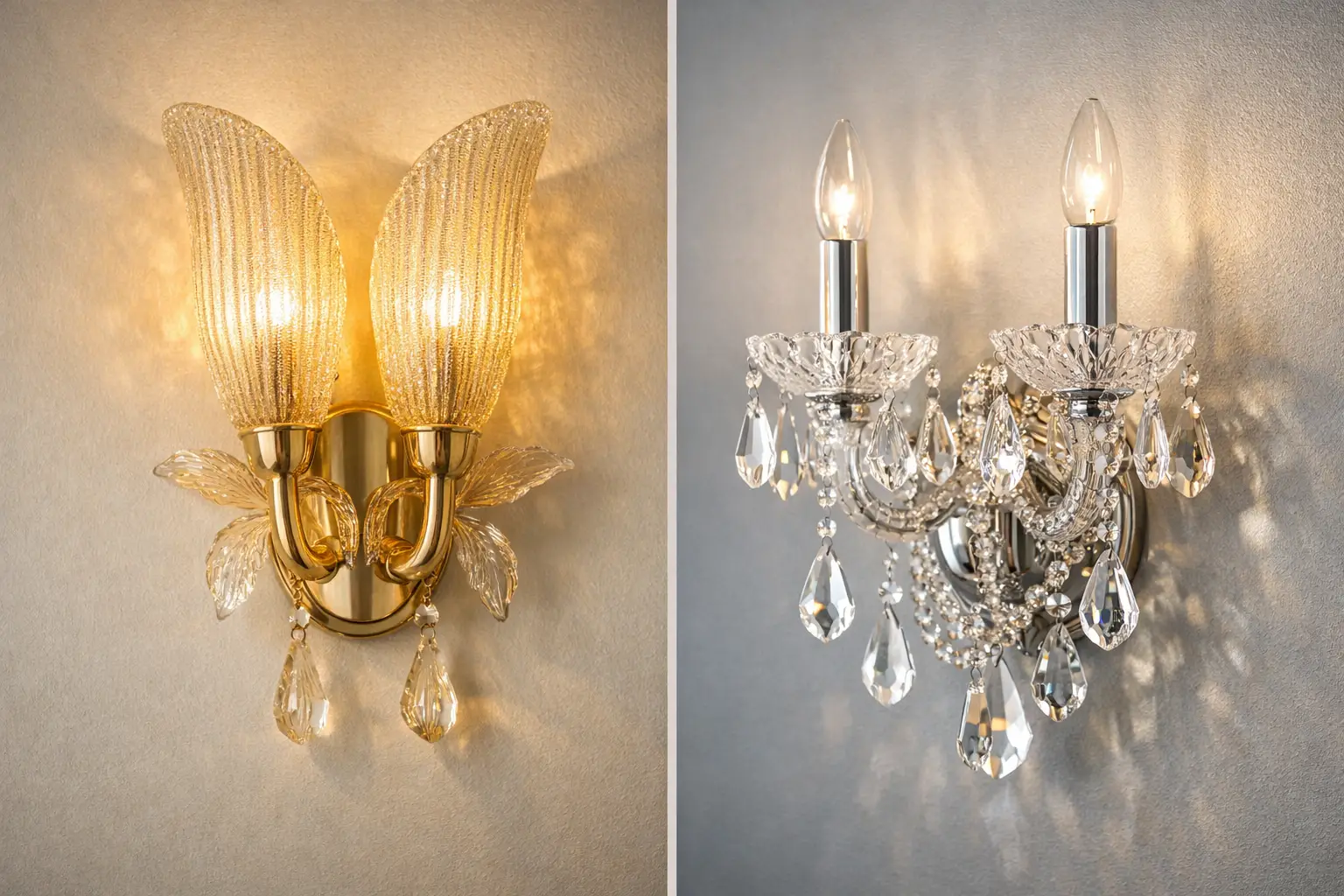
A wall light can change the entire reading of a room. Not just its brightness, but its cultural tone, its level of formality, and the way materials speak after sunset. When clients compare Murano sconces vs crystal sconces, they are rarely choosing between two simple lighting options. They are choosing between two different decorative languages.
One leans toward sculptural glass, artisanal variation, and a distinctly Italian sense of composition. The other often expresses brilliance, symmetry, and a more faceted relationship with light. Both can be beautiful. Both can be collectible. But they do not create the same atmosphere, and they do not ask for the same setting.
Murano sconces vs crystal sconces: the real difference
At first glance, the distinction seems obvious – Murano is glass from Murano, crystal is crystal. In interiors, though, the difference runs deeper than terminology. Murano sconces are often appreciated for their hand-worked character. Even when they are elegant and refined, they tend to show the human hand through shape, texture, blown elements, color transitions, and subtle irregularities.
Crystal sconces, by contrast, usually center on clarity, sparkle, and precision. Their visual impact comes from the way cut or molded elements catch and refract light. The effect is often more formal, more reflective, and in many cases more architectural in its rhythm.
This matters because lighting is never just functional. A Murano sconce can read as an art object on the wall even when turned off. A crystal sconce more often comes fully alive when illuminated, when prisms, drops, and cut surfaces begin to scatter light across the room.
Material identity and craftsmanship
Murano glass carries a strong material identity. It belongs to a centuries-old Venetian tradition in which glass is shaped not only for utility but for expression. In sconces, that can mean lattimo surfaces, smoky transparency, thick pulegoso textures, floral forms, curled arms, or mid-century silhouettes with a controlled softness. No serious collector expects sterile uniformity from authentic Murano. Variation is part of the value.
Crystal, especially in decorative wall lighting, is typically valued for its optical performance and visual crispness. Depending on the period and maker, crystal sconces may feature pendants, spears, beaded chains, or sharply cut forms designed to amplify luminosity. The craft here is no less significant, but it is often perceived through finish, balance, and the exactness of the composition.
If your eye is drawn to hand-shaped individuality, Murano usually has the stronger pull. If you prefer symmetry, glitter, and a polished sense of grandeur, crystal may feel more natural.
Why Murano often feels more artistic
Murano sconces frequently blur the line between lighting and decorative sculpture. They can be exuberant or restrained, but they rarely feel anonymous. A pair of vintage Murano appliques may introduce color, opacity, or unusual form in a way that immediately gives a wall more personality.
That artistic quality is especially relevant in interiors that already contain vintage furniture, collectible objects, or strong material contrasts. Murano tends to participate in the room as a conversation piece rather than simply an accent.
Why crystal often feels more formal
Crystal sconces usually deliver a more ceremonial kind of elegance. They can frame a mirror beautifully, elevate a dining room, or add high contrast to a classic entry hall. Their strength lies in luminosity and order. Even ornate examples tend to communicate refinement through repetition and shine rather than through expressive irregularity.
That can be ideal in spaces where you want lighting to reinforce structure and sophistication without adding too much visual softness.
Light quality and atmosphere
This is where the decision becomes practical. Murano sconces often diffuse light in a gentler way, especially when the glass is frosted, textured, layered, or lightly tinted. The glow can feel warmer, more atmospheric, and more integrated with the object itself. In bedrooms, lounges, and intimate dining spaces, that softness is often exactly the point.
Crystal sconces usually produce more scintillation. They catch light, multiply it, and make illumination visible as sparkle. That can create a glamorous effect, but it also tends to feel brighter, sharper, and more performative. In formal rooms, powder rooms, and dramatic hallways, this can be extremely effective.
Neither is better in absolute terms. It depends on whether you want ambient glow or reflected brilliance. Some interiors need a light source that recedes into mood. Others benefit from a fixture that actively animates the room.
Which style works best in different interiors
Murano sconces are remarkably flexible, but not in a generic way. They suit interiors with character – mid-century rooms, eclectic apartments, Italian-inspired homes, Art Deco settings, and contemporary spaces that need one tactile, memorable note. They are especially persuasive when used against plaster, stone, dark paint, or richly grained wood, where the glass can hold its own materially.
Crystal sconces often excel in more formal decorative schemes. They pair naturally with marble, mirrored surfaces, paneling, lacquered finishes, and spaces with a clearer sense of symmetry. In traditional rooms they feel expected in the best sense. In more modern rooms, they can work as a sharp counterpoint, provided the scale is disciplined.
Murano in contemporary rooms
One common misconception is that Murano only belongs in traditional or overtly vintage interiors. In reality, a strong Murano wall light can look exceptional in a minimal room because it introduces depth, artistry, and historical resonance without requiring a full period setting. One piece can shift an interior from clean to memorable.
Crystal in layered interiors
Crystal is sometimes dismissed as too formal, but that is not always fair. In a layered room with antique and modern elements, crystal sconces can act as punctuation. They bring brightness and vertical emphasis, especially where fabrics, rugs, and dark finishes absorb light.
Value, rarity, and collectibility
For buyers who care about provenance and long-term decorative value, Murano often carries a particular appeal. Vintage Murano lighting is tied to a recognizable geographic and cultural tradition, and certain periods, makers, and forms have strong collector interest. The value is not only in function but in authorship, material language, and historical design context.
Crystal sconces can also be highly collectible, especially when associated with important makers or period interiors, but the category is broader and more variable. There is magnificent crystal lighting, and there is also a great deal of decorative crystal that is visually attractive without being especially rare.
This is where curation matters. A well-chosen Murano sconce often announces its identity immediately. With crystal, quality can depend more heavily on details of cut, proportion, mounting, and origin. For a buyer seeking a piece with both decorative strength and a distinct design signature, Murano may offer a clearer path.
Murano sconces vs crystal sconces for everyday living
Beauty is one thing. Living with the piece is another. Murano sconces, depending on form, can be easier to integrate into daily spaces because their appeal does not rely entirely on maximum sparkle. They remain expressive in daylight and often maintain presence even when not switched on.
Crystal sconces ask for a bit more from the environment. They generally perform best when clean, properly lit, and placed where their reflective qualities can be appreciated. In the right room, that effort is worth it. In a more casual or heavily used family space, Murano may feel less demanding.
Maintenance can also differ. Intricate crystal compositions with many hanging elements can require more careful cleaning. Murano pieces vary, but many sculptural designs are comparatively straightforward, even if they still deserve attentive handling.
How to choose between them
The right choice usually comes down to what you want the wall light to contribute beyond illumination. If you want softness, artistic identity, Italian glass tradition, and a fixture that reads almost like installed sculpture, Murano is difficult to surpass. If you want brilliance, formality, and a light that adds sparkle and ceremony, crystal makes a compelling case.
It also helps to consider the room at two different hours. Ask what the sconce looks like in daylight, and what it does after dark. Murano often wins the first test through material presence. Crystal often wins the second through luminous performance. The better choice is the one that supports the room in both conditions.
For collectors and design-led buyers, the most satisfying interiors rarely follow a formula. They are built through pieces with conviction. Whether that conviction comes from the hand-shaped poetry of Murano glass or the disciplined shimmer of crystal depends on your eye, your architecture, and the kind of atmosphere you want to live with every evening.
Sorry, the comment form is closed at this time.