
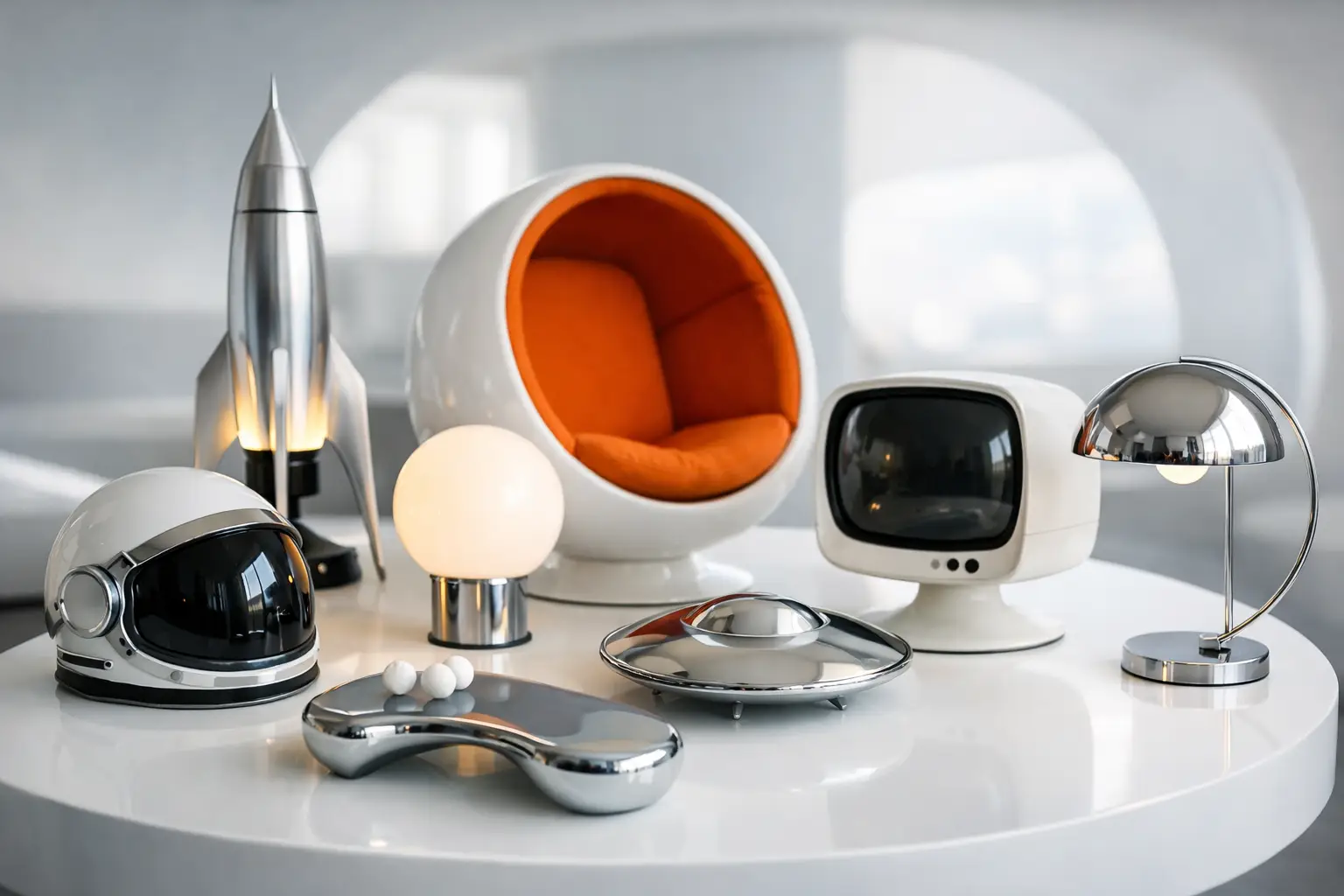
A Space Age object can change the temperature of a room before it changes anything else. A chrome arc lamp, a molded plastic chair, or a mushroom-shaped table lamp introduces a vision of the future as it was imagined between the late 1950s and the 1970s: optimistic, aerodynamic, tactile, and slightly unreal. These are not simply retro furnishings. At their best, they are compact declarations of design history.
For collectors and interiors with a point of view, Space Age design offers something rarer than nostalgia. It combines sculptural presence with a genuine material revolution, when fiberglass, acrylic, ABS plastic, polished steel, and new foams allowed designers to reject the conventional silhouette of domestic furniture.
What Defines Space Age Design?
Space Age design emerged alongside the space race, mass media, industrial innovation, and a widespread fascination with lunar travel. Its language drew from rockets, satellites, pods, helmets, and planetary forms, but its appeal was never limited to literal science fiction. The most successful pieces feel abstract rather than themed.
Look for low, rounded profiles; continuous, flowing lines; glossy surfaces; suspended elements; and forms that appear to float. A chair may resemble a capsule. A lamp can evoke a luminous globe or a hovering disc. Even ordinary household objects, from clocks to magazine racks, were reimagined with a new sense of speed and weightlessness.
Color was equally expressive. White, silver, black, tomato red, bright orange, acid green, and deep blue all appeared in the era’s interiors. Yet a Space Age room was not necessarily loud. A white fiberglass lounge chair or a smoked acrylic pendant can be remarkably restrained when surrounded by warm wood, limestone, or textured upholstery.
Beyond the cartoon version of the future
The category is often reduced to novelty furniture and exaggerated pop imagery. That overlooks its serious design contribution. Space Age designers were investigating new methods of production, modular living, and the relationship between the human body and the object. The era produced playful forms, certainly, but it also produced rigorous experiments in ergonomics, light diffusion, and compact urban living.
This distinction matters when choosing a piece. An authentic period object usually has a clarity of proportion and construction that separates it from a generic futuristic imitation. The shape may be dramatic, but it was designed to be used.
The Materials That Made the Space Age Possible
New materials were central to the movement, not a decorative afterthought. Fiberglass offered strength in thin, sculpted shells. Molded plastic made fluid curves more accessible to industrial production. Acrylic introduced transparency and color without the visual weight of traditional furniture. Chrome and lacquered metal brought reflectivity, precision, and a machine-age finish.
These materials also create the particular aging patterns collectors should understand. Fiberglass can develop a soft patina, small chips along an edge, or faint yellowing in white finishes. Acrylic may show fine surface scratches, while chrome can reveal pitting or oxidation where moisture has been present. Such signs are not automatically defects. On a well-preserved vintage piece, they can be evidence of age and originality.
Condition should be evaluated in relation to rarity, use, and price. A minor scratch on a common acrylic accessory may be reason to pass. A discreet repair to a scarce Italian lamp, especially when the original shade and structure survive, can be entirely acceptable. The important question is whether the object still communicates its intended form with integrity.
Italian Space Age Design Has Its Own Character
Italian design gave the Space Age a more sensual and theatrical dimension. Where some Northern European interpretations favored strict geometry, Italian makers often embraced expressive curves, dramatic lighting, and a sophisticated relationship between industrial materials and domestic elegance.
This is especially visible in lighting. Chrome domes, opaline globes, enameled metal shades, and smoked glass transformed illumination into sculpture. A ceiling fixture was no longer meant to disappear into a room. It could become the room’s visual center, casting reflected light across lacquer, glass, and metal.
Italian production also blurred the boundary between furniture and environment. Modular seating systems, sculptural lounge chairs, and compact bar furniture were conceived for a social, modern interior. Their forms invite arrangement rather than permanence. A single statement piece can work in a contemporary apartment, while a larger grouping creates a more immersive period atmosphere.
Murano glass belongs to this broader conversation when its form moves away from ornament and toward volume, translucency, and experimental color. A handblown globe or organic glass pendant can soften the harder edges of plastic and steel without losing the period’s forward-looking spirit.
How to Recognize an Authentic Period Piece
Authentication begins with observation, not with a label. Markings are valuable, but many legitimate pieces have lost stickers, paper labels, or original documentation over decades of use. Construction, materials, and proportion often tell a more complete story.
Examine the underside, the interior of a lamp shade, the base of a chair, and the hardware. Original components may include molded manufacturer marks, embossed logos, old electrical fittings, period screws, or specific production codes. A seller’s description should identify materials, dimensions, condition, and any known attribution with precision rather than relying only on broad phrases such as “vintage style.”
Be alert to mismatched elements. A later cord does not necessarily diminish a lamp, since rewiring is often sensible for safe domestic use. A replaced shade, non-original base, or newly applied metallic coating has greater impact because it changes the design itself. Ask whether a restoration preserves the object’s character or disguises its history.
Scale is another useful test. Many Space Age pieces look modest in photographs yet occupy a surprising amount of visual space. Before acquiring a large pendant or a low, circular sofa, measure not only the floor area but also sightlines, ceiling height, and clearance around the object. The best purchase is not merely authentic. It has to make sense in its next setting.
Styling Space Age Pieces Without Creating a Set
A room built entirely from one decade can feel theatrical, and sometimes that is exactly the intention. More often, a selective approach gives Space Age design greater impact. Let one object take the lead, then support it with quieter materials and forms.
A chrome and glass coffee table gains depth beside a walnut sideboard. A white molded chair becomes more sculptural against plaster walls, dark oak flooring, or a restrained wool rug. A vivid orange lamp can animate a neutral bedroom without turning it into a period set. The tension between the object’s futuristic curve and the room’s more enduring surfaces is often where the composition becomes interesting.
Lighting deserves particular care. Reflective finishes and colored acrylics respond dramatically to their surroundings, so the same lamp can look crisp in daylight and cinematic after dark. Use bulbs with an appropriate warmth for the material: overly cool light can make a refined chrome or Murano piece feel clinical, while excessively warm light may flatten a clear acrylic form. It depends on the finish, the room, and the mood you want the object to create.
Avoid crowding several competing silhouettes into a small area. Space Age design needs visual breathing room. A single pendant over a dining table, one sculptural floor lamp beside a low chair, or a pair of compact wall lights can carry more presence than an accumulation of unrelated futuristic accessories.
Collecting for Character, Not for a Theme
The strongest collections are guided by discernment rather than a checklist. Some buyers seek iconic designer names; others respond to anonymous Italian production, unusual materials, or an exceptional line. Both approaches are valid. Attribution can affect market value, but an unsigned object with outstanding form, quality, and condition may offer more decorative distinction than a more familiar model.
Consider the role the piece will play. Is it a focal point, a functional daily object, or a small collectible accent? A rare lamp may deserve a prominent position and careful handling. A molded side chair can be used freely, provided its structure is sound. Knowing this before buying makes it easier to judge wear, restoration, and investment.
At Sound Of Vintage Italy, the value of this period lies in that balance: objects selected not because they imitate a future once imagined, but because they still make an interior feel unexpectedly alive. Choose the piece whose material, silhouette, and light continue to hold your attention after the first glance. That is usually the one with a future in your home.