
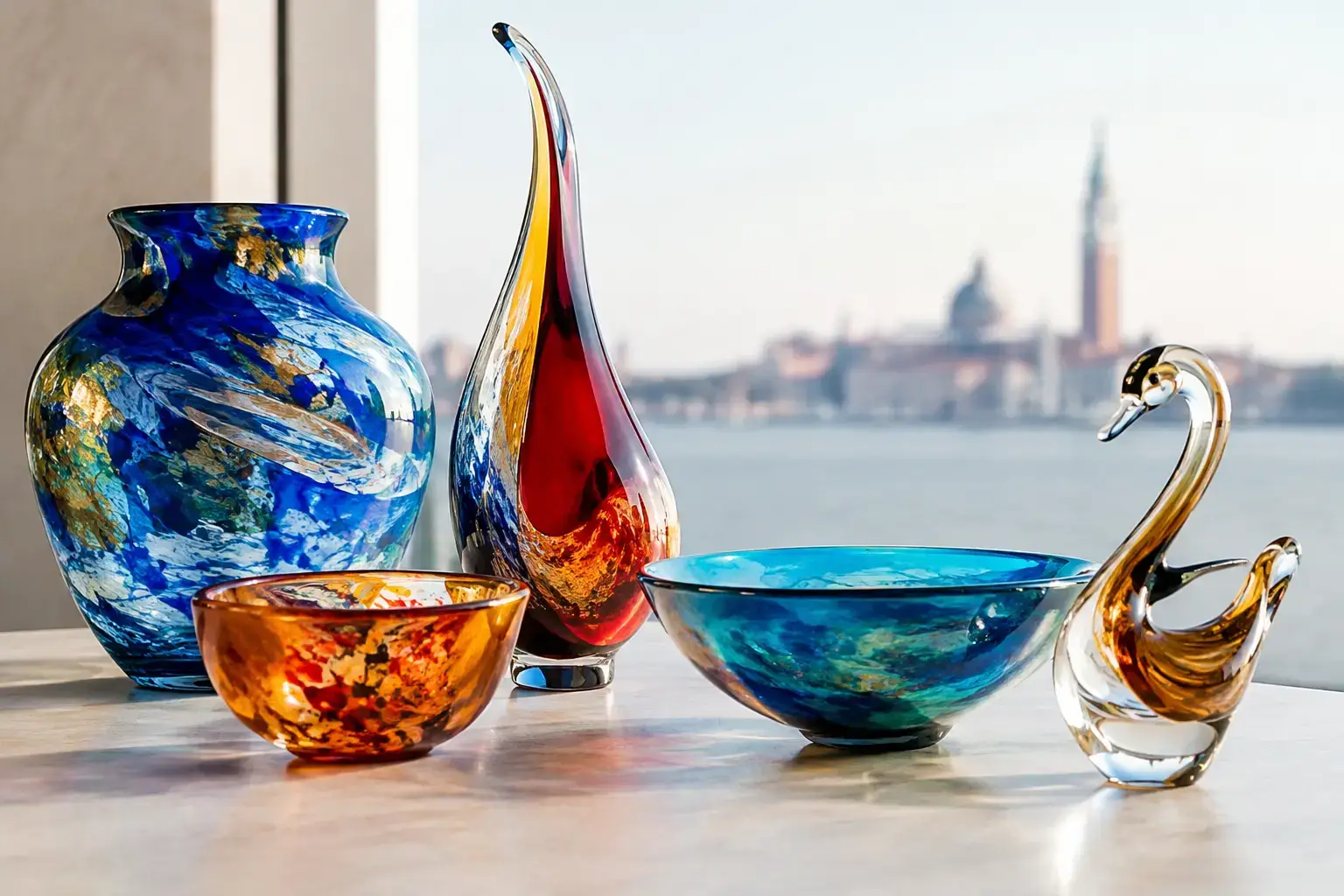
A Murano chandelier can fill a room before it is even lit. A hand-blown vase may hold its own on a restrained console, while a set of colored glasses introduces a precise note of Venetian character to a table. The Murano glass market is built on this dual appeal: these are functional objects, but also expressions of technique, design history, and individual taste.
For collectors and design-minded buyers, the category is particularly compelling because it offers enormous variety. A 1930s sculptural vase, a Mid-Century opaline pendant, and a late twentieth-century figurative object can all be authentically Murano, yet belong to very different visual and commercial worlds. Knowing what separates decorative glass from a significant piece is what makes the search rewarding.
The Murano Glass Market Is Not One Market
“Murano glass” describes a place of origin and a tradition, not one aesthetic. For centuries, the island’s furnaces developed techniques that became recognizable far beyond Venice: lattimo, or milk glass; filigree; murrine; aventurine; sommerso; pulegoso; and richly worked blown forms. The market today includes antique Venetian glass, twentieth-century studio production, iconic lighting, tableware, sculpture, and contemporary work.
That breadth creates opportunity, but it also requires discernment. A buyer looking for a dramatic 1960s fixture is assessing different qualities than someone seeking an eighteenth-century goblet or a rare Art Deco vase. Age alone does not determine desirability. Design, craftsmanship, condition, rarity, and the authority of a model or maker must be considered together.
The strongest pieces tend to have a clear visual identity. They may be quiet and refined, such as a finely proportioned translucent vase, or emphatic, such as a monumental amber and cobalt chandelier. In both cases, the object should feel resolved: its color, silhouette, scale, and technique should work as one.
What Creates Value in Murano Glass
In the Murano glass market, provenance matters because it gives context to beauty. A label, engraved signature, archival attribution, or documented history can strengthen a piece’s position considerably. However, the absence of a label does not automatically make an object unimportant. Labels are often lost, especially on older lighting and objects that have changed hands over decades.
Attribution should instead rest on a thoughtful reading of several details: the construction, the quality of the glass, the use of color, the finishing of the pontil, the hardware on lighting, and the comparison with known examples. Certain houses and designers have particularly strong recognition among collectors, including Venini, Barovier & Toso, Seguso, Mazzega, Archimede Seguso, Alfredo Barbini, Carlo Nason, and Ercole Barovier. Yet a lesser-known workshop can still produce an exceptional object.
Technique has a direct impact on value, especially when it is difficult to execute or visibly accomplished. Controlled bubbles in pulegoso glass, layered color within sommerso forms, or intricate cane work require skill that cannot be reduced to surface decoration. Look closely at transitions in the glass. Are colors cleanly integrated? Is the form balanced? Does the texture feel intentional rather than accidental? Fine Murano work rewards close viewing.
Scale also changes the equation. Large chandeliers, tall floor lamps, substantial mirrors, and sculptural centerpieces can command attention because they are difficult to source, ship, and place. Still, smaller objects should not be underestimated. A rare tumbler, a compact vase with an unusual murrine pattern, or a pair of wall sconces can be the most intelligent choice for an interior that favors precision over spectacle.
Condition Is Part of the Object’s Story
Glass is vulnerable, and condition has an immediate effect on desirability. Chips, cracks, repairs, clouding, and heavy scratches should be evaluated honestly. With lighting, buyers should also inspect the metal structure, the wiring, the fit of individual elements, and whether replacement parts have been introduced.
The answer is not always to reject a piece with wear. A scarce historical work may remain worthwhile despite minor evidence of age, particularly where the damage is stable and does not compromise the object’s structure or visual presence. Conversely, a common vase with a prominent rim chip may have little collector value. It depends on rarity, price, and how the object will be used.
For chandeliers, completeness is especially important. Missing flowers, leaves, arms, or pendants can alter both silhouette and value. Replacements are sometimes possible, but a restoration should be disclosed and judged according to quality. A sympathetic repair preserves an object’s life; an obvious mismatch can distract from it.
Recognizing Authenticity Without Reducing It to a Sticker
The broad popularity of Venetian glass has brought copies and loosely described pieces into the market. A paper label reading “Murano” is useful evidence, not final proof. Labels can be reproduced, misplaced, or added later. Equally, an unlabeled piece may be entirely authentic.
A considered purchase begins with observation. Authentic hand-blown glass may show small variations in thickness, tiny air bubbles, tool marks, and slight asymmetry. These are often signs of handwork, though they are not guarantees by themselves. The quality of the overall design is more revealing than one isolated detail.
Be cautious of descriptions that rely only on a generic label such as “Murano style.” This phrase can be visually useful but says nothing definite about origin. Ask whether a work is attributed to a named maker, whether it retains original labels or signatures, and whether the seller can describe the dating rationale. Clear language is a mark of serious curation.
Photographs should show more than the most flattering angle. For objects, seek images of the base, rim, interior, and any signature or label. For lighting, look for the ceiling canopy, fittings, arms, wiring, and close views of decorative elements. A well-presented listing does not conceal the practical parts of a beautiful object.
Design Periods That Shape Demand
Different periods speak to different interiors. Early twentieth-century Murano often carries an ornamental elegance suited to Art Nouveau and Art Deco settings. Its appeal lies in pattern, formal richness, and carefully controlled color.
Mid-Century Murano is often more architectural. From the 1940s through the 1970s, designers explored organic forms, acid colors, opaline surfaces, asymmetrical silhouettes, and modular lighting. These works sit naturally beside Italian modernist furniture, brass, travertine, and lacquered wood. They are also remarkably adaptable in contemporary homes, where one strong vintage glass piece can offset a room that feels too calculated.
Later twentieth-century glass can be more experimental or sculptural, with bolder scale and expressive form. It may be less universally collectible than canonical Mid-Century work, but that can make it an excellent field for buyers with an independent eye. The right piece does not need to follow a trend to establish a room’s character.
Buying for an Interior, Not a Display Case
A collector may pursue a named designer, a rare technique, or a defined period. An interior buyer has another question: what role should this object play in the room? The best answer often starts with scale and light.
A clear or pale opaline fixture can soften a dark dining room without competing with artwork. A deeply colored Murano vase works particularly well against neutral plaster, stone, or walnut, where its color has room to register. A pair of sconces can introduce symmetry to a hallway or bedroom, while a single sculptural lamp creates a more informal focal point.
Avoid treating Murano glass as a compulsory symbol of luxury. Its greatest strength is personality. A room filled with many competing pieces may diminish the impact of each one. Often, one chandelier with unusual hand-blown elements, or one exceptional vase placed with restraint, is more memorable than a collection arranged without hierarchy.
At Sound Of Vintage Italy, the appeal of Murano lies precisely in this ability to connect collectible design with lived-in interiors. The most compelling works are not merely preserved examples of the past. They remain visually active objects, capable of changing the atmosphere of a room.
A Market Guided by Knowledge and Taste
Prices in the Murano glass market can vary widely, from accessible decorative pieces to museum-level lighting and rare signed forms. The difference is not always immediately visible to an inexperienced buyer. That is why buying with a defined point of view is more useful than chasing the lowest price or the most familiar name.
Choose pieces whose design you would value even if the market shifted. Confirm condition, ask precise questions about attribution and restoration, and consider the object in relation to your space. The right Murano glass work will bring more than Venetian glamour: it will add color, material depth, and a distinct sense of authorship to the everyday view.