
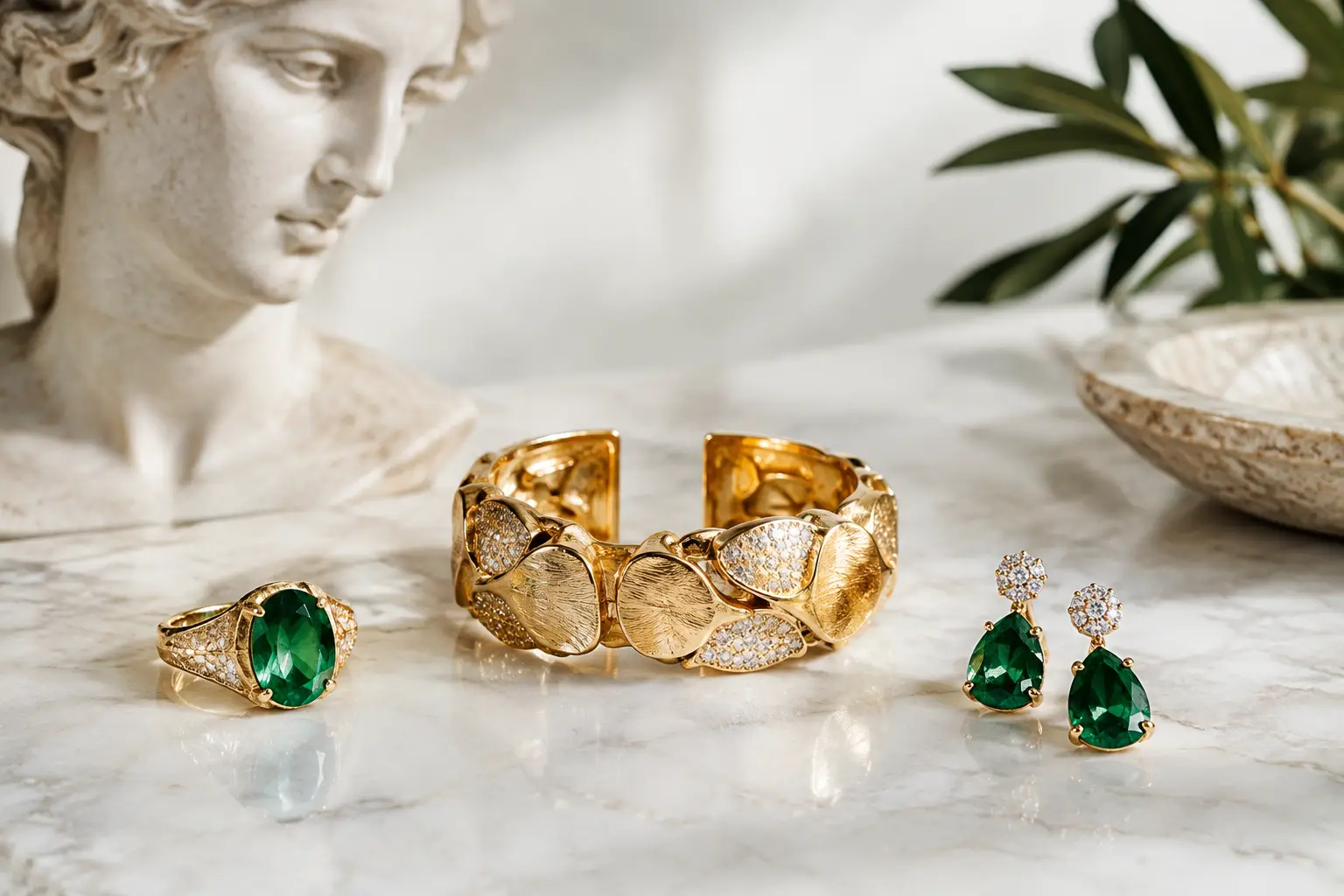
A vintage jewel is never only an accessory. It is a small-scale object of design: a study in proportion, material, light, and gesture. The most compelling Italian jewelry designers understood this instinctively, creating pieces that could hold their own beside Murano glass, a lacquered Art Deco cabinet, or the clean geometry of a 1970s interior.
For collectors, the appeal is not limited to precious metal or gemstones. Italian jewelry carries the visual language of its era. It may be architectural and emphatic, sensual and fluid, deliberately irregular, or impeccably crafted in a tradition that favors surface, color, and volume. The right piece introduces character without looking merely decorative.
Why Italian Jewelry Has a Distinct Design Language
Italian design has long resisted the idea that luxury must be quiet. From Roman high jewelry to postwar Milanese modernism, there is a recurring appetite for strong silhouettes, unexpected material pairings, and a confident relationship with color. Gold is treated not just as a store of value, but as a tactile surface: woven, engraved, hammered, brushed, coiled, or shaped into a sculptural form.
This is one reason vintage Italian jewelry remains so relevant in contemporary wardrobes. A bold 1960s gold bracelet can look remarkably current against a sharply cut jacket. A biomorphic ring from the 1970s brings warmth to a restrained monochrome look. Even when a piece is clearly of its time, it often possesses a clarity of form that keeps it from feeling dated.
There is also a regional character worth recognizing. Rome tends toward theatricality, high color, and a more sensual approach to precious stones. Milan often speaks a cleaner, more industrial modernist language. Florence is associated with exceptional goldsmithing and a reverence for handwork. Venice contributes its affinity for glass, ornament, and historical fantasy. These are not rigid divisions, but useful cues when reading a piece.
Italian Jewelry Designers Who Shaped Collecting Taste
Bulgari and the Roman appetite for color
Bulgari is inseparable from the visual drama of Roman jewelry. Its most recognizable mid-century creations favor cabochon-cut stones, rich chromatic contrasts, yellow gold, and assertive volume. The house helped make colored gems feel less formal and more expressive, often pairing materials that a conventional jeweler might have kept apart.
For vintage collectors, Bulgari is significant because its design vocabulary is immediately legible. Serpentine forms, coin jewelry, domed rings, and saturated gems do not disappear into an outfit. They become the focal point. That same visual conviction makes authentic examples especially desirable, but also calls for care: signatures, construction, condition, and documented provenance matter greatly in a category with substantial value.
Buccellati and the art of the gold surface
Buccellati represents another Italian ideal: goldsmithing as texture. Rather than relying solely on the brilliance of gemstones, the house developed an elaborate language of hand-engraved finishes, including the fine, silk-like effect often associated with its signature rigato engraving. Leaves, lace-like openwork, animal forms, and Renaissance references are rendered with extraordinary delicacy.
A Buccellati piece is best appreciated at close range. It rewards attention in the way an engraved silver object or finely worked antique frame does. This is jewelry for collectors drawn to craftsmanship that remains visible, rather than concealed beneath a polished, uniform surface.
Pomellato and the modern Milanese gesture
Founded in Milan in 1967, Pomellato brought a more democratic, fashion-aware sensibility to fine jewelry without abandoning material quality. Its early work often favored rounded forms, heavy gold, colored stones, and an ease that suited everyday wear. The proportions were generous but not ceremonial.
Vintage Pomellato is particularly appealing to those who want a recognizable design voice with a relaxed presence. A substantial chain, a softly domed ring, or a colored-stone jewel can bring weight to a collection while remaining eminently wearable. It is a useful bridge between the formal tradition of high jewelry and the freer attitude of late 20th-century design.
Marina B and jewelry as graphic composition
Marina Bulgari, working under the name Marina B, developed a more graphic and often playful language in the late 20th century. Her work is known for vivid color, geometric motifs, strong linear contrasts, and pieces that treat the body almost as a setting for abstract composition.
The best examples have the clarity of Memphis-era design without becoming novelty objects. They are precise, bold, and often surprisingly versatile when worn with simple clothing. For collectors of postmodern interiors, Marina B jewelry offers a natural parallel: a compact object with a defined point of view and no interest in anonymity.
Vhernier and sculptural restraint
Vhernier, founded in Valenza in 1984, is a later expression of Italian jewelry design, but its importance lies in how clearly it translates sculpture into wearable form. The house is recognized for smooth, sensual volumes, unusual stone combinations, and a visual language that feels controlled rather than ornate.
Its pieces demonstrate that statement jewelry does not require excessive detail. A curved band of gold or a precisely cut stone can create impact through proportion alone. This approach suits collectors with a preference for modernist furniture, Italian lighting, and objects whose quality is sensed before it is explained.
Beyond the Major Houses: What Makes a Vintage Piece Worth Seeking
The most rewarding discoveries are not always the most widely advertised names. Italy has supported generations of independent workshops, regional goldsmiths, and lesser-known makers whose work reflects the character of a specific decade. A signed jewel from a small Milanese atelier, a Florentine handworked gold brooch, or a Venetian glass-and-metal design can be more evocative than a familiar logo.
When evaluating these pieces, design should come before fashion. Ask whether the form has presence, whether the materials belong together, and whether the construction supports the visual idea. An oversized cocktail ring can be memorable because of its stone, but it may be more collectible because its setting has an unusual architectural tension. A simple gold chain may become exceptional through the rhythm of its links and the way it moves.
Condition remains essential, especially with articulated bracelets, enamel, glass, and softer stones. Minor signs of age can be appropriate in vintage jewelry, but damaged clasps, altered fittings, replaced stones, or severe wear may affect both value and usability. Hallmarks and signatures are helpful, though their absence does not automatically diminish an older handmade piece. In that case, workmanship, materials, and a credible provenance become more important.
How to Style Vintage Italian Jewelry With a Collector’s Eye
A strong jewel does not need to be matched too closely. In fact, its effect is often stronger when it introduces a measured contrast. A textured gold brooch can sharpen the line of a minimalist wool coat. Colorful stone earrings can bring life to a white shirt and tailored trousers. A sculptural bracelet can be worn alone, allowing its silhouette to read clearly.
The same principle applies at home. Jewelry deserves to be seen when it is not being worn. A carefully selected box, tray, or small mirrored surface can turn a few pieces into a personal still life. Placed near a Murano vase, a vintage lamp, or an Art Deco object, jewelry becomes part of a broader visual collection rather than something stored out of sight.
This relationship between adornment and interiors is especially natural for Italian design. Both disciplines value material presence: the reflectivity of metal, the depth of colored glass, the warmth of patina, and the tension between ornament and restraint. A jewel can echo the atmosphere of a room without attempting to coordinate with it literally.
Choosing Pieces That Will Remain Personal
The most lasting acquisitions are rarely the ones chosen only for a label or a trend. Look for a piece that has a distinct profile from across the room and a level of detail that holds attention up close. Consider how it sits on the body, how it catches light, and whether it carries the confidence of its period without becoming a costume.
For a first acquisition, a signed gold brooch, a substantial pair of earrings, or a ring with a single strong material idea often offers more versatility than an overly elaborate parure. For seasoned collectors, the interest may lie in an unusual maker, an early version of a recognizable design, or a jewel that connects to a larger collection of Italian decorative arts.
The most satisfying Italian jewelry does not ask to be saved for an occasion. It asks to be noticed, worn, and returned to – like any well-chosen vintage object with a history in its surface and a future in the life around it.