
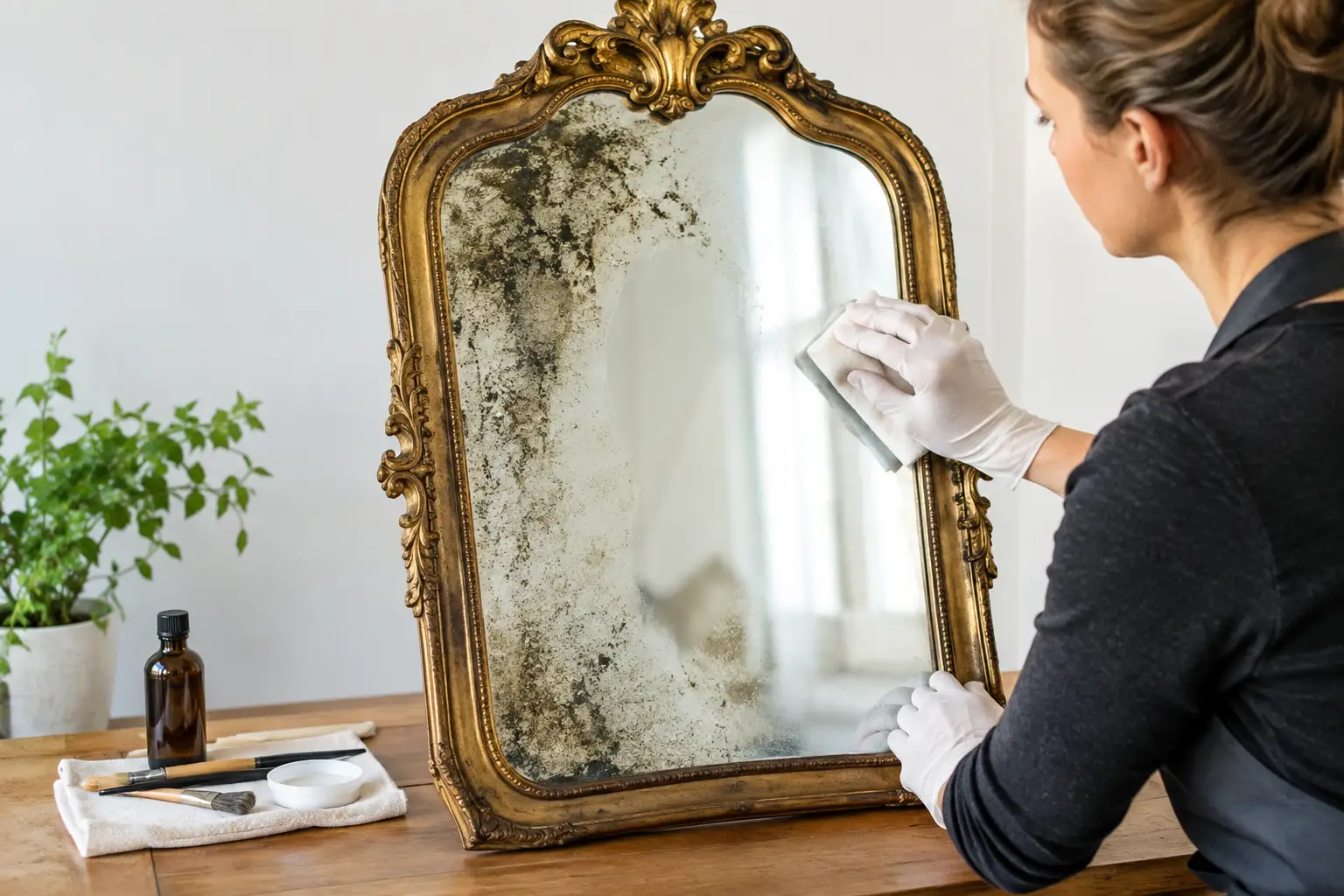
A foxed mirror surface, with its smoky edges and scattered points of silver loss, can be one of the most expressive details in an interior. It also raises a legitimate question for collectors and designers: can antique mirrors be restored without erasing the very qualities that make them desirable? Often, yes. But restoration is not automatically the right answer. The best decision depends on the mirror’s age, construction, rarity, condition, and intended role in a room.
An antique mirror is not simply a reflective panel in a decorative frame. It is an object made of distinct materials that have aged differently: glass, reflective backing, frame, gilding, wood, and sometimes an original rear board. Each carries evidence of time. Sensitive restoration respects that layered history rather than making the piece look newly manufactured.
What “Restoring” an Antique Mirror Can Mean
The word restoration covers several very different interventions. A frame may need structural stabilization while the mirror plate remains untouched. A loose gilded ornament may be reattached. Surface grime can be removed from carved wood or gilt composition. In more substantial cases, a damaged mirror plate can be repaired, replaced, or resilvered.
These options do not have the same effect on authenticity or value. Conservation aims to preserve original material and arrest deterioration. Restoration may include carefully integrated repairs that return the object to a more coherent visual state. Replacement, by contrast, changes an original component entirely.
For a rare eighteenth- or nineteenth-century mirror with a finely carved or water-gilded frame, preserving an original foxed plate is frequently preferable to fitting a flawless modern mirror. The soft, irregular reflection is part of its character. For a twentieth-century decorative wall mirror whose glass is badly delaminated and no longer functional, a new plate may be a sensible choice, especially if the frame remains the object’s principal artistic value.
The Mirror Plate: Patina, Foxing, and Resilvering
Most concerns begin with the glass itself. What is commonly called foxing is typically deterioration of the reflective layer at the back of the glass. It appears as dark specks, cloudy patches, pale areas around the perimeter, or a mottled, almost painterly surface. In older examples, this aging can be visually beautiful and entirely stable.
A conservator can clean the face of the glass, secure it safely within the frame, and improve its presentation. Yet cleaning cannot restore silver that has already disappeared from the backing. Attempts to scrub away marks from the front are one of the quickest ways to create scratches, haze, or irreversible damage.
Resilvering involves removing the existing backing and applying a new reflective coating. The result can be strikingly clear, but it also removes the original reflective surface. For a mirror valued chiefly as a decorative furnishing, that trade-off may be worthwhile. For an important period object, particularly one with early glass or a desirable degree of age, resilvering can reduce collector appeal.
There is also a technical distinction worth understanding. Very early mirrors may have been made with mercury amalgam, while later pieces generally used silvered glass. Mercury-backed mirrors require specialist handling. Their backing must never be scraped, sanded, or casually dismantled at home. Aside from the historic importance of the material, disturbed mercury residues can present a health risk.
When a New Mirror Plate Is the Better Choice
Replacement glass is often appropriate when an original plate is broken, extensively desilvered, warped beyond use, or clearly a later and poor-quality substitution. It can also be the practical answer for a large architectural mirror meant to bring light into a dark entrance hall, dressing room, or hospitality setting.
The choice of replacement matters. Standard modern mirror glass can appear too sharp and cold beside an eighteenth-century giltwood frame or an Art Deco surround. A restoration specialist may recommend antique-style glass with a warmer tone, subtle movement, or controlled aging. It should not imitate centuries of wear too theatrically. A convincing result is quiet: the frame remains the focal point, and the new plate supports it without pretending to be original.
Keep the original plate whenever possible, even if it is removed from active use. Documentation and retained components protect the object’s history and may matter to a future collector.
Restoring the Frame Without Over-Restoring It
The frame often holds the greater decorative and market value. Italian giltwood, neoclassical carved wood, Venetian glass, bamboo, brass, and Mid-Century Modern teak each require a different approach. A small repair that is correct in material and finish can be nearly invisible; a broad repaint or overly bright re-gilding can flatten the piece’s age and distinction.
Wood frames commonly suffer from open corner joints, old woodworm channels, veneer losses, or shrinkage cracks. These problems are usually repairable. A trained restorer can consolidate weakened areas, reglue joints, insert compatible timber where material is missing, and retain as much original surface as possible.
Gilt frames deserve particular restraint. Their darker recesses, rubbed high points, and small tonal shifts give gilding depth. Reapplying gold across an entire frame may make it look visually louder but historically less convincing. Localized retouching, careful cleaning, and stabilization are usually more elegant solutions.
For painted or lacquered frames, the same principle applies. The aim is not perfection. A few well-resolved signs of age allow an antique to sit naturally among contemporary furniture, Murano lighting, or sculptural modernist pieces. A mirror with honest patina often gives an interior more atmosphere than one restored to a uniform gloss.
How to Decide Whether Restoration Is Worth It
Before authorizing work, assess the mirror as a complete object. Provenance, style, construction, dimensions, and decorative quality all matter. A substantial hand-carved mirror with original water gilding may warrant a detailed conservation assessment even when the glass is compromised. A common late twentieth-century reproduction may have more practical than collectible value, making a straightforward repair more proportionate.
Consider these questions before proceeding:
- Is the glass original, and is its foxing attractive or distracting?
- Is the frame structurally sound, or does it require consolidation before hanging?
- Are the finish, gilding, hardware, and backboards original?
- Will the mirror be used as a decorative object, a functional reflective surface, or both?
- Does the projected cost reflect the piece’s quality, rarity, and place in the room?
Professional assessment is especially valuable for Venetian mirrors, giltwood examples, large pier mirrors, and pieces with elaborate appliqué ornament. It is also wise when a mirror has no obvious maker’s mark but shows signs of age, such as hand-cut glass, old joinery, or period hardware. A restorer can separate stable patina from active deterioration and identify earlier repairs that may need correction.
Care That Preserves Restoration Work
Once restored or conserved, an antique mirror needs calm, consistent care. Keep it away from direct moisture, major temperature swings, and heat sources. Bathrooms, damp basement rooms, and exterior-facing walls with persistent condensation can accelerate damage to reflective backing and wood.
Clean only the front glass with a soft, dry microfiber cloth or a cloth barely dampened with water. Do not spray liquid directly onto the mirror, because it can run behind the glass and attack the backing. Avoid ammonia-based products, abrasive powders, and household furniture polish on gilded, painted, or lacquered frames.
Hanging hardware deserves attention as well. Large antique mirrors can be unexpectedly heavy, and fragile old frames should not bear stress at weakened corners. Use professional-grade wall fixings suited to the wall structure, and allow enough support points to distribute the load. A beautifully restored mirror is only as secure as its installation.
A Restored Mirror Should Still Look Like It Has Lived
The strongest restoration is rarely the most conspicuous one. It allows the fine carving, the glow of old gilding, the cool depth of aged glass, or the clean geometry of a modernist frame to remain legible. It respects the difference between damage that compromises an object and patina that gives it presence.
For a collector, the original mirror plate may be worth preserving even when it reflects imperfectly. For an interior designer, a sensitively replaced plate may make a remarkable frame usable again. Both choices can be correct when they are made with knowledge, proportion, and respect for the piece. At Sound Of Vintage Italy, that distinction is central to looking at vintage objects not as disposable décor, but as lasting elements of a considered interior.