
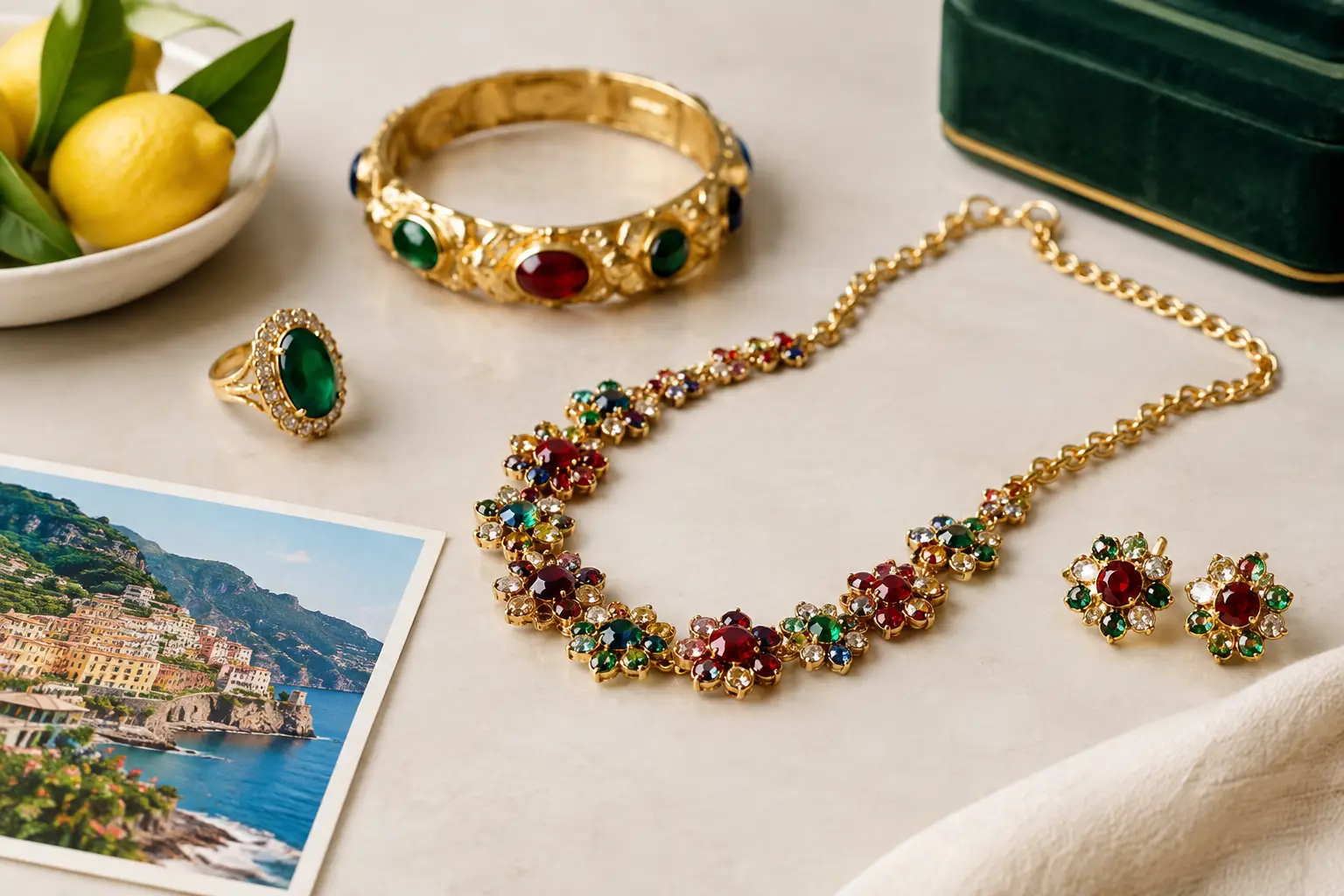
A strand of hand-worked glass beads can change the temperature of an entire room. The same is true of a sculptural resin cuff, a gilt-metal pendant with an unmistakable 1970s silhouette, or a pair of oversized earrings designed to be seen across a dining table. Italian costume jewelry brands occupy this expressive territory with particular confidence: jewelry made not to imitate fine jewelry, but to establish color, volume, texture, and presence.
For collectors, stylists, and lovers of vintage fashion, the appeal lies in more than decoration. Italian bijoux often carry the visual language of the country’s postwar design culture: Murano glass, architectural proportions, artisanal labor, theatrical color, and a refusal of understatement when understatement would be less interesting. A well-chosen piece can sit naturally beside a Mid-Century lamp, a Venetian mirror, or a sharply tailored black jacket because it shares the same sense of considered form.
What Defines Italian Costume Jewelry Brands
The term costume jewelry can be misleading. It simply distinguishes pieces made with non-precious materials from those made in gold, platinum, diamonds, or high-value gemstones. It does not mean careless, disposable, or without artistic merit. At their best, Italian examples are designed objects in miniature.
Italy’s strongest contribution to the category is its material imagination. Venetian glass beads, molded resin, enamel, rhinestones, polished brass, gilt metal, and simulated stones are treated as expressive elements rather than substitutes. A necklace may build its effect through the rhythm of irregular beads. A brooch may rely on a single unexpected combination of matte black resin and luminous glass. The value is visual, tactile, and cultural.
There is also no single Italian style. Milan brought a sophisticated, fashion-led vocabulary of graphic metalwork and bold accessories. Florence developed a tradition of artisan jewelry with references to Renaissance ornament and hand-finished metal. Venice contributed incomparable glassmaking expertise. Rome, meanwhile, provided the cinematic glamour and fashion-world drama that shaped many postwar pieces.
When evaluating a piece, provenance matters, but design matters too. A signed example can be easier to research and resell, while an unsigned necklace with exceptional glass, construction, and proportion may still deserve a place in a serious collection. The most interesting collections leave room for both.
Italian Costume Jewelry Brands and Makers to Know
Coppola e Toppo
Founded in Milan in the late 1940s, Coppola e Toppo remains one of the most recognizable names in Italian fashion jewelry. The house is especially admired for its dense constructions of glass beads, crystals, and elaborate woven arrangements. Many pieces appear almost textile-like from a distance, then reveal their intricate structure on closer inspection.
Coppola e Toppo jewelry belongs to the high-glamour side of Italian postwar design. Bib necklaces, multi-strand bracelets, and dramatic earrings were made to accompany couture rather than disappear into it. Colors range from clear crystal and smoky gray to saturated jewel tones, often with a depth that makes each piece feel more architectural than ornamental.
Condition is particularly important here. Check for missing beads, brittle thread or wire, loose clasps, and discoloration in metallic coatings. A small repair may be appropriate for a wearable piece, but extensive losses can weaken both visual impact and collector value.
Angela Caputi
Angela Caputi’s work is a different kind of Italian statement. Produced in Florence, her jewelry is known for bold resin forms, rich color, oversized links, and graphic, almost sculptural compositions. The designs often recall the confidence of 1940s and 1950s costume jewelry, interpreted with a modern eye for abstraction.
A Caputi necklace or bracelet works especially well for collectors who prefer material clarity. Resin is not pretending to be stone, and acrylic is not attempting to imitate glass. Their color and volume are the point. This makes the jewelry easy to place in a contemporary wardrobe, particularly with plain linen, black knitwear, white shirting, or minimalist tailoring.
Because the pieces are visually strong, scale should guide the purchase. A large necklace can become the central element of an outfit. Smaller earrings or a single bracelet may be the better choice for someone who wants the same aesthetic with less visual weight.
Ugo Correani
Ugo Correani occupies an important place at the meeting point of Italian jewelry and fashion history. His work, associated with major fashion houses and independent creative production, is often defined by its experimental silhouette. Think oversized metal earrings, sculptural cuffs, graphic forms, and accessories that frame the face or shoulder with deliberate drama.
Correani pieces are desirable not only as jewelry but as evidence of a particular fashion moment, especially the late 20th-century period when accessories became central to a designer’s visual identity. For this reason, attribution deserves care. Signatures, construction details, period references, and documented provenance all matter. A piece described as “in the style of” should never be valued or presented as a confirmed design.
De Rosa
De Rosa jewelry is cherished for its romantic, highly detailed approach. Floral motifs, enamel work, rhinestones, and ornate gilt-metal settings create pieces with a distinctly decorative character. The designs often feel more intimate than the broad geometric statements of Milanese fashion jewelry, making them appealing to collectors drawn to botanical forms and old-world ornament.
The line between Italian influence and international production can be complex with De Rosa, particularly across different periods. That complexity is not a flaw, but it does make careful reading essential. Look closely at markings, materials, and seller descriptions rather than relying on a name alone. Good vintage jewelry rewards attention to detail.
Fashion House Jewelry: Versace, Fendi, and Beyond
Vintage fashion jewelry from Italian houses can be highly collectible when it clearly reflects a recognizable design language. Versace, for example, is associated with baroque motifs, Medusa imagery, bold chains, and a maximalist use of gold tone. Fendi and other Italian fashion houses have also produced accessories that belong as much to fashion history as to jewelry collecting.
These pieces can command strong prices, but branding alone should not settle the question of value. Examine plating wear, rhinestone replacement, earring backs, clasps, and authenticity marks. The most desirable examples have a direct visual connection to the era that produced them. A pair of 1990s earrings should feel like the 1990s, not like a generic imitation with a logo.
Murano Glass: The Venetian Difference
Murano glass deserves separate attention because it gives Italian costume jewelry a material signature that cannot be reduced to a label. Lampwork beads, millefiori patterns, gold-flecked glass, and hand-shaped forms introduce small variations that are part of the appeal. No two beads need to be perfectly identical for a necklace to feel finished. In fact, slight irregularity can be evidence of handwork.
A Murano glass necklace can be quietly elegant or exuberantly decorative. Transparent beads may catch light like small vessels. Opaque examples can create blocks of color that read almost like modernist sculpture. Gold leaf suspended within the glass brings warmth without relying on metal plating.
Buy with a practical eye. Glass has weight, and heavier pieces should have a sound clasp and secure stringing. Inspect beads for chips near holes, where stress is most likely to appear. A few signs of age are expected in vintage jewelry, but cracks, sharp losses, or poorly matched replacement beads deserve a closer look.
How to Build a Collection with Character
The best place to start is not with a broad category but with a visual instinct. Some collectors respond to the shimmer and density of mid-century beadwork. Others prefer the unapologetic scale of resin jewelry or the polished excess of 1980s and 1990s fashion pieces. A collection becomes more coherent when it follows a point of view rather than a checklist.
Consider how jewelry will live alongside other objects. A deep cobalt Murano necklace can echo the glass of a vase or lamp. A gilt-metal cuff may pick up the warmth of a brass wall light. Black resin earrings can add punctuation to an Art Deco interior without making the room feel themed. The relationship between personal accessories and decorative objects is often more compelling than matching everything exactly.
Condition, authenticity, and wearability require a balanced judgment. Deadstock pieces with original tags can be appealing, but a gently worn necklace with a beautiful patina may have more presence. Restoration is appropriate when it preserves the design and is disclosed clearly. Over-polishing, replacement parts that alter the original silhouette, or undisclosed repairs are more problematic.
Storage also protects value. Keep pieces separate to prevent scratches, avoid prolonged direct sunlight, and never spray perfume directly onto plated metal, resin, or glass. For necklaces with older stringing, support the weight rather than hanging them for long periods.
Italian costume jewelry is at its most persuasive when it is treated as design rather than accessory alone. Choose the piece that makes you pause: the glass that holds the light differently, the cuff with the exact right weight, the unusual color that will return a little life to a favorite jacket or a carefully composed room. That instinct is often where a meaningful collection begins.