
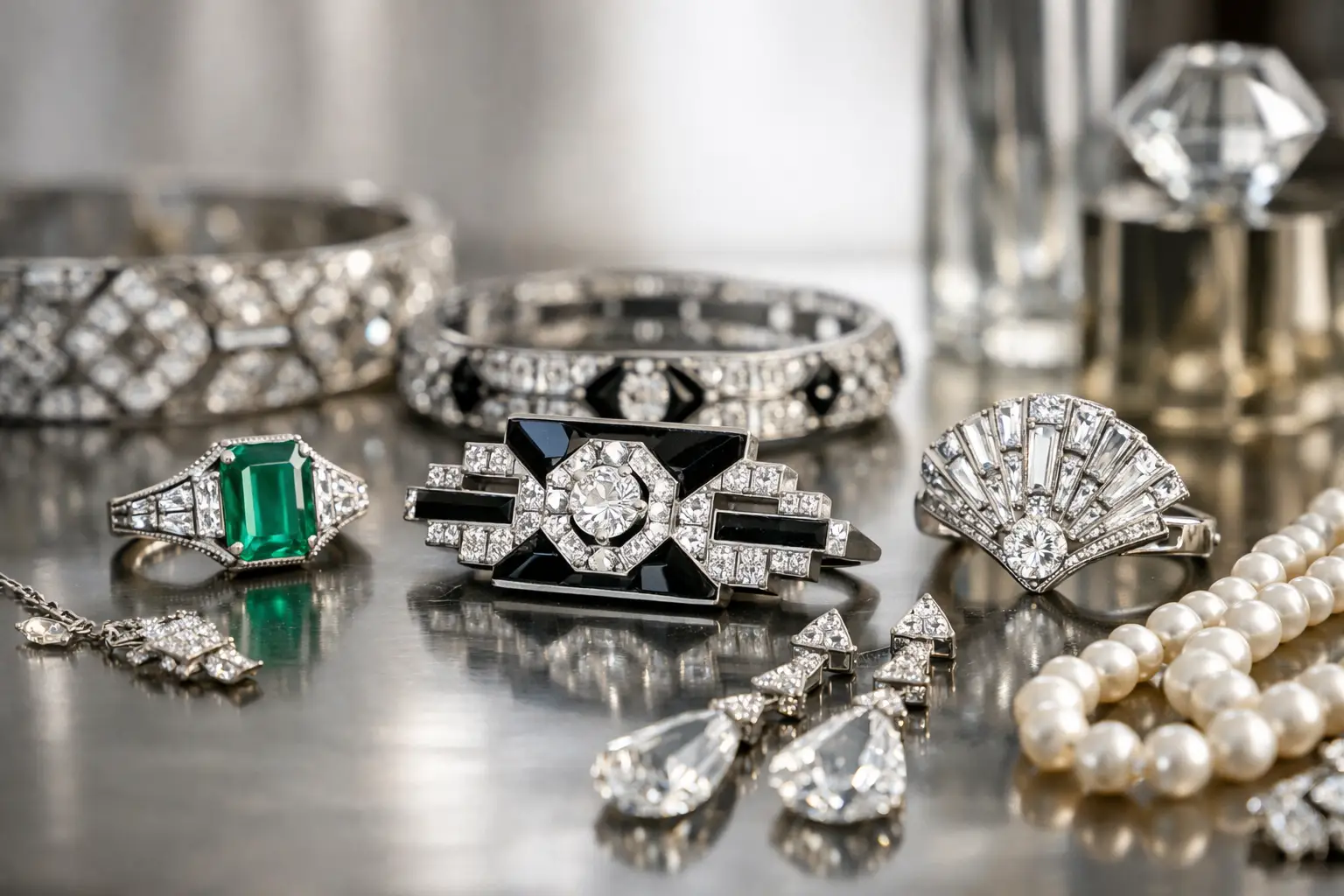
A platinum ring cut with sharp geometry, an onyx-and-diamond brooch, a jade pendant suspended from black enamel: Art Deco jewelry has a visual authority that needs little explanation. This Art Deco jewelry guide is for those drawn not only to its brilliance, but to the precision, material contrast, and cultural history held within each piece.
Created during the 1920s and 1930s, Art Deco jewelry belongs to an era that admired speed, architecture, travel, and modern craftsmanship. Its appeal remains remarkably current. A well-chosen period jewel can look as convincing with a tailored black suit as it does beside a marble vanity, a lacquer box, or a Murano glass object. The key is learning to recognize the difference between a true period piece, a later revival, and an item that merely borrows Deco motifs.
What Defines Art Deco Jewelry?
Art Deco did not emerge quietly. The style took its name from the 1925 Exposition Internationale des Arts Décoratifs et Industriels Modernes in Paris, an event that celebrated a new decorative language: streamlined, graphic, luxurious, and decidedly modern. In jewelry, that language translated into symmetry, bold silhouettes, and disciplined use of color.
The most recognizable pieces feature stepped forms, chevrons, sunbursts, fans, zigzags, and calibrated bands of stones. Unlike the flowing curves and botanical motifs of Art Nouveau, Art Deco design favors structure. Even a delicate bracelet often has the rhythm of a miniature skyscraper facade.
Contrast is central to the aesthetic. White diamonds and platinum were frequently paired with black onyx, while emerald, sapphire, ruby, jade, coral, and lacquer introduced saturated color. The result is rarely soft or sentimental. It is composed, architectural, and visually exact.
Art Deco Jewelry Guide: Materials That Matter
Material is one of the clearest ways to understand a piece’s quality, age, and intended place in the market. Platinum became especially important during the period because its strength allowed jewelers to create finely pierced settings and exceptionally light-looking structures around diamonds. White gold also appears, particularly in pieces made after the mid-1920s and in jewelry produced for a wider market.
Diamonds were often cut in ways that differ from the modern round brilliant. Old European cuts, single cuts, baguettes, trapezoids, triangles, and calibré-cut stones are all common in period designs. Calibré cutting deserves particular attention: small colored stones were precisely shaped to fit a geometric outline with almost no visible interruption. This technique required skill, planning, and significant labor.
Onyx is among the defining Deco materials, especially when used as a crisp dark frame for diamonds. Emerald, sapphire, and ruby bring a more opulent dimension, while carved jade, coral, rock crystal, and black enamel reflect the period’s fascination with materials and motifs from Asia, Egypt, and beyond. These influences can be beautiful, but they should be understood in their historical context rather than treated as interchangeable ornament.
Not every authentic Art Deco jewel is platinum and diamond. Silver, gold, marcasite, paste stones, and glass were also used to create striking accessories. A fine costume brooch from the era may have considerable decorative value even without precious gemstones. What matters is coherence of design, craftsmanship, condition, and provenance.
How to Tell Period Art Deco From Later Revival
Art Deco has been revived repeatedly, from the 1970s through contemporary fine jewelry collections. Revival jewelry can be beautifully made, but it should be described honestly. The collector’s value of a 1920s bracelet is different from that of a later ring designed in the same vocabulary.
Start with construction. Period pieces often reveal hand-finishing in the galleries beneath stones, openwork settings, hand engraving, and carefully articulated links. A modern piece may be cast more uniformly, with heavier proportions or machine-consistent details. This is not a rule without exceptions, but it is a useful first observation.
Then look at the stones. Antique-cut diamonds and hand-cut calibré gems can support a period attribution, though stones are sometimes replaced over time. A jewel with modern round brilliants is not automatically later, since repairs and alterations happen, but it calls for closer examination. Matching wear across the setting, clasp, and stones often tells a more reliable story than one detail alone.
Hallmarks can help, especially on European pieces, but they are not a complete answer. Marks may be worn, partial, added after a later modification, or absent on delicate settings. A maker’s signature can be highly desirable, yet unsigned jewelry from the period can be superb. When an attribution affects price materially, an independent appraisal or specialist opinion is a sensible part of the purchase.
Condition Is Part of the Object’s History
Vintage jewelry is meant to show its age differently from a newly made piece. Light surface wear, gentle softening at the edges of a setting, or a discreet repair may be entirely acceptable. In some cases, these traces are evidence that the jewel has been worn and preserved over decades rather than stored untouched.
The important distinction is between honest age and damage that compromises use or value. Examine clasps, hinges, pin stems, prongs, and the stability of articulated sections. In rings, check whether the shank has been thinned by years of wear or enlarged so extensively that the original proportions are distorted. In bracelets and necklaces, inspect for stretched links, replacements, or insecure closures.
Gemstones require the same attention. Emeralds and enamel are especially vulnerable to chips and fractures; onyx can crack along edges; carved jade and coral can be damaged by impact. Small replaced stones may be acceptable when the repair is sympathetic and disclosed. A large replacement that interrupts the original pattern changes the visual integrity of the piece.
Do not assume that restoration is always negative. A professional repair can make a fragile jewel wearable again. The trade-off is that extensive rebuilding, re-plating, or replacement of major elements may reduce collector interest. The best choice depends on whether the piece is being acquired as a historical object, a personal accessory, or both.
Choosing a Piece With Presence
For a first acquisition, a brooch, pendant, dress clip, or pair of earrings can offer the clearest introduction to the period. These forms often show Art Deco’s graphic identity without requiring the fit considerations of a ring or bracelet. A brooch with onyx and marcasite, for example, can bring immediate character to a lapel, silk scarf, or evening coat.
Rings are more intimate and often more expensive, particularly in platinum with diamonds and colored stones. Choose them for proportion rather than size alone. A compact geometric cluster can have greater presence than a larger but less resolved design. Art Deco rings were designed to be seen from across a room, yet their best examples retain balance when viewed close up.
If you collect decorative objects as well as vintage fashion, consider jewelry as part of a wider visual conversation. The clean line of a diamond-and-onyx bracelet can sit naturally beside a chrome lamp, a lacquered tray, or a sculptural Italian mirror. This does not mean turning jewelry into a display prop. It means recognizing the same pleasure in material, silhouette, and period sensibility across different categories.
Wearing Art Deco Jewelry Now
Art Deco jewelry does not require a costume approach. Its geometry is strongest when given room to register. A single substantial brooch on a plain wool jacket, an emerald-and-diamond ring worn with an unadorned dress, or black enamel earrings paired with a crisp white shirt can feel more deliberate than a crowded arrangement.
Mixing periods can work well, provided there is one clear focal point. A Deco bracelet beside a simple modern watch may be effective; several competing statement pieces usually dilute the design. Consider scale, metal tone, and the graphic strength of the jewel before adding more.
Care should be equally considered. Store pieces separately in a soft-lined box or pouch to prevent diamonds and metal edges from scratching softer stones. Avoid ultrasonic cleaning for emeralds, enamel, pearls, coral, glued settings, or jewels with uncertain repairs. A soft cloth and professional cleaning when needed are generally the more respectful approach.
The finest Art Deco jewel is not necessarily the most elaborate or the most famous. It is the one whose line, materials, and condition continue to feel resolved after the first flash of sparkle has passed. Choose with patience, ask precise questions, and let the piece earn its place in your collection.