
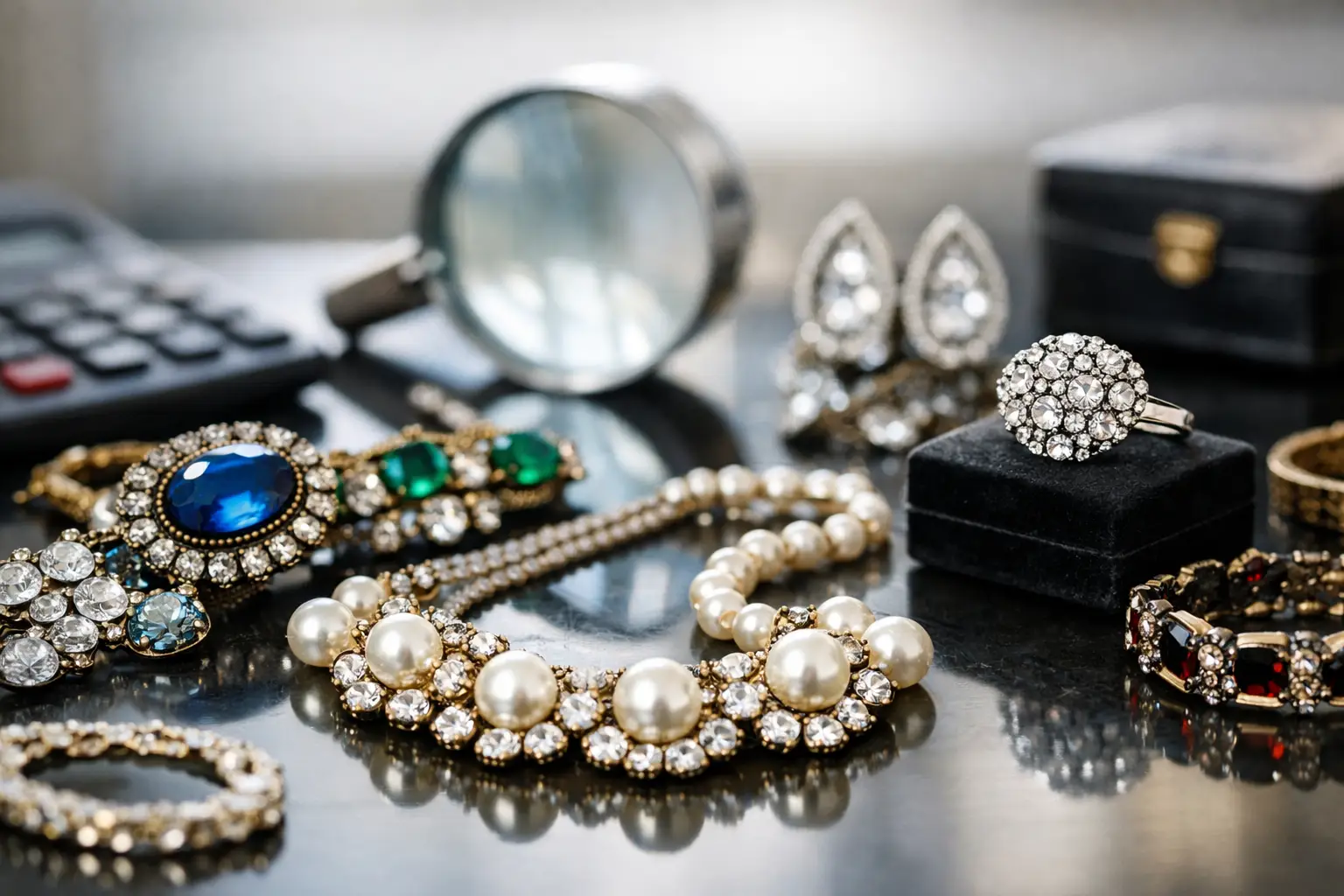
A rhinestone brooch can be worth far more than its base-metal construction suggests. The same is true of a sculptural bracelet in molded resin, a signed glass necklace, or a pair of earrings that perfectly captures the optimism of the 1960s. Costume jewelry value is not measured by intrinsic material alone. It lives in design, authorship, condition, rarity, and in the visual conviction of the piece itself.
For collectors and design-minded buyers, this is what makes vintage fashion jewelry so compelling. It offers a concentrated expression of an era: Art Deco geometry, Hollywood glamour, Mid-Century color, or the audacious scale of 1980s Italian design. A well-chosen piece does not need precious stones to carry presence.
What Determines Costume Jewelry Value?
The most valuable examples tend to combine several qualities rather than relying on one. A recognized maker can create immediate market interest, but a lesser-known piece with extraordinary construction and a distinct stylistic identity may be equally desirable. Conversely, a famous name cannot fully compensate for severe damage, missing components, or a design that is too common to feel special.
The first question is whether the jewel has a clear design language. Is it unmistakably of its period? Does it show a coherent use of materials, color, and proportion? A necklace with hand-set glass cabochons, a brooch constructed as a miniature architectural composition, or earrings with finely articulated metalwork often holds attention because every element has been considered.
Costume jewelry was designed to create effect. Its value often increases when that original effect remains intact: stones catch the light as intended, enamel retains its depth, and the clasp or setting feels substantial rather than merely functional.
Signature, maker, and attribution
A signature can be significant, particularly when it belongs to a respected house or designer. Names associated with American costume jewelry, French couture, Italian fashion, or Murano glass may carry strong collector appeal. The mark should be examined closely, however. Signatures can vary by production period, and a label alone is not proof of age, quality, or authenticity.
Unsigned jewelry deserves more attention than it often receives. During the twentieth century, many high-quality pieces were made for department stores, fashion houses, and private labels without a visible signature. Others lost their marks through wear or repair. In these cases, the workmanship becomes the evidence: the finish of the back, the quality of the clasp, the precision of stone settings, and the way individual components are assembled.
Attribution should remain disciplined. A piece that resembles a known maker is not necessarily by that maker. It is better to describe strong stylistic affinities than to turn resemblance into certainty. For a buyer, this distinction affects both price and long-term confidence.
Materials matter, but not in the obvious way
Glass, crystal, enamel, Lucite, Bakelite, resin, faux pearl, paste, and gilt metal belong to the vocabulary of costume jewelry. Their value comes from how they are used. Hand-blown glass, unusual color combinations, expertly molded plastics, and finely layered enamel can make a piece materially modest but visually exceptional.
Murano glass is a particularly expressive example. Beads with controlled inclusions, aventurine sparkle, gold leaf, or softly irregular handwork bring a level of artisanal character that cannot be reduced to raw-material cost. The same principle applies to early plastics: an original, beautifully carved Bakelite bangle may be more collectible than a generic jewel made with a higher-cost metal.
Materials also help establish period. Certain plastics, stone cuts, clasp types, and plating techniques can support a date range, especially when considered together. No single detail should be treated in isolation.
Condition and Costume Jewelry Value
Condition is where decorative desirability meets practical reality. Vintage jewelry was worn, stored, traveled with, and occasionally repaired. Minor signs of age can be compatible with value. A lightly softened gilded finish or gentle wear to a clasp may simply confirm that the object has lived a life.
The more serious concerns are missing stones, darkened or cloudy rhinestones, cracked enamel, warped metal, degraded faux pearls, damaged beads, and repairs that alter the original silhouette. On a piece built around symmetry, one replacement stone in the wrong color or cut can substantially change its impact. On a rare and highly collectible design, a professional period-appropriate repair may be acceptable, but it should always be disclosed.
Examine jewelry in daylight and from the reverse side. The back often reveals more than the front: solder work, corrosion, old glue, replacement fittings, and structural stress can all be easier to see there. Clasps, hinges, and clip mechanisms should function securely, although extreme care is needed with delicate early pieces.
Original presentation can add another layer of interest. A branded box, original card, purchase documentation, runway reference, or a clear family provenance may strengthen the story around a jewel. These additions do not transform an ordinary object into a rare one, but they can make a desirable piece more complete.
Rarity Is Not the Same as Scarcity
A piece can be scarce simply because few survived. That does not automatically make it wanted. Collectible rarity occurs when limited availability meets sustained interest: a sought-after designer, an iconic motif, a notable material, a fashion-house association, or a design that represents its decade with unusual clarity.
Some motifs return repeatedly to the market because they remain visually persuasive. Art Deco-inspired clips, figurative brooches, floral forms, bold cocktail earrings, and dramatic collar necklaces each have an established audience. Yet the strongest examples go beyond category. They feel balanced, inventive, and immediately recognizable from across a room.
This is also where fashion cycles matter. Jewelry with oversized proportions or colorful resin may rise in visibility when maximalist dressing returns, while delicate, restrained pieces may appeal to buyers seeking quiet period elegance. Trend interest can influence price, but it is less durable than quality. The piece with enduring value is usually the one that remains convincing after the trend has passed.
How to Judge a Piece Before You Buy
Begin with your eye, then verify what your eye has noticed. Look at the jewel as an object of design rather than as an accessory photographed against a white background. Does it have depth? Is the scale intentional? Are the materials integrated into a complete composition, or do they feel generic?
Then assess construction. Quality costume jewelry often has weight appropriate to its form, cleanly set stones, well-finished edges, and secure hardware. This is not a universal rule: some important period pieces are deliberately light, especially those made from plastic or delicate metal. The goal is not heaviness for its own sake, but coherence between material and design.
Ask whether all elements appear original. Mismatched earring backs, newer safety catches, inconsistent stones, or fresh adhesive deserve closer inspection. Alterations are not always disqualifying, particularly when a piece has been sensitively adapted for wear, but they should be reflected in the price.
Finally, consider the market with restraint. Online asking prices can be aspirational and often say little about actual transaction value. Compare like with like: the same maker, era, model, condition, and completeness. A signed example in excellent condition can belong to a very different price range from a similar-looking but damaged or later piece.
The Decorative Value Beyond the Price Tag
The most rewarding vintage jewelry has a life beyond the jewelry box. A graphic brooch can transform the lapel of a tailored jacket. A glass necklace can bring color to a quiet interior when displayed on a dressing table or mannequin form. A pair of sculptural earrings can establish the entire mood of an evening look.
This decorative dimension matters, especially for those who collect across fashion, lighting, glass, and furniture. The same eye that recognizes the rhythm of a Murano chandelier or the line of an Italian Mid-Century chair can recognize when a jewel has sculptural authority. It is a small object, but it can carry an entire visual world.
For that reason, the best purchase is not always the most expensive or the most visibly branded. Choose the piece whose materials, condition, and history support its price, but also the one that continues to command your attention. That sustained response is often the first sign that a jewel will remain valuable in your collection.