
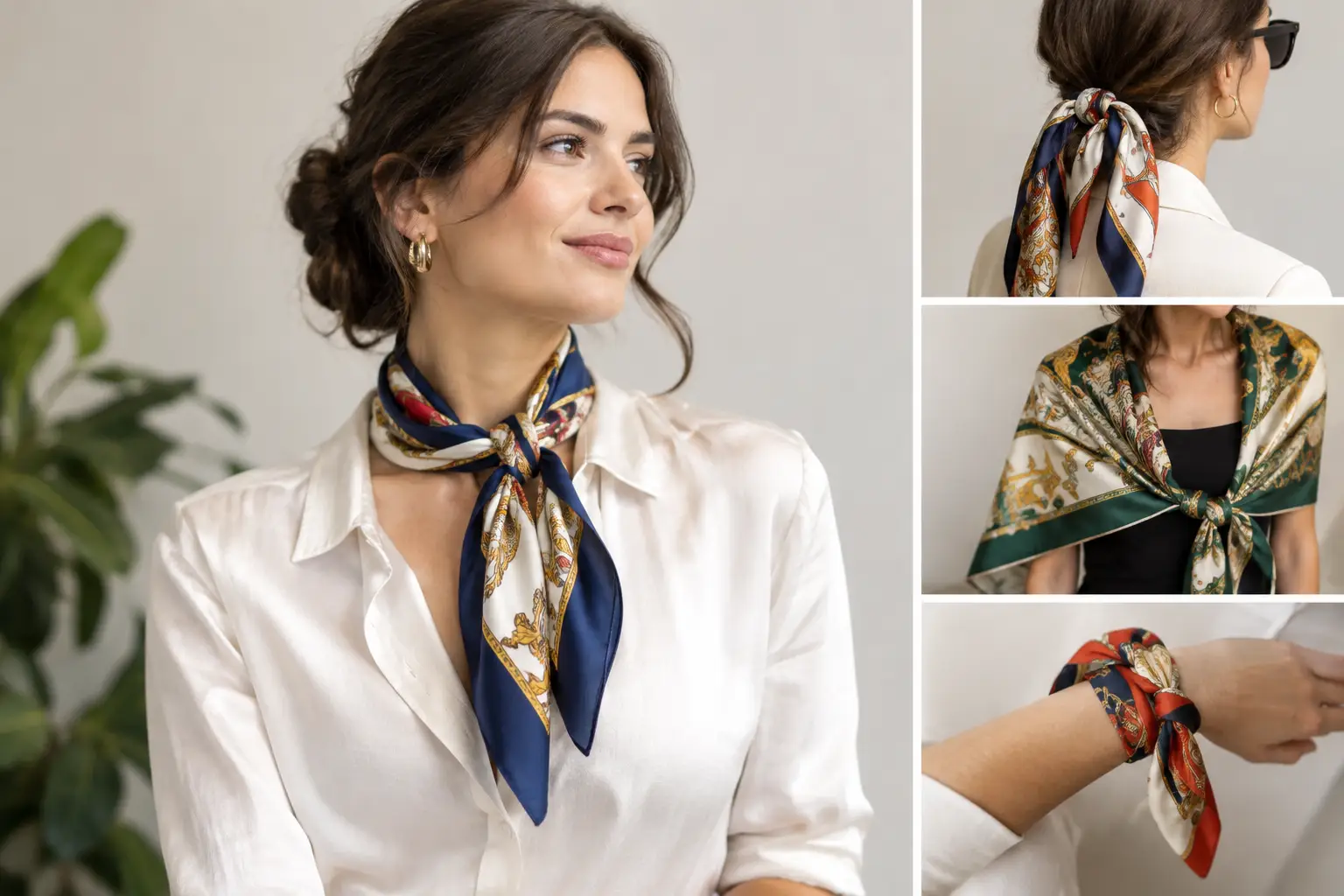
A vintage silk scarf should not be treated like a finishing touch chosen at the last minute. Its print, hand-rolled edge, and particular drape can set the tone for an entire look. Knowing how to wear vintage silk scarves means allowing the piece to remain visible, while giving it enough restraint to feel personal rather than costume-like.
The most successful styling begins with the scarf itself. A 1950s floral square, a geometric 1960s design, or a richly colored 1980s carré each carries a different visual language. Look closely at the palette, scale of the motif, and condition of the silk before deciding where it belongs. A scarf with an intricate equestrian or architectural print asks for clean clothing around it. A small, graphic pattern can withstand more texture and contrast.
Begin with the scarf’s proportions and character
Vintage silk scarves are often squares, but their dimensions vary considerably. A small 20-inch scarf works beautifully at the throat, in the hair, or tied to a bag. A classic 35-inch square has more presence and offers the most styling possibilities. Long silk rectangles, meanwhile, create a linear accent that suits tailored jackets and simple dresses.
The quality of vintage silk is part of its appeal. It has a softer surface than many contemporary scarves and may carry a slight patina from age. Do not try to force it into a sharply sculptural shape if the fabric wants to fall gently. Let the material guide the styling. A supple, light silk is ideal for a loose neck knot, while a heavier twill holds a more defined fold.
Color matters as much as construction. Rather than matching every tone in the print, choose one color to echo elsewhere in your outfit: the deep green in a botanical motif, a tobacco border, a small flash of coral. This creates coherence without turning the scarf into an accessory set.
How to wear vintage silk scarves around the neck
The neck remains the most natural place for a vintage silk scarf, particularly when the rest of the outfit is pared back. Fold a square scarf diagonally into a triangle, then roll it loosely from the pointed end toward the long edge. Tie it once at the side of the neck and leave the ends short. This approach feels polished with an open-collar cotton shirt, a fine knit, or a white T-shirt under a structured blazer.
For a more classic treatment, fold the scarf into a narrow band, wrap it once around the neck, and make a small centered knot. Keep the knot compact. The effect is most convincing when paired with a shirt collar, a crewneck sweater, or a coat with a clean neckline. It references mid-century elegance without becoming overly literal.
A triangle fold is a stronger choice for cooler months. Place the point at the front of the throat, wrap the ends around the neck, and either tie them beneath the triangle or let them fall at the back. With a camel coat, a navy pea coat, or a leather jacket, this styling gives a silk scarf enough visual weight to work as part of outerwear rather than as a delicate ornament.
There is a trade-off: elaborate knots can obscure exceptional prints. If the scarf has a compelling central illustration or a hand-painted border, use a loose drape or a simple bias fold instead. The goal is not to display every inch of silk at once, but to preserve the logic of the design.
With tailoring and tailored separates
A vintage scarf is particularly effective against precise tailoring. Wear a small square scarf under the collar of a white poplin shirt, tied low enough that the knot appears only when the jacket is open. Alternatively, place a narrow-folded scarf at the base of a V-neck vest or cardigan. It breaks up the formality of tailoring while retaining its refinement.
Avoid pairing a highly decorative scarf with an equally decorative jacket. If the silk features Art Deco geometry, choose a charcoal, cream, black, or navy suit with minimal texture. A patterned scarf and a patterned blazer can work, but only when one pattern is significantly smaller and quieter than the other.
Wear it in the hair without losing the print
Hair styling gives new life to smaller vintage silk squares, especially those with lively color or a playful motif. Fold the scarf diagonally, roll it into a band, and tie it around a low ponytail or chignon. Position the knot slightly off-center rather than directly above the elastic for a softer result.
A headband styling is equally effective, though it depends on the scarf’s condition. Use a scarf without fragile areas along its folds, since tension and friction can stress older silk. Wrap the band from the nape toward the crown and tie it underneath the hair or at the top in a discreet knot. This works best with loose waves, a low bun, or a sharply cut bob.
For a more restrained alternative, thread a narrow folded scarf through a braid or wrap it around the base of a bun. You still gain the color and texture of silk, but the print appears in small, considered glimpses. This is often the better choice when the scarf is rare, signed, or especially delicate.
Give a handbag more identity
Tying a vintage silk scarf to a handbag handle is one of the easiest ways to introduce a collectible textile into everyday dressing. A plain leather tote, top-handle bag, or structured satchel provides the best setting because it allows the scarf to become the focal point.
Use either a simple knot at the base of one handle or wrap the silk around the handle in a spiral, securing each end with a small knot. The first option keeps more of the print visible; the second adds color while protecting the leather from hand oils. For an exceptional scarf, a loose knot is preferable to a full wrap, which can hide much of the design and create unnecessary wear along the folds.
Consider the bag’s era as well as its color. A 1970s scarf with warm rust, ochre, and chocolate tones pairs naturally with cognac leather. A crisp 1960s optical print feels right against black, ivory, or lacquered accessories. Contrast can be striking, but it should feel intentional rather than accidental.
Use a scarf as a belt or waist accent
A larger square scarf can be folded into a broad band and worn through belt loops on trousers or tied over a simple dress. This is most successful when the silk is substantial enough to hold its shape and the garment has an uncluttered waistline.
On high-waisted denim or tailored trousers, leave one end longer than the other and place the knot slightly to the side. With a slip dress or column dress, tie the scarf at the natural waist and let a corner fall vertically. The effect is elegant, but not every vintage scarf should be used this way. Very fine silk can slip, and older fabric may not tolerate repeated pulling through belt loops.
If you want the same visual effect with less strain, knot the scarf over a narrow leather belt. The leather provides structure, while the silk adds softness and color. It is a useful solution for scarves with sentimental or collectible value.
Let the scarf speak to the rest of your wardrobe
Vintage accessories become modern when they are placed beside pieces of another era. A silk scarf with a 1940s floral print can look remarkably current with wide-leg jeans, a white tank, and understated gold jewelry. A vivid 1980s design becomes more sophisticated when worn with a sculptural black dress and simple loafers.
This balance matters. Wearing a vintage scarf with a vintage handbag, vintage dress, vintage gloves, and heavily styled hair can be beautiful for an occasion, but it can also feel too composed for daily life. Usually, one or two historic elements are enough. Let the scarf carry the narrative while the rest of the look supplies calm structure.
At Sound Of Vintage Italy, the appeal of a selected vintage accessory lies not only in its rarity but in its ability to enter a contemporary life without losing its history. A silk scarf can do precisely that: it is decorative, portable, and deeply individual.
Care for silk as part of styling it
A beautifully styled scarf loses its impact if the silk is creased, stained, or fatigued. Handle vintage pieces with clean, dry hands and avoid spraying perfume directly onto the fabric. Fragrance, hairspray, and skincare products can leave marks that are difficult to remove from older silk.
Store scarves flat when possible, away from direct sun and humidity. If folding is necessary, refold them occasionally so the same crease does not become permanent. For light wrinkles, use a low-heat iron with a clean pressing cloth, preferably on the reverse side. When in doubt, take a valuable or fragile scarf to a specialist textile cleaner rather than attempting a home wash.
The right vintage silk scarf does not need a complicated outfit or a theatrical knot. Choose one placement, allow the print room to breathe, and wear it often enough that its history becomes part of your own.