
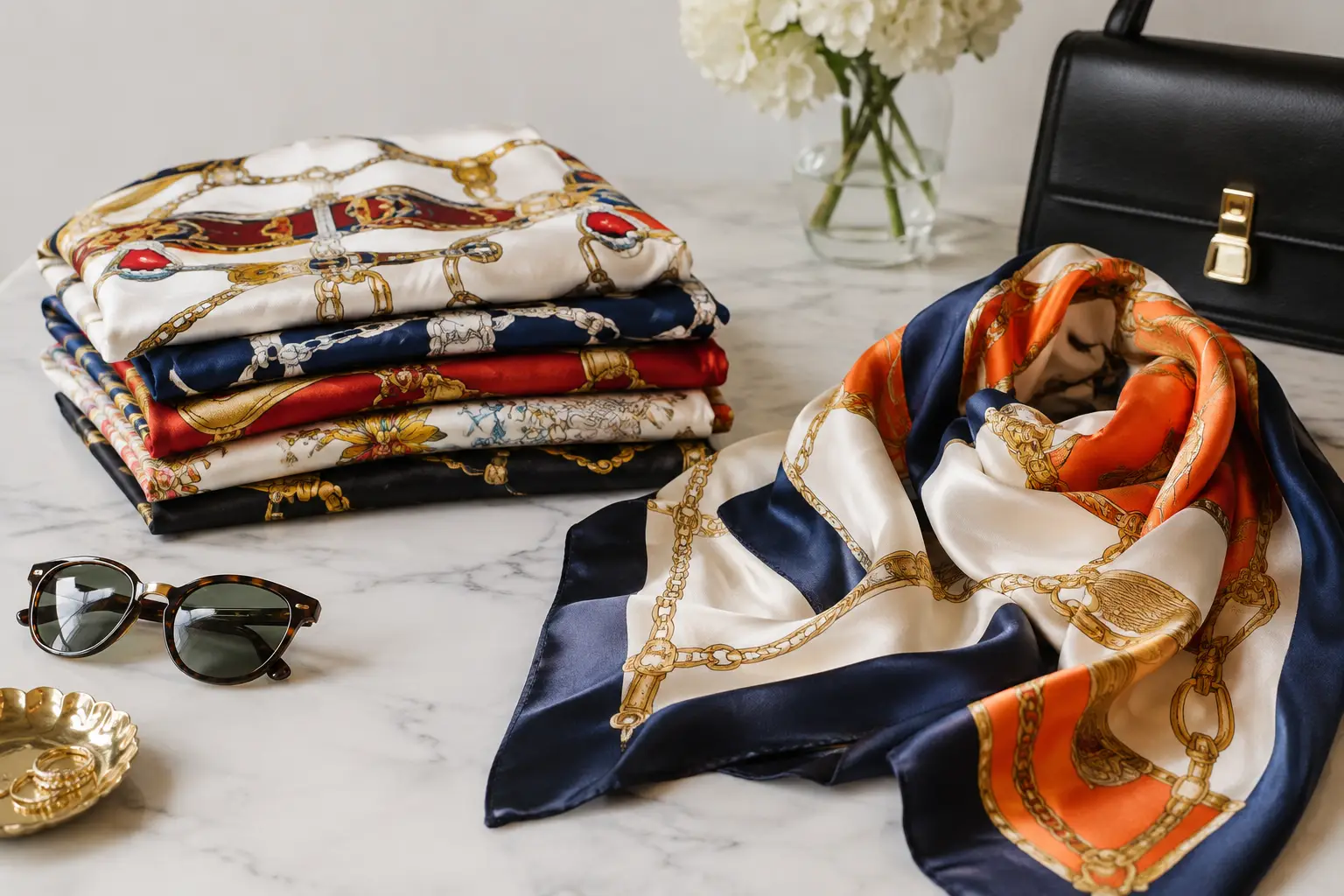
A well-chosen scarf can carry more visual authority than an entire outfit. The best vintage designer scarves are not simply accessories from another era: they are small-scale works of graphic design, defined by exceptional silk, memorable color, and the codes of a fashion house at a particular cultural moment. A 1970s equestrian print, a geometric composition from the 1960s, or a hand-rolled silk square in a rare palette can become as compelling on a wall or within a collection as it is around the neck.
For collectors, the appeal lies in the meeting of fashion history and decorative presence. Unlike a garment, a scarf is not dependent on a precise size or silhouette. It can be worn, framed, draped over a chair, or preserved as a textile object. Its value rests on more than the label: design, condition, material, rarity, and provenance all matter.
What Makes a Vintage Designer Scarf Worth Collecting?
The most desirable examples have an immediate visual identity. They show the house’s vocabulary clearly, whether that means an equestrian motif, an Art Deco line, a baroque chain print, a painterly floral, or a confident monogram. The best pieces feel complete from every angle, with a composition that retains its strength when folded or displayed flat.
Material is equally revealing. Fine silk twill is the classic choice for luxury carré scarves because it holds color beautifully and has enough body to shape elegantly. Silk chiffon offers transparency and movement, while silk satin has a more lustrous, evening-oriented character. Hand-rolled edges, clean printing, and a soft yet substantial hand are positive signs, although the construction should always be considered alongside the period and intended design.
Condition can change the equation considerably. A rare print may still deserve attention with minor wear, especially if it is intended for framing or archival collecting. For regular wear, look closely for pulled threads, stains, fading along folds, fragrance residue, and brittle fabric near the edges. A vintage scarf should show its age gracefully, not conceal damage beneath an attractive label.
10 Best Vintage Designer Scarves to Look For
1. Hermès silk carré scarves
The Hermès carré remains the reference point for collectible designer scarves. Its enduring appeal comes from disciplined craftsmanship and designs that often work like miniature narratives: carriages, bridles, maps, natural history, mythology, and ceremonial objects all appear with extraordinary detail. Earlier colorways and discontinued designs are especially interesting, but condition is critical. A vivid, clean carré with intact hand-rolled hems is generally more compelling than a rarer example marked by heavy staining or color loss.
2. Gucci equestrian and flora prints
Gucci scarves from the 1960s through the 1980s often balance Italian exuberance with a highly recognizable visual language. Equestrian hardware, stirrups, horse bits, bamboo, and the famous Flora motif are enduring collector favorites. The original Flora scarf, created for Grace Kelly in the 1960s, has particular historical resonance, though later vintage interpretations can be equally decorative. Look for saturated color, sharp print registration, and silk with a fluid but substantial finish.
3. Emilio Pucci psychedelic silk scarves
Emilio Pucci transformed printed silk into a language of movement. His vintage scarves are distinguished by energetic abstract forms, optical rhythms, and combinations of fuchsia, turquoise, violet, citrus, and black that still feel remarkably current. A Pucci scarf works beautifully as wearable color, but it also has a strong place in an interior with Mid-Century Modern or Italian modernist references. The more complex the print and the more intact the color, the greater its decorative impact.
4. Versace baroque and chain-print scarves
Vintage Gianni Versace scarves bring a theatrical dimension to a collection. Medusa heads, rococo scrolls, coins, gold chains, leopard details, and jewel-like colors create the maximalist vocabulary for which the house became known. Pieces from the late 1980s and 1990s are especially sought after for their strong association with the era. These scarves are not quiet supporting accessories. They are focal pieces, best chosen by those who want a vivid counterpoint to a tailored black coat, a neutral room, or a restrained wardrobe.
5. Chanel logo and jewelry-motif silk scarves
Chanel vintage scarves offer a different kind of recognition: graphic, polished, and often more understated than their reputation suggests. Look for interlocking Cs, camellias, quilted motifs, pearl strands, costume jewelry, or chain details arranged with a crisp sense of balance. Earlier examples may feature refined neutral palettes, while later pieces can be bolder and more overtly branded. Authentication deserves particular care here, as Chanel scarves are widely copied. The quality of silk, label construction, print clarity, and edge finishing should all be examined together.
6. Dior archival florals and monogram designs
Vintage Christian Dior scarves can be overlooked beside more obvious fashion-house icons, which makes them a rewarding field for collectors with a discerning eye. They range from romantic florals and delicate botanical studies to assertive logo patterns and ornate borders. Many designs have a distinctly Parisian elegance, but the best examples avoid sweetness through strong composition and nuanced color. They suit collectors drawn to a more feminine, refined expression of vintage luxury.
7. Yves Saint Laurent graphic silk squares
Yves Saint Laurent scarves often reflect the designer’s fascination with art, travel, and bold chromatic contrast. Graphic borders, stylized florals, geometric forms, and richly colored motifs are common, with some pieces carrying the sharp visual tension associated with the house’s ready-to-wear collections. They can feel especially at home with 1970s tailoring, safari-inspired pieces, or an interior that mixes brass, lacquer, and modern art. Seek out designs where the central motif remains legible even when the scarf is knotted.
8. Salvatore Ferragamo illustrated scarves
Ferragamo has a long relationship with graphic storytelling, and vintage scarves often feature animals, shoes, flowers, travel scenes, and whimsical illustrations. They are less aggressively logo-driven than some contemporaries, which gives them a particular appeal for collectors who value print design over immediate brand recognition. A Ferragamo scarf can be elegant without feeling formal, making it one of the most versatile choices for everyday wear.
9. Valentino romantic and ornamental scarves
Vintage Valentino silk scarves are often characterized by romantic florals, classical ornament, delicate borders, and a softer palette of ivory, red, navy, powder blue, or rich jewel tones. Their appeal is decorative rather than graphic in the modernist sense. Choose them for a wardrobe or room with an appreciation for old-world references, tailored femininity, and a more intimate kind of luxury.
10. Leonard Paris botanical prints
Leonard Paris is an essential name for collectors of floral silk. The house is celebrated for exuberant botanical prints, sometimes so detailed and saturated that they resemble tropical gardens or painted textiles. Vintage Leonard scarves offer a strong alternative to the usual luxury-house signatures. They are ideal for someone who wants lush color and textile artistry, with less emphasis on monogram recognition.
How to Choose Between Iconic and Unusual Designs
The right scarf depends on the role it will play in a collection. An iconic Hermès or Gucci print is easier to recognize, easier to style, and often easier to resell. It brings the reassurance of an established market, although the most famous motifs can command higher prices and attract more reproductions.
An unusual Ferragamo illustration, early Pucci colorway, or little-seen Dior floral may offer greater individuality. These pieces can be more rewarding visually, particularly when selected for a specific interior or personal wardrobe. They also require more confidence: their appeal may be rooted in design quality rather than immediate name recognition.
For a first purchase, favor a square silk scarf around 34 inches, often described as a carré. This proportion is the most versatile. It can be worn at the neck, tied to a bag, folded as a headscarf, or framed as a textile composition. Larger shawls have greater drama, while smaller squares are charming but more limited in display and styling.
Authentication and Care for Vintage Silk
A label alone is never sufficient proof of authenticity. Examine whether the print is crisp rather than blurry, whether colors appear intentional rather than flat, and whether the silk feels appropriate to the stated house and period. Hand-rolled hems are common on fine vintage silk squares, but they are not a universal guarantee. Compare the construction, typography, care labels, and overall quality as a whole rather than relying on one detail.
Store silk away from direct light, moisture, and plastic bags. Folding is traditional, but changing the folds occasionally helps avoid permanent creases. For display, use UV-protective glazing and acid-free materials. Dry cleaning should be approached cautiously: a specialist experienced with vintage textiles is preferable, especially for hand-painted, printed, or fragile silk.
At Sound Of Vintage Italy, a vintage fashion accessory is selected with the same attention given to Murano glass or an Italian design object. Its value is not only in the maker’s name, but in the distinctive visual life it brings to a room, a wardrobe, and a collection.
The most satisfying scarf is rarely the one with the loudest logo. It is the piece whose color, scale, and history continue to hold your attention long after it has been folded away.