
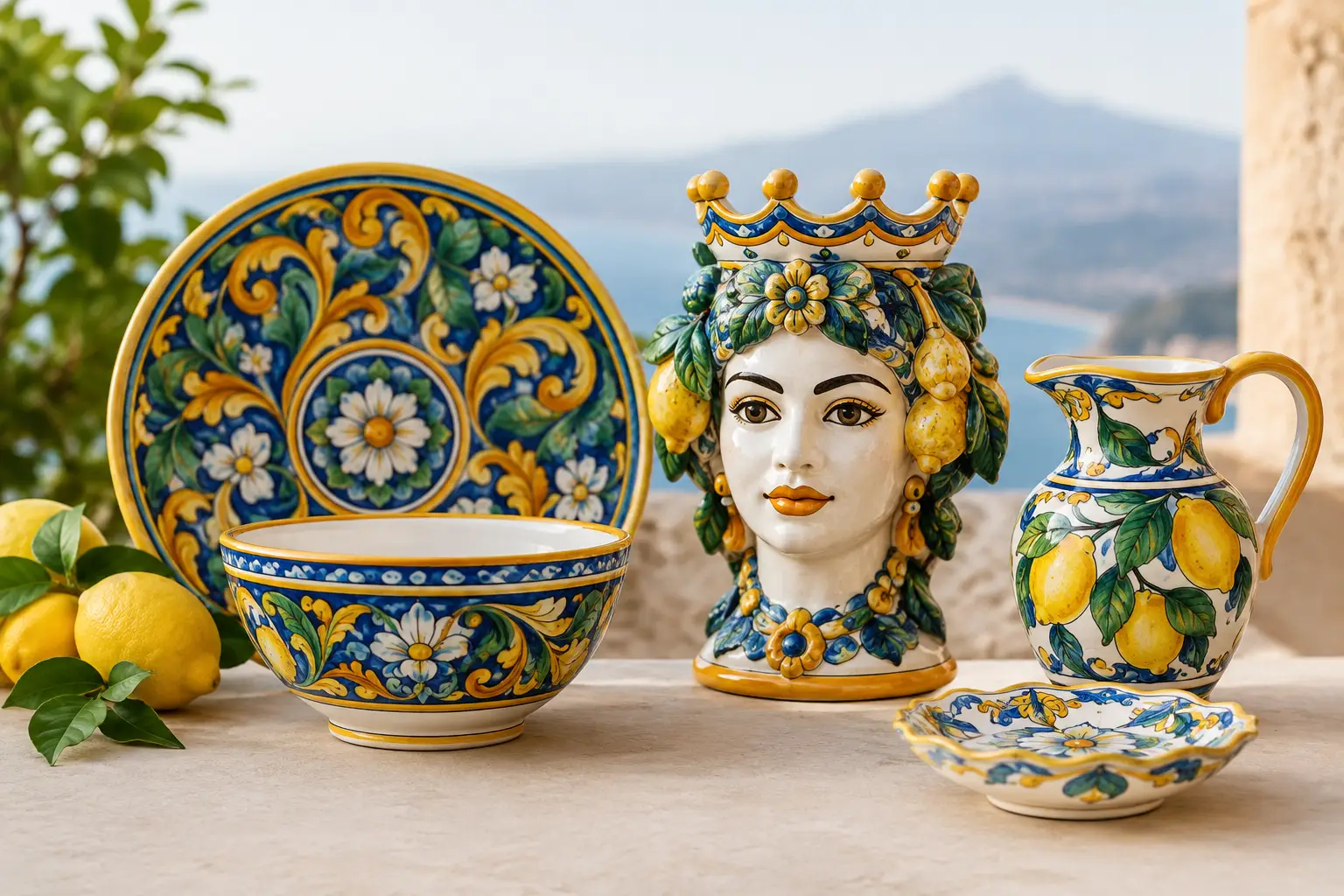
A Sicilian ceramic should never feel like a generic souvenir. Its appeal lies in the tension between exuberance and discipline: saturated color, theatrical ornament, and centuries of Mediterranean visual culture held within a form made for a table, a wall, or a carefully composed interior. The best Sicilian ceramics carry this presence immediately, yet reward a closer look through their hand-painted surfaces, modeled details, and unmistakable sense of place.
For collectors and design-minded buyers, the question is not simply which object is most colorful. It is which piece has enough character to hold its own beside vintage lighting, Murano glass, modernist furniture, or an antique mirror – without reducing Sicily to a decorative cliché.
What Makes Sicilian Ceramics Distinctive
Sicilian ceramics belong to a broad visual tradition shaped by Arab, Spanish, Greek, and Italian influences. That layered history is visible in the palette: cobalt blue, copper green, saffron yellow, turquoise, white, and the warm earthen tones of terracotta. It is equally present in the motifs – citrus fruits, prickly pears, fish, flowering scrolls, geometric borders, noble coats of arms, and the iconic Teste di Moro.
The strongest examples do not rely on color alone. Their visual energy is anchored by proportion and workmanship. A charger plate needs a border that frames rather than overwhelms its center. A ceramic vase needs a silhouette that remains convincing from every angle. A sculptural head should have expression, volume, and detail rather than the flattened look of factory decoration.
This is why Sicilian ceramic is so adaptable in interiors. It can introduce warmth into a restrained contemporary room, give an otherwise neutral dining table a more personal rhythm, or create a vivid dialogue with the clean lines of Italian modernism. Its decorative force is not quiet, but it can be highly considered.
The Best Sicilian Ceramics by Place and Tradition
Sicily’s ceramic traditions are not interchangeable. Knowing the principal centers helps a buyer recognize the vocabulary, quality markers, and mood of a piece.
Caltagirone: Maiolica With Architectural Presence
Caltagirone is the name most closely associated with Sicilian ceramics, particularly hand-decorated maiolica. Its workshops are known for expressive figurative work, ornamental vases, wall plates, tiles, and sculptural forms rich in historical references. The city’s famous ceramic staircase is an apt introduction to the local language: pattern is generous, color is declarative, and each surface is designed to be seen.
Caltagirone pieces are especially effective when an interior needs a focal point. A pair of large urns, a substantial fruit bowl, or a richly painted plate can anchor a console or sideboard with the authority of an art object. Smaller objects work well too, but scale matters. A tiny, highly ornamented piece can disappear in a large room unless it is grouped with other objects of comparable visual weight.
Look for confident drawing, clean transitions between colored areas, and glazing that enhances rather than obscures the painted surface. Handmade irregularity is expected. Uneven brushwork, slight variations in form, and small shifts in tone are often evidence of process, not flaws.
Santo Stefano di Camastra: Color, Utility, and Everyday Ritual
On Sicily’s northern coast, Santo Stefano di Camastra has a long tradition of ceramics that move naturally between decorative and functional roles. Plates, bowls, pitchers, tiles, and serving pieces often feature sunny palettes, floral borders, and motifs drawn from the island’s landscape and domestic life.
This is often the most natural direction for collectors who want to use ceramics rather than display them exclusively. A hand-painted serving bowl on a kitchen island or a set of plates placed on an open shelf can make daily rituals feel more intentional. Yet utility should not be confused with informality. The most compelling pieces still have a clear composition, a balanced rim, and color combinations that remain fresh outside a holiday setting.
If you are buying several items, avoid trying to make every pattern match. A more sophisticated table combines related colors or forms while allowing individual pieces to retain their identity. For example, cobalt, green, and lemon yellow can create continuity across varied motifs without looking like a coordinated retail set.
Teste di Moro and Pigne: Sculpture With Symbolic Weight
The Testa di Moro is perhaps the most recognizable Sicilian ceramic form: a sculptural head, commonly made as a vase, with elaborate headdresses, jewelry, and expressive features. The pigna, or pinecone, is another enduring symbol, associated with prosperity, continuity, and hospitality. Both have a strong decorative history, but their popularity also means quality ranges widely.
A well-made Testa di Moro reads as sculpture before it reads as a souvenir. The facial modeling should have depth; the crown, turban, or floral decoration should follow the shape rather than sit on it as an afterthought. Glaze application should be deliberate, particularly around the eyes, lips, and raised details. On a pigna, examine the rhythm of the scales and the overall proportion. A strong example has density and movement without becoming visually clumsy.
These forms suit entry consoles, fireplace mantels, garden rooms, and niches where one object can carry the composition. They can also work in pairs, though a matched pair should be truly balanced in height, coloration, and condition. Otherwise, choose a single exceptional piece rather than forcing symmetry.
How to Judge Craftsmanship and Authenticity
The best Sicilian ceramics are not necessarily antique, nor are contemporary works automatically less valuable. What matters is clarity of origin, quality of execution, condition, and the presence of an individual hand. A contemporary artisan-made vase can be a more compelling acquisition than a poorly preserved older object with no clear provenance.
Start with the base. Many workshop pieces are signed, marked, or labeled, sometimes with a town name or artisan signature. Marks are useful, but they should be considered alongside the object itself. A label alone cannot compensate for weak modeling or careless decoration.
Then study the glaze. Crazing, the fine web of lines that can develop in glazed surfaces over time, is not always a problem. On older ceramics, it may be part of the object’s history. But staining beneath the glaze, active flaking, major chips, poorly restored breaks, or cloudy areas around repairs can affect both appearance and value. For functional pieces, consider whether the condition makes them suitable for use or better reserved for display.
Hand-painted decoration should have variation and intent. Perfect repetition can suggest transfer printing or industrial production, while visible brushwork gives a piece life. That said, handmade does not mean every inconsistency is desirable. Look for an artist’s control within the variation: a border that remains rhythmic, colors that are layered thoughtfully, and figurative details that retain their definition.
Choosing Sicilian Ceramics for a Collected Interior
Sicilian ceramics are most convincing when they are given room to speak. One large platter displayed vertically above a sideboard can be more effective than a crowded wall of unrelated smaller plates. A bowl filled with seasonal fruit can bring color to a marble dining table without making the room feel themed. A pair of pigne can sharpen the architecture of a mantel or bookcase.
For interiors with Mid-Century furniture, choose forms with clean outlines and let the decoration provide contrast. A cobalt and white Caltagirone vase beside walnut or teak creates a striking conversation between graphic surface and warm wood grain. In more classical spaces, ornate maiolica can echo gilded frames, carved consoles, and patterned textiles without feeling out of place.
Color is the central decision. If a room is already visually rich, select a ceramic object with a more limited palette – perhaps blue and white, green and cream, or a terracotta ground with restrained detailing. In a quiet room, a lemon yellow platter or vividly painted Testa di Moro can become the note that changes the entire atmosphere.
Scale deserves equal attention. Large ceramics have sculptural power but require visual breathing room. Small pieces can be exquisite, especially on a desk, shelf, or dressing table, yet they need thoughtful placement. Grouping three objects with related colors but differing heights often feels more collected than lining up matching pieces.
A Piece That Should Feel Chosen
The right Sicilian ceramic does more than reference a destination. It brings a particular intensity of color, craft, and cultural memory into an interior that may otherwise be defined by restraint. Whether it is a Caltagirone vessel, a hand-painted platter, a sculptural Testa di Moro, or a finely modeled pigna, choose the piece that holds attention even when nothing else is competing for it. That is usually where lasting decorative value begins.