
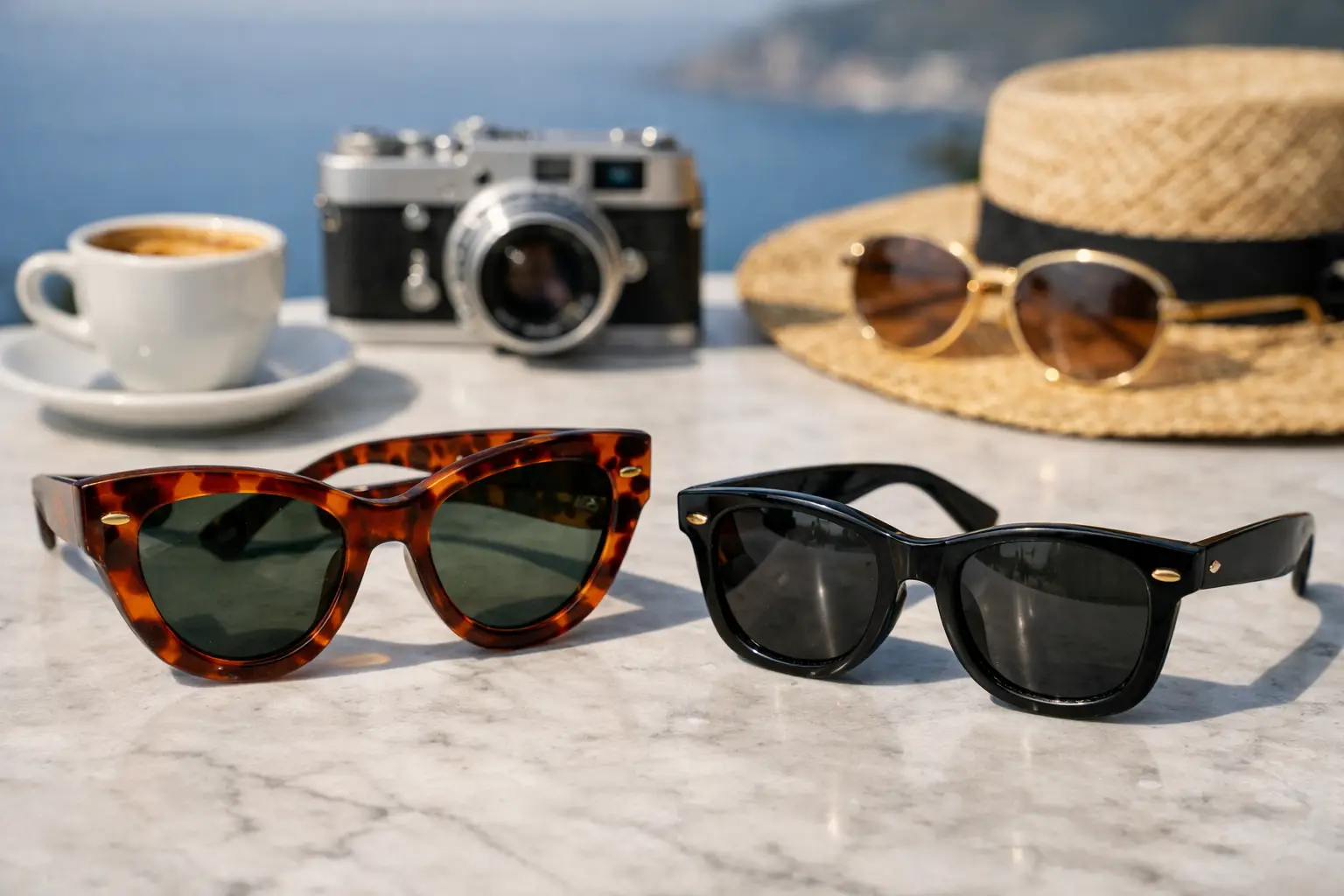
A pair of sunglasses can carry the same presence as a Murano glass object or a well-composed Italian lamp: the line is immediate, but the character reveals itself slowly. The best Italian vintage sunglasses are not defined by a logo alone. They are distinguished by proportion, material, craftsmanship, and an ability to make a face look more intentional rather than merely more fashionable.
For collectors and design-minded dressers, Italian eyewear offers a particularly rich field. From the restrained geometry of postwar frames to the expressive scale of the 1970s and 1980s, these objects sit at the meeting point of industrial design, personal style, and daily use. A well-chosen vintage pair does not need to imitate a current trend. It has already survived one.
What Defines the Best Italian Vintage Sunglasses?
The most compelling examples begin with silhouette. Italian design has often favored visual clarity: a sharply cut rectangular acetate frame, a rounded profile with architectural thickness, an aviator reduced to its essential lines, or an oversized shape balanced by a fine bridge. Even when the form is dramatic, it should feel resolved from every angle.
Material is equally revealing. Cellulose acetate remains one of the great pleasures of vintage eyewear. It has depth that injection-molded plastic rarely achieves, especially in tortoiseshell, smoky gray, amber, ivory, and layered colorways. A substantial acetate frame should feel dense but not cumbersome. Its surface may show gentle signs of age, yet it should retain luster and definition around the edges.
Metal frames deserve the same scrutiny. Look for clean soldering, balanced temples, refined hinges, and plating that has aged with dignity. Gold-tone metal, brushed silver, warm bronze, and enamel details can all be beautiful, but excessive flaking or corrosion changes a frame from evocative to compromised. Vintage is not synonymous with worn out.
Italian provenance matters because it often reflects a particular culture of making. Makers in regions associated with optical manufacturing developed strong technical knowledge alongside a sensitivity to fashion and design. Labels such as Persol, Safilo, Luxottica, Lozza, and Ratti can offer useful points of reference, though a lesser-known workshop with exceptional construction may be more interesting than a famous name in poor condition.
The Italian Design Eras Worth Knowing
1950s and early 1960s: measured elegance
Postwar Italian sunglasses often favor moderate scale and disciplined shape. Think soft cat-eye frames, compact panto rounds, sleek browlines, and tailored rectangular profiles. The appeal lies in restraint. These frames complement linen tailoring, a crisp white shirt, or a softly structured interior palette without becoming costume-like.
Look closely at the bridge and the temple line. In the finest examples, these details are not decorative extras but part of the frame’s overall rhythm. Black acetate can feel severe and refined; honey and dark tortoiseshell bring a warmer, more domestic quality.
Late 1960s and 1970s: color, volume, and confidence
This is the era for larger lenses, sculptural acetate, gradient tints, and frames that treat eyewear as a central element of dress. Oversized square forms, rounded shields, pale translucent colors, and strong gold hardware all belong to this period’s visual vocabulary.
The trade-off is wearability. A very large frame can be magnificent in a collection yet too theatrical for everyday use, depending on face shape and wardrobe. Choose it when the scale feels purposeful. The best 1970s sunglasses frame the face with confidence while still allowing the eyes and expression to remain present.
1980s and 1990s: graphic identity
Italian sunglasses from these decades often become bolder, sharper, and more brand-conscious. Black, white, red, lacquered finishes, angular metalwork, and confident logos reflect a period when fashion accessories became unmistakable visual statements.
These are excellent choices for those drawn to Memphis-inspired interiors, graphic tailoring, or a more editorial style of dressing. Yet the most lasting pieces are usually not the loudest. Seek strong construction and a shape that has a reason beyond its label.
How to Choose a Vintage Pair That You Will Actually Wear
A remarkable frame should suit the wearer, not only the photograph. Begin with width. The outer edge of the frame should generally align with, or sit only slightly beyond, the widest part of the face. If it extends too far, it can appear unstable; if it is too narrow, the look becomes cramped.
Bridge fit is the detail that decides whether a pair lives in its case or becomes part of a daily rotation. A frame may be visually perfect but slide, pinch, or rest too high on the nose. Acetate can sometimes be adjusted by an experienced optician, while metal nose pads offer more flexibility. Do not assume every vintage frame can be altered without risk, particularly if the acetate is dry or the hardware is fragile.
Lens condition requires a practical view. Light surface marks may be acceptable in a collectible object, especially if the original lenses carry a distinctive tint or engraving. Deep scratches, haze, peeling coatings, or lens distortion are more serious. Replacement lenses can make a frame wearable again, but they may alter its originality. There is no universal answer: a rare collector’s piece may merit preservation, while an everyday frame often benefits from new lenses with proper UV protection.
Before purchasing, assess the frame as a whole. Check that the temples open evenly, hinges are secure, screws are present, and the front has not twisted. Examine the acetate near the hinges and bridge for fine cracks. Fading, small marks, and a softened finish can be part of a piece’s history. Structural weakness is another matter.
Details That Separate a Find From a Generic Vintage Frame
The most satisfying sunglasses often reveal their quality in details that are easy to miss at first glance. Hand-finished bevels create a gentle play of light along the frame front. A wire core visible through translucent temples can be functional and decorative. Small maker marks, period typography, original cases, and intact temple inscriptions add context, even if they should never substitute for condition.
Color deserves careful consideration. Classic black is versatile, but it is not automatically the most refined choice. Tobacco acetate can echo walnut, leather, and brass. Deep green works beautifully with navy and stone. A pale cream frame can bring a precise Art Deco note to an otherwise simple look. As with decorative objects, the color should establish a relationship with the surrounding palette rather than compete with everything in it.
Avoid judging authenticity from a single inscription. Marks can wear down, labels can be incomplete, and vintage production changed over time. Instead, consider the consistency of the entire object: the quality of the materials, the finish, the hardware, the typography, and the relationship between the stated maker and the frame’s design language. A considered selection process is more valuable than a quick promise of rarity.
Styling Italian Vintage Sunglasses as a Design Choice
Vintage eyewear works best when it is treated as part of a broader visual language. A compact tortoiseshell frame brings structure to relaxed linen and soft knitwear. A large 1970s acetate shape can sharpen an otherwise minimal outfit. Fine metal aviators pair naturally with leather, brushed steel, and tailored wool.
The same principle applies to interiors. A person drawn to a smoked-glass table lamp, a brass mirror, or a sculptural Murano vase may find that those preferences extend naturally to eyewear. The object closest to the face should have the same integrity as the object placed in a room: strong line, honest material, and a presence that does not require explanation.
At Sound Of Vintage Italy, this way of looking matters. Vintage accessories are not secondary decorations. They are small-scale design objects, chosen for their ability to hold memory, material character, and individual style in a single form.
The right pair may be quietly elegant or unapologetically graphic. What matters is that it feels specific: a frame with a period, a point of view, and enough quality to make every wear feel like a considered choice.