
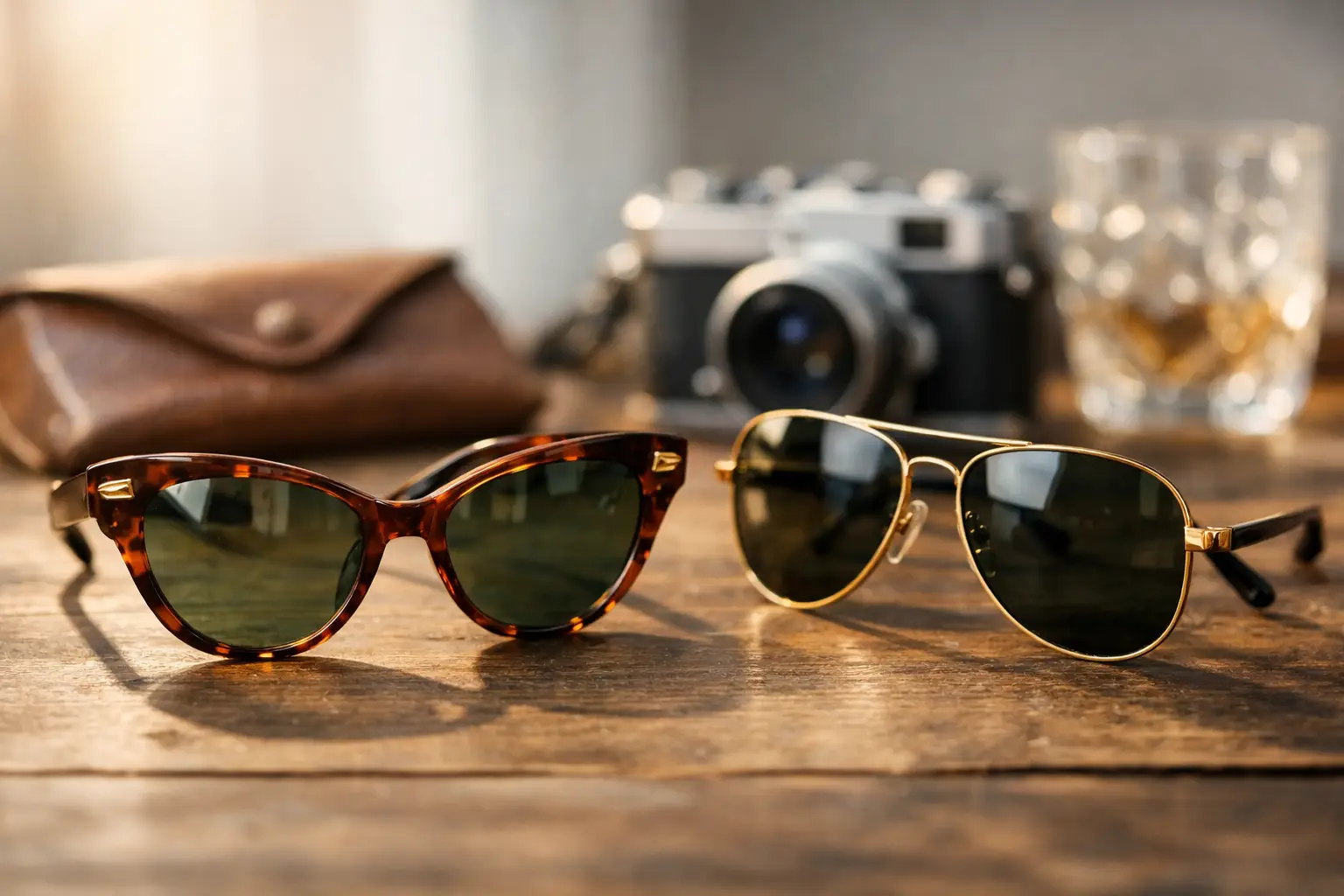
A pair of vintage sunglasses can change the proportion of a face, sharpen an otherwise simple look, and carry the visual language of an entire decade. Unlike contemporary accessories designed for rapid turnover, an original frame often reveals a precise point of view: the sculptural optimism of the 1960s, the graphic glamour of the 1970s, or the confident minimalism of the 1990s. For collectors and style-conscious wearers alike, the appeal lies in that combination of function, material, and memory.
The right pair should never feel like a costume. It should feel considered – an object with a past that still belongs naturally in the present. Choosing well means looking beyond a recognizable silhouette and paying attention to construction, condition, fit, and provenance.
Why Vintage Sunglasses Still Feel Relevant
Eyewear is one of the most immediate expressions of design. It sits at the center of the face, where line, scale, and color are noticed before almost any other detail. This is why certain historical models remain compelling long after their original season has passed. A well-made frame has an architectural quality: temples create a horizontal line, lenses establish rhythm, and the bridge gives the composition its balance.
Vintage pieces also offer a level of individuality that is difficult to find in mass-produced accessories. Tortoiseshell acetate with visible depth, warm amber lenses, brushed metal details, and softly worn finishes have a presence that cannot be replicated by an artificially distressed surface. Small variations are part of the character. A frame may show the hand of its era through thick, generous acetate, a deeply curved brow line, or slender wire construction that feels almost like jewelry.
There is also a practical reason to look backward. Many vintage sunglasses were made with substantial materials and repairable parts. Metal frames may be adjusted, screws replaced, and lenses changed when the structure remains sound. That does not make every old pair a good investment, but it does make thoughtful selection worthwhile.
The Key Vintage Sunglasses Silhouettes
A frame becomes iconic when its shape continues to communicate clearly outside its original context. Some styles are particularly versatile because they have already passed through several fashion cycles without losing their identity.
Cat-eye: graphic and feminine
The cat-eye frame is defined by its lifted outer corners, from subtle upswept lines to dramatic pointed wings. Mid-century examples often have a refined, almost architectural tension: narrow fronts, decorative temples, and colors such as black, ivory, red, or translucent smoke. They suit oval and heart-shaped faces especially well, though the angle of the wing matters more than a strict face-shape rule.
Choose a restrained cat-eye for everyday tailoring or a more pronounced version when the eyewear is meant to lead the look. The difference is considerable. A small lift can look polished; an exaggerated point becomes a statement piece.
Oversized 1970s frames: bold but balanced
Large square, rounded, and butterfly-shaped frames from the 1970s bring a distinct sense of glamour. Their appeal comes from scale, but scale needs balance. An oversized frame should align comfortably with the width of the face and leave enough space below the cheekbone. If it rests on the cheeks when you smile, it may be too deep or improperly adjusted.
Warm brown acetate, gradient lenses, and gold-tone hardware make these frames particularly effective with linen, silk, denim, and monochrome dressing. They can also provide an elegant contrast to a spare modern interior, much like a single Murano glass object gives warmth to a room of clean lines.
Aviators: utility refined into style
Aviators began with a functional purpose, yet their thin metal construction and large teardrop lenses became a permanent design code. Vintage versions can feel more delicate than their contemporary counterparts, often with finer bridges, engraved details, or lenses in green, gray, or amber rather than a standard dark tint.
They are broadly adaptable, but fit is essential. The bridge should sit securely without pinching, while the lower rim should not extend so far that it overwhelms the face. A true aviator has presence without heaviness.
Round and P3 frames: intellectual, soft, and precise
Round eyewear ranges from small wire frames to substantial acetate styles. P3 frames – softly rounded with a gently flattened top – are a classic choice for those who prefer a quieter silhouette. They work particularly well when the wardrobe favors texture and material over obvious branding: wool, leather, cotton poplin, and brushed knits.
The trade-off is that very round frames can emphasize the fullness of a round face. A keyhole bridge, a slightly wider lens, or a darker brow line can introduce the definition that a completely circular shape lacks.
How to Judge an Original Frame
Age alone is not enough. A pair of vintage sunglasses should be evaluated as an object: its materials, markings, condition, and ability to be worn. Authenticity is not only about a famous name. An unbranded Italian acetate frame with excellent construction can be more compelling than a heavily worn designer model with little structural integrity.
Start with the frame itself. Acetate should have depth rather than a flat, printed appearance. Look for clean edges, solid hinges, and temples that open and close without excessive looseness. Fine surface marks are common and often removable through careful professional polishing, but deep cracks near the bridge or hinges are more serious. These areas carry stress and can be difficult to restore convincingly.
On metal frames, examine plating wear, corrosion around screws, bent rims, and the condition of nose pads. Patina can be attractive, especially on gold-tone metal, but active corrosion is not simply a cosmetic concern. It may compromise the frame over time.
Markings inside the temples can offer useful clues: brand name, model number, country of manufacture, and size details. They should be consistent in typeface and placement, though wear can soften inscriptions. Markings alone are not proof, particularly on widely copied luxury designs. Construction quality, period-appropriate materials, and a credible overall design matter together.
Lenses require a separate decision. Original lenses preserve integrity and may feature period tints or subtle etched branding. However, old lenses can be scratched, distorted, or insufficient for current UV protection. Replacing them with high-quality UV-filtering lenses is often the sensible choice for a frame intended for regular wear. The value of an untouched collectible and the usefulness of an everyday accessory are not always the same thing.
Fit, Comfort, and the Value of Adjustment
A remarkable frame that slides down the nose or presses behind the ears will remain in its case. Vintage sizing can differ from current conventions, so measurements are helpful, but they do not replace trying a frame on. The lens width, bridge width, temple length, and overall front width should work together with the wearer’s features.
Acetate frames can often be gently adjusted by an experienced optician, especially at the temples. Metal frames offer more flexibility, but they should not be repeatedly bent at home. The goal is a secure, light contact: the frame should sit level, keep a comfortable distance from the eyelashes, and distribute weight evenly across the nose and ears.
If a frame has sentimental or collectible value, ask for conservative adjustment. Originality has value, and an aggressive alteration can change the line that made the piece desirable in the first place.
Styling an Era Without Recreating It
The most successful way to wear vintage eyewear is through contrast. Pair a 1960s cat-eye with a crisp white shirt and straight-leg jeans, not a head-to-toe period outfit. Let an oversized 1970s frame accompany a minimal black suit. Place a slim 1990s oval shape against a textured knit or a structured coat. The sunglasses become the historic note in a contemporary composition.
Color can make the difference between integrated and theatrical. Black, tortoiseshell, translucent brown, and brushed gold offer longevity because they speak easily to a wide wardrobe. More unusual shades – seafoam acetate, white enamel, ruby lenses, or patterned temples – deserve room around them. Keep other accessories deliberate but quiet.
For collectors, display can be part of the pleasure. A small selection kept in lined cases or a dedicated drawer preserves the frames while making their distinct forms visible. As with vintage lighting or decorative glass, care is part of connoisseurship. Avoid prolonged heat, direct sun when stored, and harsh cleaning products that can dull acetate or damage coatings.
A well-chosen pair of vintage sunglasses does more than reference another era. It brings an edited, personal sense of design to the everyday – proof that the objects we wear can hold history without ever feeling dated.