
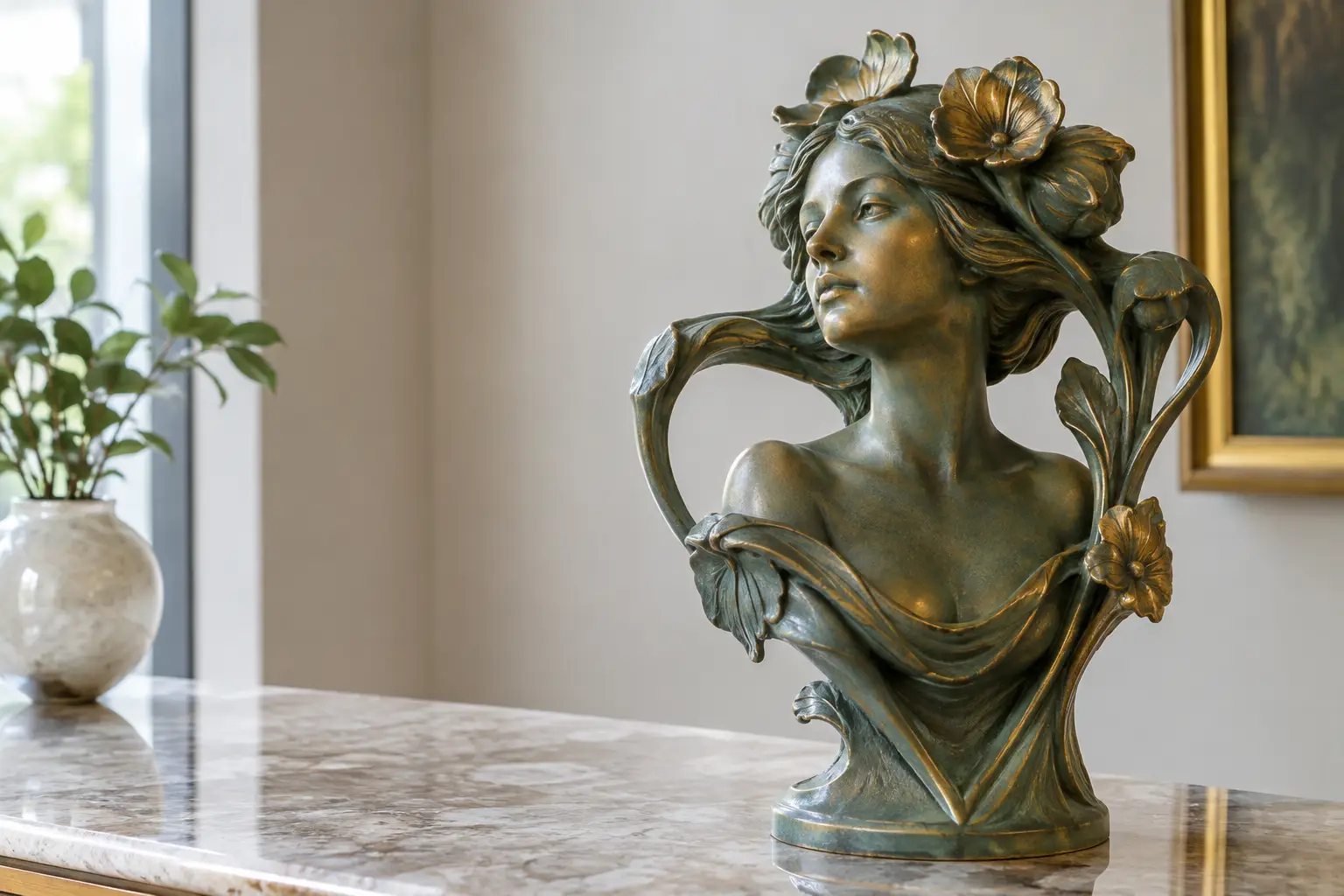
A bronze figure whose hair dissolves into water lilies. A carved female profile framed by iris stems. A small glass-and-metal object where the line of a wing becomes the structure itself. Art Nouveau sculpture was never intended to sit quietly in the background. It gives an interior a point of tension, softness, and cultivated visual memory – qualities that standardized decor cannot reproduce.
For collectors and design-minded homeowners, the appeal lies in more than age. A well-chosen piece carries the ambition of an era that wanted art to inhabit everyday life: the entrance hall, the mantel, the desk, the vanity, and the garden room. Its presence is immediately recognizable, yet its integration into a contemporary interior can be remarkably natural when scale, material, and provenance are considered with care.
What Defines Art Nouveau Sculpture?
Emerging in Europe around 1890 and reaching its height before the First World War, Art Nouveau rejected the rigid historicism of the nineteenth century in favor of a new decorative vocabulary. Its signature was the line: elongated, asymmetrical, and alive. Curves were not simply ornament. They described the growth of a stem, the fold of a body, the pull of a wave, or the flight of an insect.
In sculpture, this language appeared through female figures, botanical forms, animals, masks, and mythological subjects. The human figure was often less a portrait than a decorative force, merging with flowers, drapery, or flowing hair. This is one reason an original piece still feels so compelling. It holds movement even when it is made from bronze, marble, stoneware, ivory, or patinated spelter.
The period was international, though its expressions were distinct. French sculpture often pursued sensual modeling and luxurious finishes. Belgian and Austrian makers could be more architectural or graphic. Italian Liberty works brought their own interpretation, balancing floral ornament with regional craftsmanship and a strong relationship to decorative arts. Rather than treating these differences as secondary, a considered collection notices them. Origin can shape both the character of a work and the story it tells in a room.
Materials That Change the Reading of a Piece
Material is never incidental in Art Nouveau. Bronze allows depth, shadow, and nuanced patina, making it especially suited to figures and natural forms. A dark brown or green patina can lend gravity; warmer golden tones can make a small object feel more intimate and decorative.
Glass introduces another register. Sculptural objects incorporating colored, iridescent, or acid-etched glass can catch changing light throughout the day, particularly near a window or on a console beneath a wall sconce. Ceramic and stoneware pieces often emphasize the hand of the maker through glaze, relief, and tactile surfaces. Marble, alabaster, and ivory were used to create delicacy, but they demand particularly careful assessment of condition and ethical, legal documentation where applicable.
A mixed-material sculpture can be among the most expressive choices, but it also needs closer inspection. Original mounts, secure joins, consistent aging, and appropriate surface wear matter. An appealing silhouette should never replace attention to construction.
How to Recognize an Authentic Art Nouveau Sculpture
Authenticity is not always announced by a famous signature. Many fine objects were produced by workshops, foundries, or decorative arts manufacturers, and some marks are discreet, worn, or absent. The most useful approach is to assess the piece as a whole: design, casting or carving quality, material, condition, and provenance should support one another.
In bronze, look for crisp yet natural detail. A strong period cast retains subtle transitions in the face, hands, foliage, and drapery rather than relying on a flat, overly uniform surface. Patina should have variation and depth, especially in recessed areas, though honest handling can reveal lighter points on high relief. An aggressively polished surface may weaken both visual integrity and collector interest.
For ceramic, glass, and stoneware, examine the relationship between decoration and form. Period pieces tend to feel resolved from every angle. A flower, dragonfly, or female figure should not seem merely applied to an otherwise generic object. On carved works, tool marks and fine transitions deserve attention, as do cracks, restorations, and small losses that may affect value differently depending on rarity and scale.
Marks can be helpful, but they should be read with restraint. A foundry stamp, artist signature, inventory number, or country-of-origin mark may clarify attribution, yet no single detail substitutes for knowledgeable evaluation. Later reproductions exist in considerable numbers, particularly for popular figural bronzes and lamp bases. Their presence does not make a decorative object without merit, but it does change how it should be described, valued, and acquired.
Placing Art Nouveau Sculpture in a Modern Interior
The strongest interiors do not recreate a period room. They establish a conversation between eras. Art Nouveau sculpture offers a particularly elegant counterpoint to the clean geometry of mid-century furniture, the reflective surfaces of Murano glass, or the measured glamour of Art Deco lighting.
A small bronze can transform an entry console when given enough empty space around it. Avoid crowding it with objects of equal visual intensity. A piece with an active silhouette needs a calm field: a travertine top, dark wood, plaster wall, or a restrained mirrored surface can provide the necessary contrast.
Larger sculptures benefit from deliberate viewing distance. A floor-standing figure, architectural bust, or substantial ceramic work should be placed where its outline can be read against a wall rather than lost among textiles and furniture. Lighting matters as much as placement. A warm, directional lamp reveals the relief of casting and carving, while diffuse light may suit translucent glass or pale stone.
There is also a useful scale principle. If the sculpture is highly detailed, keep adjacent accessories few and materially quiet. If it is broad and abstracted, it can hold its own near a patterned rug, a dramatic lamp, or richly veined marble. The goal is not minimalism for its own sake. It is hierarchy.
Rooms That Benefit From a Sculptural Accent
In a living room, an Art Nouveau bronze can soften angular seating and lend focus to a bookcase or fireplace surround. In a dining room, a low sculptural object can work beautifully on a sideboard, provided it does not compete with table service or obstruct sightlines. A bedroom invites more intimate works: a small bust, a floral relief, or a graceful lamp sculpture can bring personality without formality.
The home office is an especially persuasive setting. A period desk accessory, figure, or small ceramic object introduces tactility to a space often dominated by screens and hard edges. For hospitality interiors, a single authentic work in a reception area can communicate more discernment than a room filled with generic decorative pieces.
Condition, Patina, and the Value of Restraint
Collectors sometimes expect an antique sculpture to appear pristine. In reality, gentle signs of age can be part of its authority. Minor surface wear, softened patina, and small irregularities may confirm a long and honest life. The question is whether condition supports the object’s stability, appearance, and historical coherence.
Restoration is not automatically a reason to reject a piece. Professional repairs to a fragile ceramic element or a discreet stabilization of an old mount can be appropriate. What matters is transparency. Extensive recasting, replaced decorative elements, fresh artificial patina, or repairs that alter the original silhouette deserve a more cautious valuation.
Care should be equally restrained. Dust bronze with a soft, dry brush or microfiber cloth, and avoid commercial polishes that strip patina. Keep glass and ceramics away from unstable shelves, direct heat, and abrupt temperature changes. Stone and marble should be protected from acidic liquids. Above all, resist the urge to make an old object look new. Its surface is often where much of its beauty resides.
Choosing a Piece With Lasting Presence
The best Art Nouveau sculpture is not necessarily the largest, rarest, or most elaborate example. It is the one whose form continues to reveal itself: a line that changes in evening light, a patina that deepens beside wood and brass, a motif that gives a room a more personal rhythm.
When selecting, begin with the object rather than the label. Consider whether its material is convincing, its condition is honestly represented, and its scale suits the life of the room. A distinctive period sculpture asks to be seen, but it also rewards long acquaintance. That is precisely what makes it more than an accent: it becomes part of the interior’s identity.