
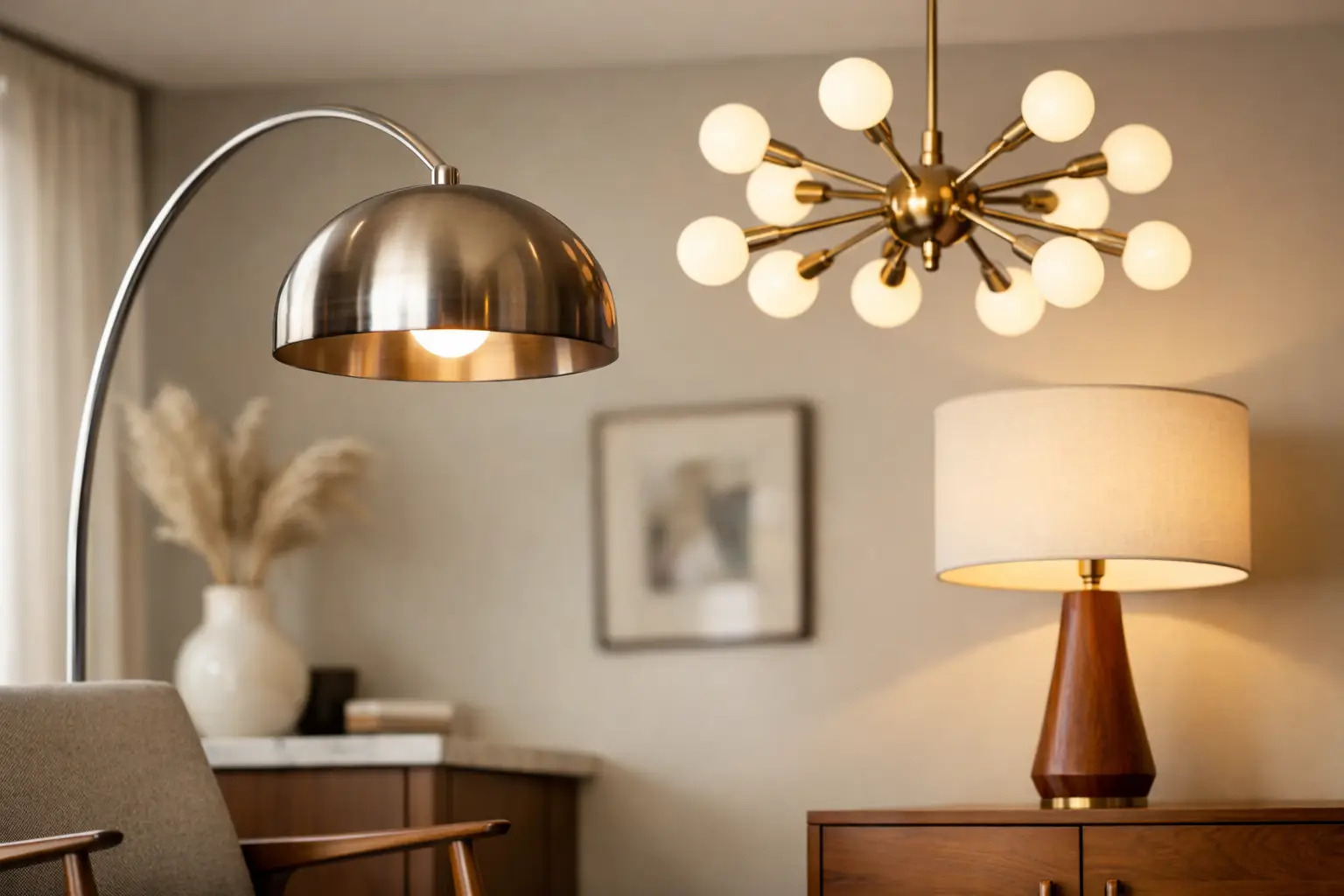
A room can hold the right furniture and still feel unresolved until the lighting is chosen well. That is where a thoughtful mid century lighting guide becomes useful – not as a rigid formula, but as a way to understand proportion, material, and atmosphere. In interiors shaped by character rather than trend, lighting is rarely a finishing touch. It is often the element that gives the room its rhythm.
Mid-century lighting remains enduring because it combines clarity of line with warmth. The silhouettes are disciplined, but never cold. Brass, teak, lacquered metal, opaline glass, parchment shades, and Murano elements all belong to a design language that values restraint without giving up personality. The result is decorative presence with function at its core.
What defines mid-century lighting
The category is broad, and that breadth is part of its appeal. A 1950s Italian chandelier in hand-blown glass does not speak in the same voice as a pared-back Scandinavian floor lamp, yet both belong comfortably within the mid-century landscape. What ties them together is a sense of purpose. Shapes are clear. Ornament, when present, is integrated rather than applied. Materials are chosen to be seen.
This is also why true mid-century pieces hold visual authority even in contemporary rooms. They do not rely on excess. A well-made sconce with a sculptural brass arm, a pendant with a satin glass diffuser, or a tripod floor lamp with a refined shade can shift the entire reading of a space without overwhelming it.
For collectors and design-conscious buyers, the term should not flatten distinction. Mid-century is not one look. Italian modernism, French lighting from the 1950s, American studio production, and Scandinavian design all contribute different attitudes. Knowing which one suits your interior matters more than following a generic vintage script.
A mid century lighting guide by room and function
The most successful interiors layer light. A single ceiling fixture, however beautiful, rarely creates enough depth. Mid-century lighting is especially effective when different sources are allowed to work together – overhead light for structure, wall lighting for contour, table and floor lamps for intimacy.
Living room
In the living room, a chandelier or pendant often establishes the room’s architectural center. If the space already contains visually active furniture, a cleaner fixture can create balance. If the furnishings are restrained, a more sculptural light can become the room’s focal point.
Floor lamps are particularly strong in mid-century settings because they bridge utility and silhouette. Arc forms, tripod bases, and brass stems with adjustable shades all bring height without heaviness. Table lamps should not be treated as secondary. A ceramic base, smoked glass body, or Murano form on a side table adds a local pool of light and a layer of visual texture after sunset.
Dining room
Above a dining table, scale is non-negotiable. A fixture that is too small tends to look incidental, no matter how rare or beautiful it may be. Mid-century dining lights work best when they hold the table with confidence. Multi-arm brass chandeliers, linear suspensions, and glass pendants with strong geometry all perform well here.
The trade-off is between drama and ease. A low-hanging sculptural piece creates intimacy, but it must not interrupt sightlines or feel oppressive. In formal dining rooms, symmetry may be welcome. In more relaxed spaces, a single assertive pendant can feel fresher.
Bedroom
Bedrooms benefit from softer expression. Wall sconces beside the bed can free the nightstand and give the room a composed, hotel-like quality. Table lamps with opaline or frosted glass produce a gentler glow than exposed bulbs and suit the quieter mood of the room.
This is one of the clearest examples of where authenticity should meet practicality. An original lamp with a delicate shade may be visually ideal, but bedroom lighting is used frequently and often at close range. Condition, rewiring, and bulb compatibility deserve close attention.
Entry and hallway
These are transition spaces, but they should not be treated casually. A ceiling mount, flush fixture, or pair of sconces can set the tone from the first moment. Mid-century lighting is especially effective here because it makes an impression quickly. Even a compact fixture with brass detailing or hand-worked glass can establish a strong decorative identity.
Materials that give the period its character
Material is often the fastest way to read quality. In mid-century lighting, brass has a particular importance. It adds warmth, reflects light with subtlety, and ages in a way that often improves the piece. Patina should not automatically be seen as a flaw. In many cases, it is part of the object’s depth.
Glass is equally central, though it appears in very different registers. Opaline and frosted glass create calm diffusion. Smoked and colored glass introduce atmosphere and a slightly more graphic presence. Murano glass occupies a more expressive territory, where craftsmanship and luminosity become inseparable. In the right room, a Murano chandelier or table lamp does more than illuminate. It becomes an art object with functional purpose.
Wood, especially teak and walnut, softens metal-heavy compositions and tends to work beautifully in domestic settings. Lacquered aluminum and painted steel carry a more industrial or architectural note. None of these materials are interchangeable. They alter not just the look of the lamp, but the way the room receives it.
How to judge proportion, not just style
One of the most common mistakes in vintage lighting is buying with the eye only and not with the room in mind. A striking fixture can fail if its scale is wrong. Mid-century pieces often have airy profiles, which can make them appear smaller in photographs than they feel in person.
Ceiling height, table width, wall span, and the visual weight of surrounding furniture all matter. A large chandelier in a sparse room can look deliberate and elegant. The same piece in a crowded room may feel congested. Small sconces in a narrow hallway can be refined. In a double-height entry, they may simply disappear.
There is also the question of density. Some interiors need one exceptional object and quiet elsewhere. Others benefit from repetition – matching sconces, a pair of table lamps, or a pendant that echoes a furniture detail. Good curation is often an exercise in restraint.
Authenticity, restoration, and what to inspect
For serious buyers, originality is only part of the equation. Condition determines whether a piece will remain purely decorative or function beautifully in daily life. Vintage lighting frequently requires rewiring, and that is not a drawback in itself. Professional updating is often essential, especially for US use.
What deserves scrutiny is the quality of restoration. Look closely at metal surfaces, glass integrity, replacement parts, sockets, canopies, and shade fittings. A lamp may be authentic and still have elements that were changed over time. That is not always negative. It depends on whether those changes preserve the design’s integrity or dilute it.
With Murano and other artisan glass, variation is expected. Slight asymmetry, tonal shifts, and hand-finished details are often signs of craftsmanship rather than defects. The real question is whether the object still carries coherence – materially, structurally, and visually.
Mixing mid-century lighting with contemporary interiors
The appeal of mid-century lighting today lies partly in its adaptability. It can sharpen a minimalist interior, warm an architectural apartment, or add discipline to more layered eclectic rooms. The key is not to force a period set. In many cases, one or two well-chosen vintage lights have more effect than filling a room with references.
If the interior is very contemporary, choose pieces with strong form and clean materials – brass, white glass, black lacquer, or sculptural metal. If the space already contains antiques or decorative richness, a mid-century fixture can create tension in the best sense, introducing clarity without flattening the room’s history.
This is where a curated approach matters. Sound Of Vintage Italy speaks to collectors and interiors with point of view because the value of vintage lighting is not simply age. It is selection. Distinction comes from choosing pieces that hold their own, converse with the room, and remain visually persuasive over time.
Why the right light feels collected, not decorated
Well-chosen mid-century lighting never feels like an accessory added for effect. It feels embedded in the room’s logic. That may come through a suspended Murano fixture over a dining table, a pair of brass sconces framing a mirror, or a single floor lamp that gives a corner structure and mood.
Taste is visible in these decisions. Not in how much is added, but in what is allowed to stand out. The best pieces do not ask for attention loudly. They command it through line, material, and proportion.
If you are building a room with lasting character, choose lighting early, choose it with discipline, and let each piece earn its place. The room will tell you when the light is no longer decoration, but identity.