
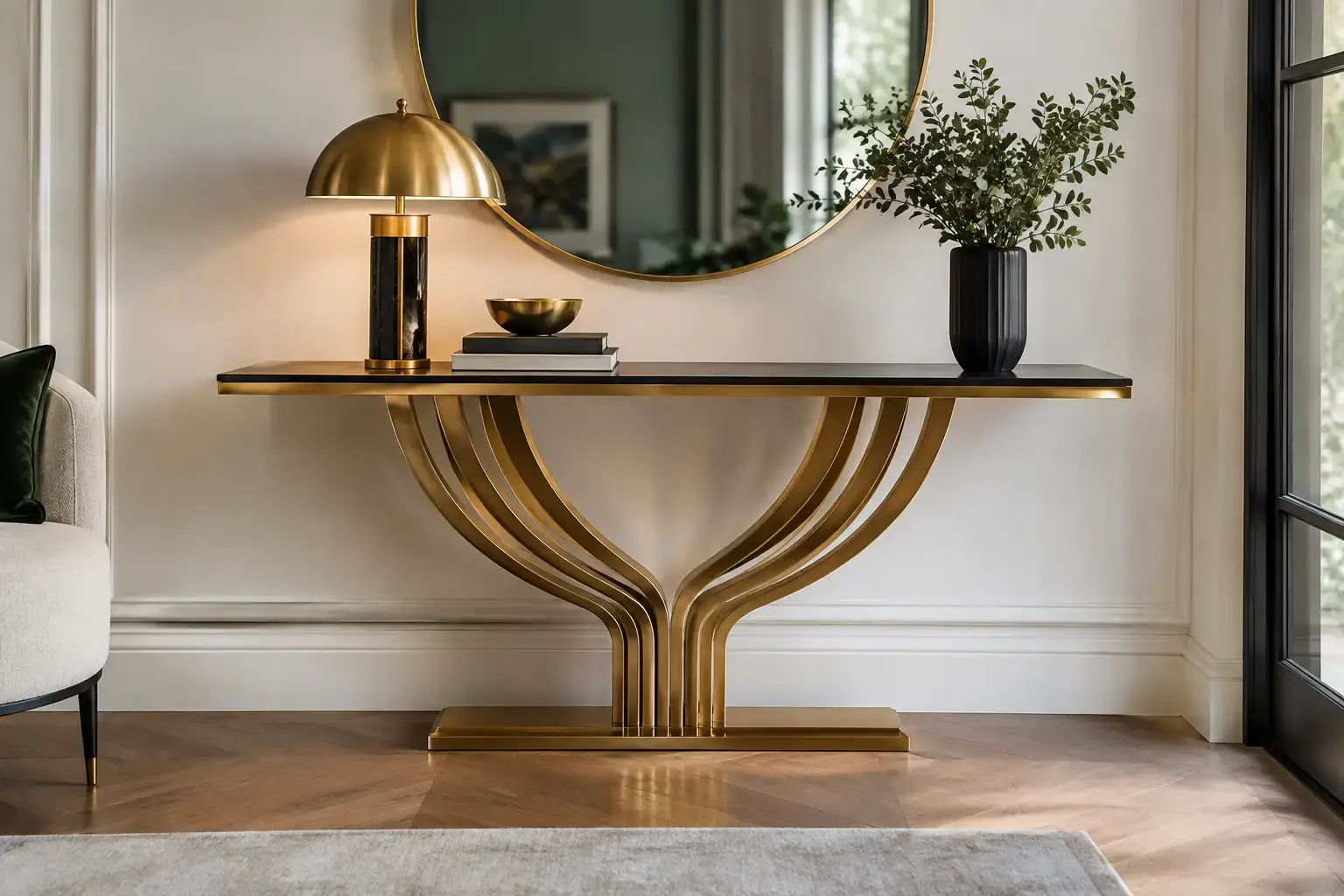
A console table has very little room to hide. Set against an entry wall or beneath a mirror, its silhouette is read at once: the line of the legs, the sheen of the veneer, the confidence of its hardware. The best Art Deco console tables earn that attention through proportion and material contrast, not through ornament alone. They bring architectural clarity to a room while retaining the glamour that made the style so enduring.
For collectors and design-minded interiors, the most compelling examples are rarely the loudest. A stepped base in dark walnut, a parchment top edged in brass, or a pair of chromed supports can establish an entire decorative direction. The right piece should feel precise, substantial, and unmistakably individual.
What Defines the Best Art Deco Console Tables?
Art Deco furniture emerged from a fascination with modernity, luxury, and geometry. In console tables, this vocabulary appears through streamlined volumes, softened corners, dramatic veneers, and metals used as deliberate accents. The period spans more than one look, so it is useful to distinguish between a 1920s French-inspired piece, a 1930s Italian design, and a later Hollywood Regency interpretation.
The finest tables tend to have a strong relationship between form and surface. A waterfall edge may emphasize the uninterrupted grain of a burr walnut veneer. A black lacquered structure may be balanced by ivory-toned parchment, marble, or polished brass. Even a narrow table can feel important when its proportions are disciplined and the finish has depth.
Authenticity matters, but it is not the only measure of value. An original period console may offer construction details, patina, and rare materials that a contemporary reproduction cannot replicate. Yet a high-quality later piece can be the wiser choice for a heavily used foyer or a compact apartment where exact dimensions matter. The distinction should be clear in the description and reflected in the price.
Four Art Deco Console Styles Worth Seeking
The French lacquer and parchment console
French Art Deco consoles often feel refined rather than severe. Look for ebonized or lacquered wood, pale parchment panels, bronze details, and elegant curved or tapering supports. These tables suit interiors where a console is expected to converse with sculptural lighting, a gilt mirror, or an upholstered bergere rather than act as simple storage.
Parchment deserves close inspection. Natural tonal variation is part of its appeal, and gentle signs of age can be desirable. Deep cracks, lifting, extensive staining, or poorly matched restoration require a more careful assessment. A beautifully preserved surface brings a quiet luminosity that photographs rarely capture fully.
The Italian walnut and brass console
Italian Art Deco furniture frequently combines classical cabinetmaking with a more muscular sense of volume. Walnut, mahogany, and rosewood veneers may be arranged in geometric patterns, while brass sabots, trim, or handles introduce a measured note of glamour. The result can be warmer and more architectural than its French counterpart.
This is an excellent direction for homes that already contain mid-century Italian lighting, Murano glass, or richly toned woods. A walnut console with restrained brass detailing bridges decades particularly well. It can sit comfortably beside a 1950s mirror without forcing the room into a period set.
The chrome and glass console
For a cleaner, metropolitan reading of the period, chrome and glass offer a striking alternative to figured wood. Tubular or flattened metal frames, smoked glass, mirrored tops, and black lacquered elements create visual lightness while retaining Deco drama. These pieces work especially well in narrow halls because they reflect light and preserve a sense of openness.
Their trade-off is practical. Glass reveals dust and fingerprints, while original mirrored panels can show foxing around the edges. That aging can be attractive when it is even and stable, but it should be considered part of the table’s visual character rather than treated as invisible damage.
The sculptural pedestal console
A console with a central pedestal, paired plinths, or boldly stepped feet carries more decorative authority than a simple four-legged design. It is often the best option for a wide wall, a formal dining room, or the space behind a sofa, where the table will be seen from several angles.
Because these forms have visual weight, scale is essential. A pedestal table that is too deep can crowd circulation; one that is too slight can appear disconnected from the wall or mirror above it. Allow the architecture of the room to lead the decision.
How to Choose an Art Deco Console by Scale
The right console begins with measurement, but the final choice is about visual proportion. In an entry, leave sufficient passage around the piece and avoid a depth that interrupts the natural path from door to room. A narrow profile can still feel luxurious when the material is exceptional.
For most residential settings, console height should relate to the object above it. A mirror, painting, or pair of sconces needs enough breathing room to read as a composition. If the table is low and monumental, choose wall decor with a stronger vertical presence. If it is tall and delicate, a more restrained mirror may be enough.
Width depends on the wall, not merely on available inches. A console that occupies roughly two-thirds of the usable wall often looks considered, though symmetry can alter that rule. Between two doors, a smaller piece may be all that is needed. Along a long dining-room wall, a broader console can act as a display surface for glass, ceramics, and a pair of lamps.
Do not overlook the lower area of the table. Open metal bases create air and light. A veneered cabinet form adds gravity and can conceal visual clutter, but it demands a room with enough space around it. The best choice depends on whether the goal is atmosphere, function, or both.
Materials, Patina, and Condition
A close look at materials separates a considered vintage acquisition from a decorative approximation. Veneer should have richness and continuity, even where age has softened its sheen. Minor variations, small restorations, and light surface marks are common in furniture that has lived well. What matters is whether those traces support the piece’s authenticity or compromise its structure.
Check edges, corners, drawers, and the underside. Veneer lifting near a corner, uneven lacquer, unstable joints, or replacement hardware can affect both longevity and value. Restored furniture is not automatically less desirable. Professional conservation can make a fragile piece usable again, particularly when original finishes and construction have been respected.
Stone and glass require their own judgment. Marble may have small fills, faint etching, or old repairs. Smoked glass can show minor scratches that disappear in a room but are evident in direct light. Brass develops patina, and not every collector wants it polished to a uniform shine. In a sophisticated interior, a surface with history often has more presence than one made artificially perfect.
Styling an Art Deco Console Without Recreating a Set
An Art Deco console is strongest when it is allowed to lead rather than compete. Above it, choose a mirror with an intentional profile: a scalloped frame, a clean oval, a sunburst in moderation, or a simple period-appropriate rectangle. A mirror should extend the console’s language, not repeat every detail.
On the surface, restraint is more convincing than accumulation. A Murano vase with a sculptural silhouette, a low bronze object, or a pair of vintage lamps can create a complete composition. If the console has a highly figured veneer or reflective top, use fewer objects and give the material space to register.
Color can sharpen the effect. Deep tobacco, black, oxblood, emerald, ivory, and soft gray all complement Deco finishes, but the room need not become a themed interior. A single original console against plaster walls, contemporary art, and a neutral rug often feels more alive than a room filled exclusively with period references.
Sound Of Vintage Italy approaches such pieces as objects with both decorative force and individual histories. That is the real appeal of a well-chosen vintage console: it does more than fill a wall. It gives an arrival, a dining room, or a quiet hallway a distinct point of view.
Choose the table whose materials reward a closer look and whose proportions make the surrounding room feel more resolved. Years from now, that instinctive sense of rightness will matter far more than whether every detail followed a decorative rule.