
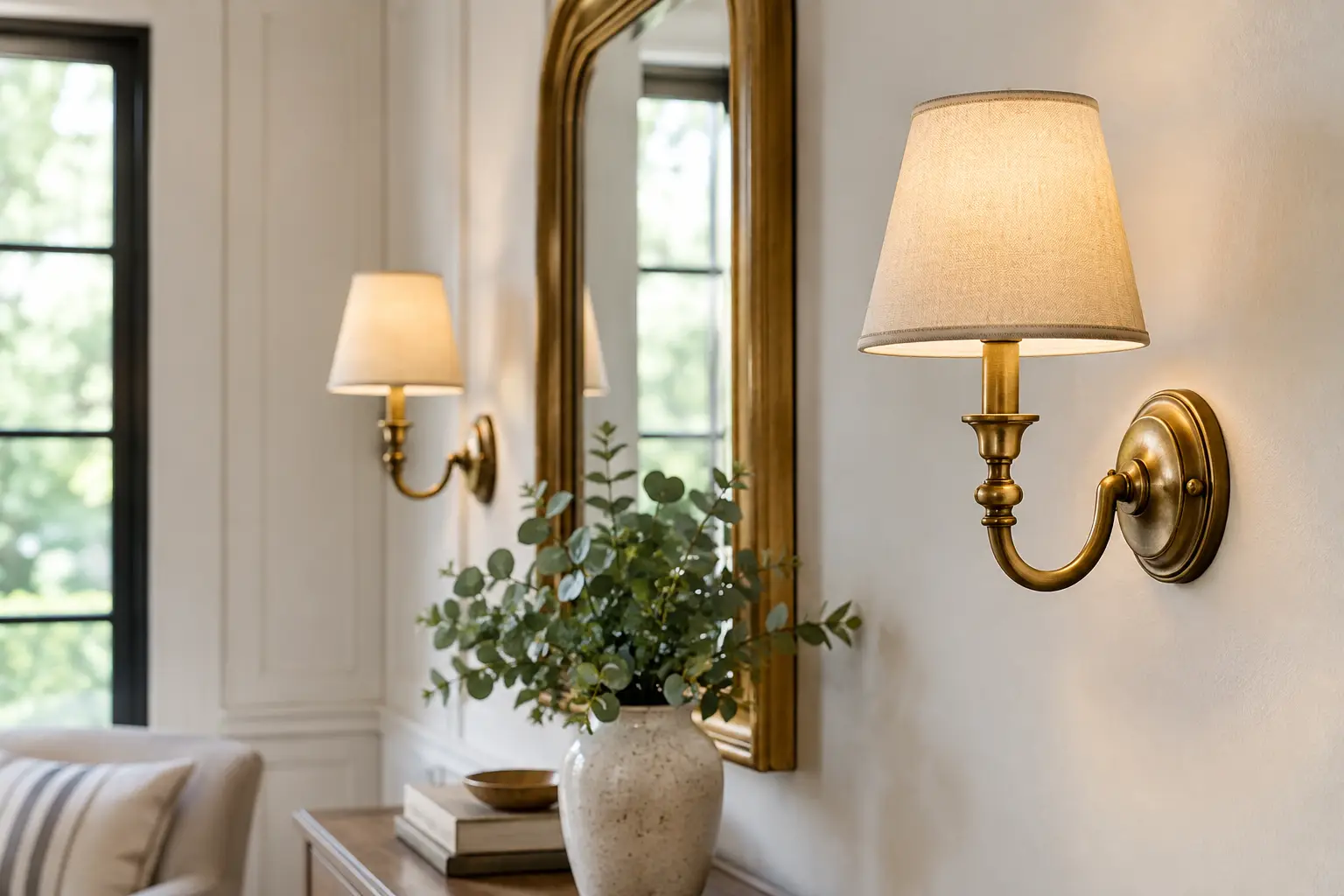
A pair of wall sconces can do more than illuminate a passageway. It can establish the period of a room, sharpen the profile of a mirror, bring warmth to a bedroom, or turn a restrained entry into a composed interior. To choose vintage wall sconces well, look beyond the immediate appeal of brass, glass, or patina. The strongest choice is one that understands the architecture, the light, and the visual language already present in the room.
Vintage lighting has a particular authority because it was made for interiors with character. Whether the reference is Italian Mid-Century design, the geometry of Art Deco, or the lyrical detail of Art Nouveau, an original sconce carries proportion, material presence, and a history that contemporary reproductions rarely achieve. The question is not simply whether a piece is beautiful. It is whether it belongs.
Begin with the Room, Not the Object
A vintage sconce is never seen in isolation. Its silhouette will be read against plaster, paneling, wallpaper, stone, tile, or the edge of a mirror. Before considering a particular model, identify what the room requires: ambient light, focused light, a decorative punctuation mark, or all three.
In a narrow hallway, shallow-profile sconces preserve circulation and prevent the wall from feeling crowded. In a living room, a more sculptural form can hold its own beside a substantial sofa, antique console, or large artwork. A bedroom calls for a different judgment. Here, bedside sconces should be practical enough for reading while remaining quiet enough not to compete with the bed, headboard, or textiles.
Scale is the first discipline. A small pair of Murano glass sconces can disappear on a broad wall, while oversized metal fixtures may overwhelm a compact powder room. Measure the available width and projection, then consider the empty space around the fixture. Vintage lighting needs air around it. A sconce placed too close to a cabinet, curtain, or artwork loses its outline and its effect.
Choose Vintage Wall Sconces by Design Period
The design period should inform the selection, but it does not need to dictate a room with museum-like precision. Often, the most convincing interiors combine periods through a shared material, palette, or sense of proportion.
Mid-Century Modern: graphic and architectural
Italian Mid-Century sconces often favor disciplined geometry, opaline or textured glass, brass, lacquered metal, and articulated arms. They suit interiors where clean lines, walnut, marble, or restrained color establish the foundation. A pair with conical shades can introduce a precise, directional light; a curved glass diffuser softens a more severe setting.
These pieces work especially well in studies, dining rooms, and hallways where their functional clarity becomes part of the composition. Their trade-off is that they can appear overly formal in a room dominated by rustic finishes or highly ornamental furniture. The contrast can be compelling, but it should feel intentional.
Art Deco: symmetry and presence
Art Deco wall sconces bring a different kind of drama. Think stepped forms, frosted glass, polished metal, stylized floral motifs, and strong vertical lines. They are natural companions to dark wood, black lacquer, mirrored surfaces, and stone, but they can also lend distinction to a contemporary interior that needs a more deliberate focal point.
Art Deco pieces are particularly effective in pairs. Framing a fireplace, mirror, doorway, or bed allows their symmetry to become part of the room’s architecture. If the space is already rich in pattern and decorative detail, select a simpler Deco form rather than adding another layer of visual noise.
Art Nouveau and decorative antique forms
For rooms with softer lines, artisanal finishes, or historic details, Art Nouveau sconces offer movement and intimacy. Floral motifs, sinuous arms, etched glass, and aged bronze can bring a wall to life without relying on excessive brightness. They are less about crisp illumination than atmosphere.
This is where condition and authenticity matter especially. Gentle wear on metal or slight irregularity in hand-worked glass may be part of the object’s value, not a flaw to erase. At the same time, distinguish a desirable patina from corrosion, instability, or damage that compromises safe installation.
Let Material Shape the Atmosphere
The material of a vintage sconce determines how it receives daylight and how it behaves after dark. Brass has warmth, whether polished or naturally oxidized. Chrome and nickel offer a cooler, more metropolitan note. Painted metal can introduce color with a distinctly period-specific character. Murano glass, with its depth, texture, and variation, brings an unmistakable Italian presence even when unlit.
Glass deserves close attention because it affects both the quality and direction of light. Opaline glass creates a gentle, diffuse glow, making it suitable for bedrooms, corridors, and spaces where flattering ambient light matters. Clear or lightly textured glass can feel brighter and more graphic. Colored glass creates mood, but it also changes how a wall and surrounding finishes are perceived. In a small room, a deeply tinted shade may be evocative but too dim as the only source of illumination.
Aged finishes should be welcomed when they are coherent with the piece. A mellow brass surface, small signs of oxidation, or the slight tonal variation of older glass gives vintage lighting its visual depth. Over-restoration can flatten that character. Yet a collector’s eye should remain practical: missing components, fractures near mounting points, and poorly executed repairs deserve careful assessment.
Consider Light as Carefully as Style
A sconce can be decorative and still fail the room if its light is wrong. Assess whether the fixture throws light upward, downward, outward, or through a diffuser. Upward-facing shades emphasize ceiling height and create softness. Downward light is more useful beside a bed, in a reading corner, or over a vanity. A fully enclosed glass shade offers a broader atmospheric glow but may not provide sufficient task lighting on its own.
Bulb choice matters, even with an original fixture. Warm white light generally complements vintage metals, wood, and glass better than a stark cool tone. Use a dimmer when possible, particularly in dining rooms, bedrooms, and living areas. It allows a rare piece to shift from functional illumination to evening atmosphere without losing its presence.
For rooms that need substantial brightness, wall sconces should work with other layers of light: a ceiling fixture, table lamps, or floor lamps. Asking a pair of decorative vintage sconces to light an entire room often leads to disappointment. Their strength is in shaping the room, not replacing every other source.
Placement Creates the Final Effect
Placement can make a modest fixture look exceptional or diminish a remarkable one. Around a mirror, sconces should sit at a height that lights the face rather than casting shadows from above. At a bedside, the ideal height depends on mattress height, headboard scale, and whether the fixture is intended for reading. In hallways, consistency matters: a repeated rhythm of matching or related sconces creates a sense of order.
Pairs are the classic choice, but a single vintage sconce can be equally persuasive. One placed beside an artwork, at the end of a corridor, or above a small console can introduce asymmetry with purpose. This approach is useful when only one original fixture survives, or when the room benefits from a more collected, less formal arrangement.
Do not assume matching is always necessary. Related sconces from the same period can create a more personal interior than an exact pair, provided they share a finish, glass treatment, or overall scale. The distinction should feel curated rather than accidental.
Verify Condition, Wiring, and Installation
The romance of vintage lighting should be balanced with technical care. Ask whether the fixture has been rewired, whether its electrical components suit current standards, and whether the wall mounting hardware is appropriate for its weight. Older European pieces may require adaptation for American electrical systems and junction boxes.
Original sockets, switches, and wiring can be historically interesting, but they are not always suitable for regular use. Professional rewiring preserves the exterior character while allowing the piece to perform safely in a contemporary home. This is particularly relevant for metal sconces, multi-arm designs, and fixtures with delicate glass elements.
Also consider the wall itself. Plaster, stone, tile, and paneling each demand a different installation approach. A valuable sconce deserves secure mounting, careful alignment, and hardware that does not place stress on an original backplate or glass shade.
Select for Character, Not Just Coordination
The most memorable rooms are not built from objects that merely match. They are built from pieces that add tension, memory, and a point of view. A restrained contemporary apartment may gain depth from a pair of 1950s Italian brass sconces. A historic home may become more alive with a sculptural modernist fixture in the right material. The success lies in proportion and conversation between objects, not rigid stylistic rules.
At Sound Of Vintage Italy, the appeal of vintage lighting rests precisely in this balance: each selected piece can serve a practical purpose while carrying the visual intelligence of its period. Choose the sconce that changes how the wall is perceived, then give it the space, wiring, and light it deserves. A well-placed original does not simply brighten a room. It gives the room a memory.