
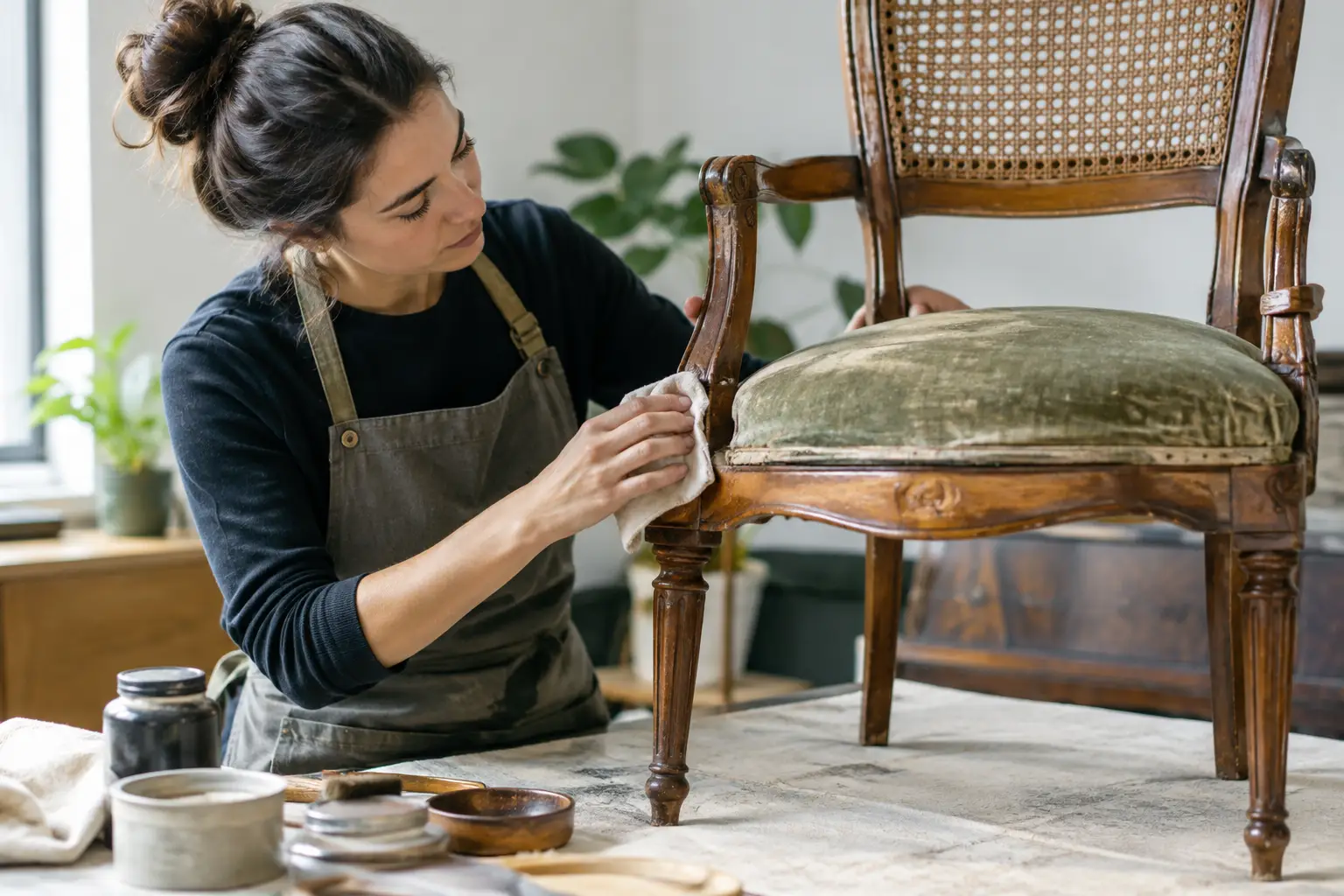
A walnut sideboard with faded edges, a lounge chair with worn leather arms, or a painted Italian chest with fine craquelure does not need to look new to deserve a place in a considered interior. Vintage furniture restoration is most successful when it respects that distinction. The objective is not to erase time, but to return function, stability, and visual clarity to a piece whose history is part of its appeal.
For collectors and design-conscious homeowners, restoration is a decision of proportion. Too little intervention can leave a beautiful object vulnerable or unusable. Too much can remove original surfaces, obscure craftsmanship, and reduce the very character that made the piece worth choosing.
What Vintage Furniture Restoration Should Protect
A vintage piece carries more than its silhouette. Its value may sit in a hand-finished veneer, an original lacquer, an aged brass fitting, a maker’s label, or the subtle variation created by decades of use. These details establish authenticity, especially in Mid-Century Modern, Art Deco, Italian modernist, and earlier decorative furniture.
Patina is often misunderstood as damage. In reality, a gentle deepening of wood tone, small signs of handling, and a softened sheen can make a piece more visually convincing than a freshly stripped and heavily varnished surface. Patina becomes a problem only when it hides active deterioration: unstable joints, lifting veneer, woodworm damage, water staining that continues to affect the material, or a finish that has failed beyond preservation.
The first question, then, is not “How can this be made perfect?” It is “What should remain visible?” A 1950s Italian console with light surface wear can retain its original finish while receiving discreet structural work. A dining table with a severely burned top may need more extensive intervention, but even then, the original edge profile, grain direction, and construction should guide the process.
Conservation, Repair, or Refinishing?
The right approach depends on the object, its condition, and its design significance. Conservation is the lightest touch. It may involve careful cleaning, wax removal, stabilization of a loose inlay, or protection of an original finish. This is usually the preferred route for rare pieces, signed works, and furniture with particularly expressive surfaces.
Repair addresses function. A chair that rocks, a drawer that sticks, or a cabinet door with failed hinges can be repaired without changing the object’s visual identity. Traditional joinery should be retained whenever possible. Replacing a missing dowel or regluing a mortise-and-tenon joint is very different from rebuilding an entire frame with modern hardware.
Refinishing is the most transformative option, and it deserves the greatest restraint. It can be appropriate when a previous restoration has left a thick, unsuitable coating, when the finish is irreversibly compromised, or when the object was never intended to derive its value from an original surface. Yet stripping a piece simply because it looks aged is rarely a sophisticated choice. Original lacquer, shellac, and hand-applied finishes often have a depth that contemporary products cannot reproduce.
There is no universal rule. A modestly produced 1970s cabinet may benefit from a sensitive refresh. A rare Gio Ponti-era piece, by contrast, requires a conservator’s mindset, even when its flaws are immediately visible.
Begin With an Honest Assessment
Before any work begins, examine the furniture in natural light and from every angle. Look inside drawers, beneath tabletops, and along the back. Construction often reveals more than the front-facing surface: maker stamps, labels, old repairs, material changes, and signs that an element may not be original.
Solid wood, veneer, lacquered surfaces, painted finishes, cane, leather, and metal details all respond differently to cleaning and repair. Veneer is especially easy to damage through over-sanding. A thin decorative layer can be lost in minutes, exposing a less attractive substrate beneath. Likewise, water rings on shellac may be repairable without stripping, while a modern polyurethane layer may call for a different method altogether.
Photograph the piece before intervention, including labels and distinctive details. This creates a useful record for insurance, resale, and future conservation. It also prevents a common mistake: improving one element so radically that it no longer belongs to the rest of the furniture.
Signs that call for a specialist
Certain conditions should not be handled as a weekend project. Active insect activity, major veneer loss, marquetry, intricate inlay, Boulle work, structural cracks in sculptural seating, and historic painted decoration all require informed treatment. The same applies to pieces with rare glass, Murano inserts, parchment, or delicate brass components.
A specialist is not only a repairer. The right restorer understands period materials and knows when an apparently minor mark is evidence of age, provenance, or original technique. That judgment is often more valuable than the repair itself.
Materials Matter More Than Quick Fixes
Many restoration disappointments begin with products chosen for speed rather than compatibility. Silicone-based polishes can create problems for later refinishing. Heavy sanding flattens edges and removes the softness that distinguishes a hand-finished object. Strong household cleaners can cloud lacquer, dry leather, or leave residue in carved details.
For routine care, begin gently: a soft dry cloth, a careful dusting of joints and carvings, and a product chosen specifically for the existing material and finish. Test anything unfamiliar on an inconspicuous area first. The aim is to remove surface grime, not to chase an artificial shine.
When replacement parts are necessary, material and scale should be considered carefully. New brass pulls may look too bright against an aged cabinet. A replacement leather panel in a chair may need a finish that sits comfortably beside the original upholstery. Exact matching is not always possible, and it need not be. A respectful repair can be legible on close inspection while still feeling coherent from across the room.
Restoring Function Without Flattening Character
Furniture is made to be used, and a restoration that returns a piece to daily life can be deeply worthwhile. A sideboard should open smoothly. A desk should support work. A chair should be safe to sit in. Function, however, should not become an excuse for altering proportions or replacing every aged component.
Consider how the piece will live in its next setting. A fragile original finish may be best suited to a console, display cabinet, or occasional table rather than a high-traffic family dining surface. Conversely, a well-restored oak table can become more compelling through use, provided it is protected from standing water, direct heat, and harsh cleaning agents.
Placement matters as much as restoration. Keep wood furniture away from radiators, intense direct sunlight, and abrupt humidity changes. These conditions can cause movement, warping, splits, and fading. A stable environment is one of the most elegant forms of preservation.
Value Is Not Only Financial
Vintage furniture restoration can affect market value, but value is never purely commercial. For a signed or scarce design, originality often commands greater collector interest than a flawless but heavily altered surface. For a decorative piece selected primarily for its presence, a careful restoration may increase its usefulness and visual impact considerably.
The clearest way to decide is to separate three values: historical value, collector value, and living value. They may align, but they do not always. An untouched cabinet may be historically compelling yet impractical for everyday storage. A sensitively repaired lamp table may be less original in a strict sense, but far more capable of contributing to a room.
Sound Of Vintage Italy approaches selected objects with this balance in mind: each piece deserves to retain the details that make it distinct, while remaining capable of being appreciated beyond a photograph or a showroom setting.
The Most Beautiful Result Is Usually the Least Obvious
The finest restoration does not announce itself from across the room. It allows the line of a chair, the warmth of a walnut cabinet, or the quiet irregularity of an aged painted surface to take precedence. It leaves enough evidence of time to make the object believable, while resolving the issues that prevent it from being enjoyed.
Choose intervention with the same discernment used to choose vintage furniture in the first place. A repaired joint, a conserved finish, and a surface allowed to keep its history can give a room something no new object can replicate: a sense that beauty has been lived with, not manufactured on demand.