
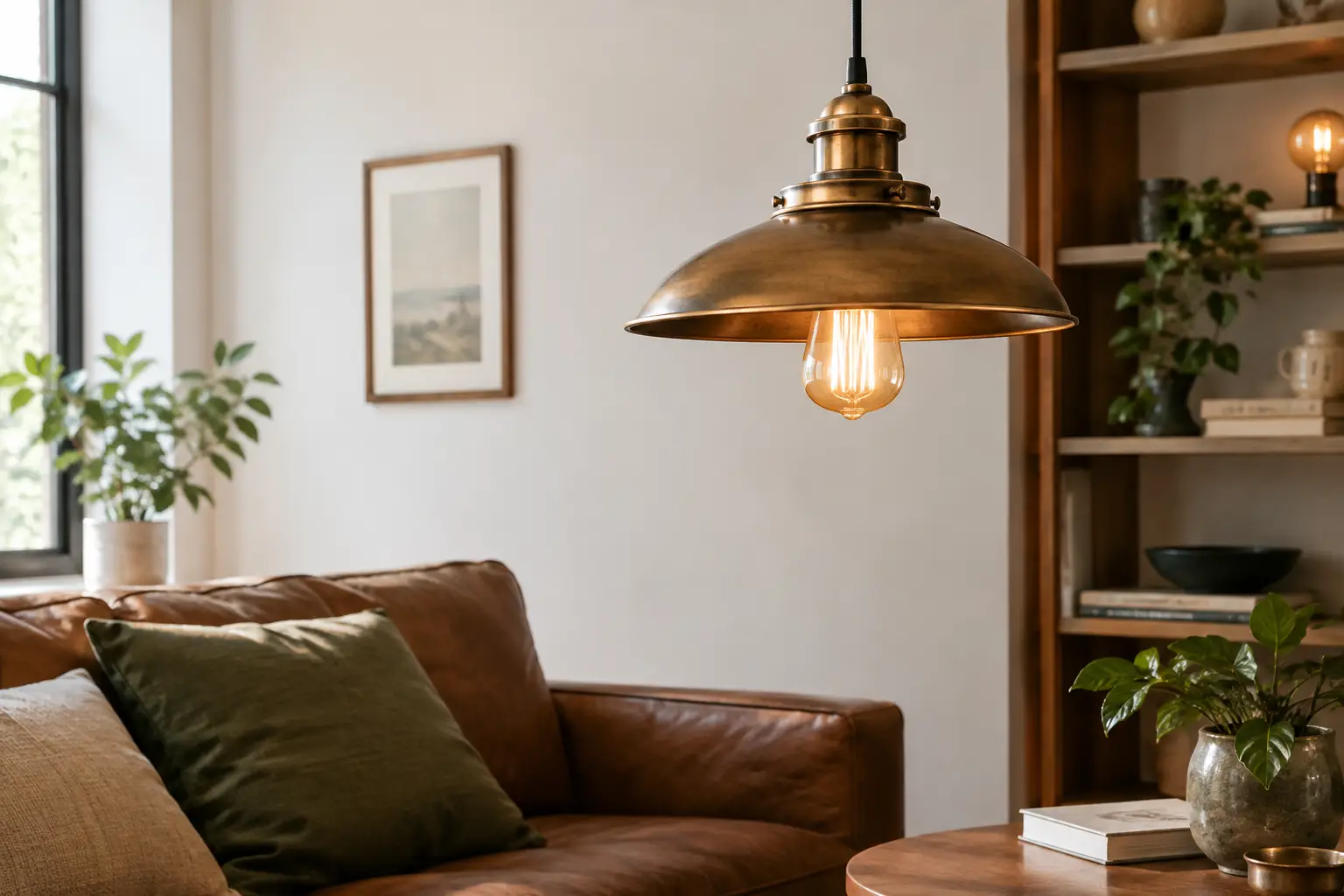
A room can be beautifully furnished and still feel anonymous until the light is right. Vintage lighting changes that equation: it introduces material, silhouette, and a particular quality of glow that contemporary fixtures often imitate but rarely reproduce. A Murano glass pendant, a sculptural 1970s floor lamp, or a brass Art Deco wall sconce does more than illuminate a surface. It establishes the visual temperature of the entire interior.
For collectors and design-conscious homeowners, the appeal lies not in nostalgia alone. The best historic fixtures carry evidence of a specific design language, whether the disciplined geometry of Art Deco, the expressive experimentation of Italian modernism, or the organic glamour of mid-century glass. They make an interior feel considered rather than merely decorated.
Why Vintage Lighting Has Lasting Presence
Lighting is experienced at eye level and above it, which gives it unusual authority in a room. A chair can be overlooked; a distinctive chandelier rarely can. Its profile is visible from multiple angles, its materials react to daylight, and its illumination alters the character of every object around it.
This is why a single original fixture can have more impact than a series of decorative additions. Brass develops a soft depth over time. Handblown glass captures irregularities that make light feel alive. Painted metal, smoked acrylic, parchment, travertine, chrome, and lacquer each produce a different dialogue between the object and the room.
Italian vintage lighting is especially compelling because it often balances technical invention with theatricality. Postwar designers and manufacturers treated a lamp as a complete object, not simply a functional necessity. The result may be a precise geometric suspension, a cluster of colored glass, or a floor lamp whose adjustable arm gives it an almost architectural presence.
Age is not automatically a guarantee of quality. A fixture becomes truly desirable when craftsmanship, condition, proportion, and design relevance come together. The goal is not to fill a home with old objects. It is to select pieces with enough visual conviction to remain interesting for decades.
Choosing Vintage Lighting by Room and Function
The most successful choice begins with function, then moves to style. Consider what the fixture must do before deciding how dramatically it should be seen. A dining table needs directed illumination and a pendant sized to the table rather than to the room alone. An entry can support a more sculptural statement because the fixture is often viewed in passing, from below, and against relatively open space.
In a living room, layered light is usually more persuasive than one central ceiling fixture. A chandelier or pendant can set the composition, while table lamps create intimacy and a floor lamp brings useful light to a reading chair or side table. Mixing periods can work beautifully when there is a clear material thread: for example, an Italian chrome lamp paired with a walnut credenza, or Murano glass balanced by a restrained contemporary sofa.
Bedrooms benefit from a gentler approach. Wall sconces offer a polished alternative to bedside lamps and free valuable surface space, but they should be installed at a height that feels natural when seated in bed. A pair need not be overly formal. Matching sconces create symmetry, while two complementary pieces from the same period can feel more collected and personal.
In a dining room, scale deserves particular attention. A fixture that is too small can disappear over a large table, while one that is too low interrupts sightlines and conversation. There is no universal measurement that solves every interior. Ceiling height, table shape, and the visual weight of the fixture all matter. A transparent glass chandelier may occupy considerable volume without making the room feel crowded, whereas an opaque metal pendant of the same width can appear much heavier.
The Materials That Define a Period
Certain materials immediately signal a historical moment, but they should be read with care. Murano glass is among the most recognizable, prized for its handworked surface, color, and ability to diffuse light with exceptional softness. Opaline, lattimo, pulegoso, and clear textured glass can each create entirely different effects. A cluster of Murano pendants can be luminous and dramatic, while a single glass table lamp offers a quieter point of refinement.
Brass belongs to many periods, from early twentieth-century decorative pieces to streamlined mid-century designs and the warmer, bolder lighting of the 1970s. Its patina is part of its value. Over-polishing can erase the nuanced surface that gives an original piece depth, although excessive oxidation may need sensitive cleaning. The right decision depends on the lamp’s finish, its age, and whether the existing surface is stable.
Chrome and steel bring a cooler, more graphic character. They work naturally with Italian modernism, Space Age forms, and interiors that favor contrast over softness. Acrylic and colored plastic, often associated with the 1960s and 1970s, can be equally collectible when the form is strong and the material has been well preserved. Slight signs of age are expected; cracks, distortion, or severe discoloration call for closer evaluation.
Authenticity, Condition, and Electrical Safety
Buying vintage means learning to distinguish honest age from avoidable compromise. Minor wear should not be confused with damage. Small marks to metal, gentle fading, or irregularities in handmade glass often confirm a fixture’s history. Missing components, unstable joints, substantial chips, and poorly executed repairs are different matters because they affect both appearance and use.
Provenance can add confidence, particularly for recognized designers or important manufacturers, but an object does not need a famous signature to be worthy. Many exceptional Italian and European fixtures were produced by workshops whose identities are less widely documented. Construction quality, original details, material integrity, and an informed assessment of period are often more meaningful than a label alone.
Electrical condition requires practical attention. Original wiring can be historically interesting, but it may not be appropriate for regular use in a contemporary home. Rewiring by a qualified professional is often the sensible choice, especially for lamps that will be used daily. Confirm bulb compatibility, voltage requirements, grounding where applicable, ceiling canopy condition, and the weight-bearing capacity of the intended installation point.
This is not a compromise of authenticity when handled correctly. A carefully updated electrical system allows the fixture to live in the present while preserving its original structure, shade, glass, metalwork, and visual identity.
How to Mix Periods Without Losing Coherence
A home furnished entirely in one period can be striking, but it can also become overly literal. Vintage lighting is often most effective when it creates a conversation across decades. An Art Deco chandelier can sharpen a minimalist dining room. A 1970s Italian mushroom lamp can soften a tailored mid-century interior. A pair of restrained brass sconces can bring warmth to a contemporary hallway with stone or plaster walls.
The key is to repeat one or two visual ideas rather than every stylistic detail. You might connect disparate pieces through amber glass, black metal, polished chrome, or rounded forms. Alternatively, use contrast deliberately: a highly ornamental chandelier above a clean-lined table becomes more convincing when the surrounding palette remains calm.
Avoid treating every fixture as a statement piece. A room needs hierarchy. If the ceiling light is elaborate, let the secondary lamps be quieter. If a monumental floor lamp is the focal point, choose a ceiling fixture that supports the composition rather than competing with it. This measured approach allows each object to be seen clearly.
A More Considered Way to Buy
Before choosing a piece, look at the room in the evening as it is now. Notice where shadows collect, where conversation happens, and which materials need warmth or definition. Then assess the fixture as both an object and a source of light. Its dimensions, mounting method, shade condition, wiring, and relationship to the architecture are as relevant as its beauty.
Sound Of Vintage Italy approaches vintage lighting as a curated category of design objects, from expressive Murano glass to wall sconces, table lamps, floor lamps, and chandeliers with distinct historical character. The value of a focused selection is not simply convenience. It is the ability to encounter pieces that already speak a coherent visual language while retaining their individual histories.
Choose the fixture that continues to hold your attention when it is switched off. The finest light is not only cast across a room; it is carried by the object itself, through the quiet authority of its form, material, and past.