
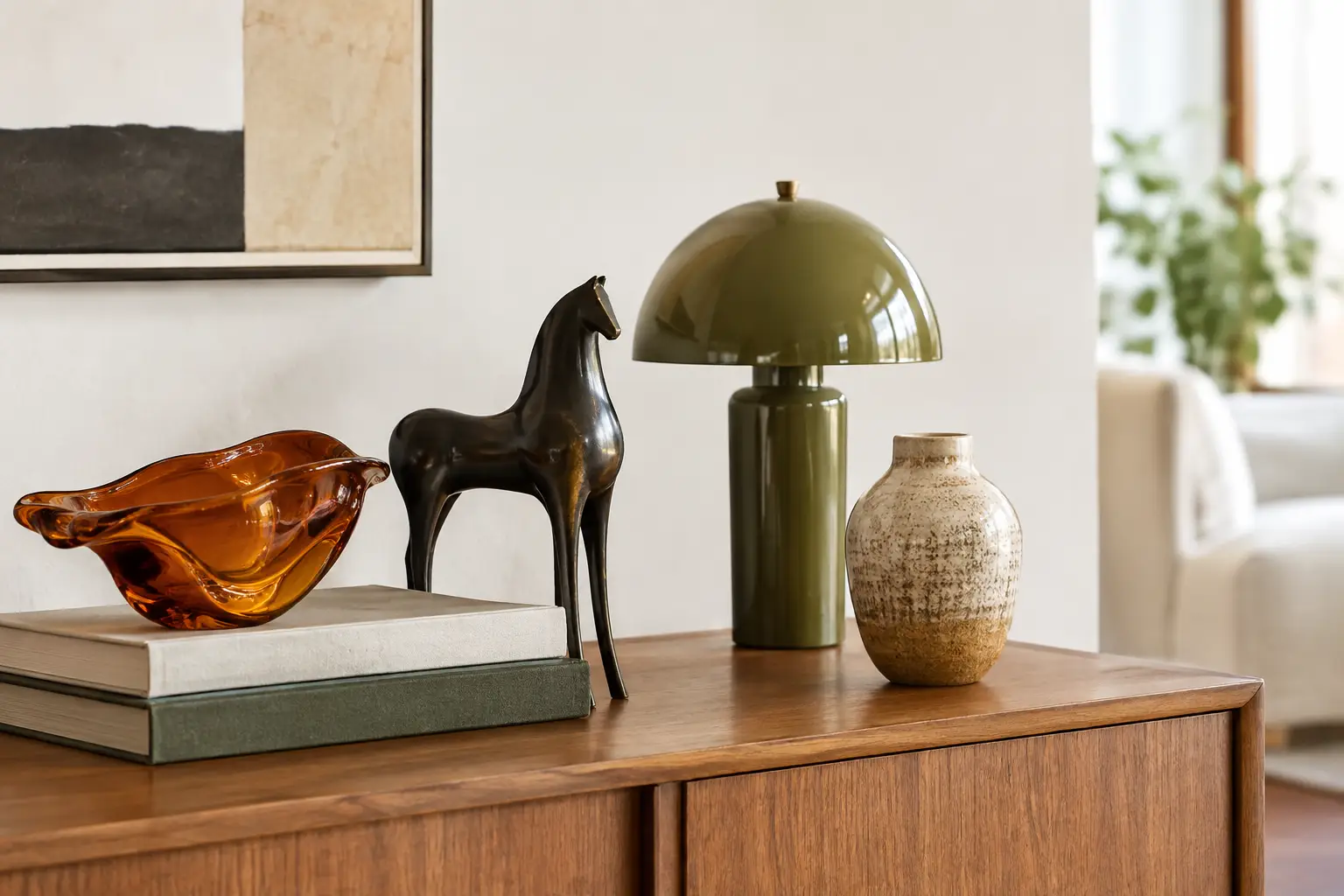
A room becomes memorable when one object changes its temperature: a Murano glass lamp casting an amber glow, a 1970s mirror catching an unexpected angle, a small Art Deco box bringing precision to an otherwise quiet console. The most compelling collectible design trends are not about filling a home with recognizable names. They are about choosing pieces with enough presence to hold a space, and enough history to reward a closer look.
For collectors and design-conscious homeowners, the current direction is clear. Decorative objects are being selected less as background and more as cultural artifacts: works of glass, metal, lacquer, and wood that carry the signature of an era, a workshop, or a particular way of living. The appeal lies in visual distinction, but also in permanence. A well-chosen vintage piece does not need to follow a season to remain relevant.
Collectible Design Trends: A Return to Character
The era of the perfectly coordinated interior is giving way to rooms with contrast. Rather than matching every surface and silhouette, collectors are pairing a clean-lined contemporary sofa with a Barovier-style chandelier, or placing a 1950s Italian brass lamp beside a severe modern table. This approach makes space for individual objects to be seen.
That shift has made provenance, material, and condition more significant than broad labels alone. “Vintage” is no longer enough to describe an object’s appeal. Buyers increasingly want to know whether a glass piece reflects Murano craftsmanship, whether a lighting fixture retains its original patina, and whether the shape belongs to a documented design language such as Italian Mid-Century Modern, Art Nouveau, or Art Deco.
The distinction matters because collectible design is not simply old design. It is design with a recognizable point of view. A graceful 1940s sconce, a vivid Venetian vase, or a Sicilian ceramic object may all be decorative, yet each brings a different cultural register into an interior.
Sculptural Lighting Takes the Lead
Lighting has moved from supporting role to focal point. This is especially visible in the demand for chandeliers, wall sconces, table lamps, and floor lamps with expressive forms: blown glass petals, ribbed shades, brass branches, painted metal, and geometric shades that create their own architecture after dark.
Italian lighting of the 1950s through the 1970s remains particularly desirable because it balances function with theatricality. A chandelier can be airy rather than imposing. A floor lamp can introduce a vertical line without visually crowding a room. A pair of sconces can give a hallway, dining room, or bedroom a deliberate sense of rhythm.
There is a practical consideration here. Original vintage lighting may require inspection, rewiring, or adaptation to local electrical standards. For a collector, this is not a flaw but part of responsible ownership. The value of an authentic fixture often lies in preserving its period elements while ensuring that it can be used safely in a contemporary home.
When selecting lighting, scale is often more important than rarity. An exceptional chandelier that overwhelms a low ceiling will not show to its advantage. Conversely, a modest but beautifully proportioned table lamp can become the object that completes a reading corner, entry table, or bedside arrangement.
Murano Glass Beyond the Display Cabinet
Murano glass continues to attract collectors because it combines technical mastery with a remarkable range of expression. Clear and smoky tones suit restrained interiors; opaline, amethyst, ruby, and gold-flecked glass introduce color without the flatness of a painted surface. Every variation in density, bubble, swirl, and reflection gives the material a living quality.
The current preference is for Murano used as part of daily visual life rather than treated as a distant museum object. A single substantial vase on a dining table, a pair of glass lamps on a lacquered cabinet, or a handblown bowl placed against matte plaster can create a dialogue between transparency and texture.
The most successful placements allow the glass room to breathe. Murano is visually active, especially when illuminated, so it benefits from nearby surfaces that are calm: travertine, walnut, linen, plaster, or dark-stained wood. Several highly decorative pieces grouped together can be magnificent, but only when united by color, form, or period. Otherwise, the effect can become decorative noise.
The New Value of Decorative Small Objects
Large furniture commands attention, but smaller collectible objects are increasingly shaping the identity of a room. Decorative boxes, picture frames, ashtrays, candlesticks, trays, and fashion accessories offer an accessible way to collect historical design without making a major spatial commitment.
Their strength is concentration. A finely made compact, a brass animal sculpture, or a hand-painted Sicilian piece can carry a whole vocabulary of style in the space of a bookshelf. These objects also invite collecting in series, where the pleasure comes from contrast: three different examples of Italian glass, several silver-toned table pieces from distinct decades, or a grouping of ceramic forms in related earth tones.
Small objects should not be scattered indiscriminately. Give them a clear setting: a tray, a vitrine, the center of a coffee table, or a shelf with enough negative space around it. The goal is not to make an interior feel crowded with possessions. It is to make each object legible.
For those beginning a collection, this category offers a useful lesson in discernment. Look closely at craftsmanship, weight, finishing, material transitions, and signs of handwork. A piece does not need to be monumental to be distinctive. Often, the most personal collection begins with one object chosen purely because it is impossible to confuse with anything else.
Art Deco and Art Nouveau in Contemporary Rooms
Art Deco remains compelling for its command of line, symmetry, and material contrast. Chrome, mirrored glass, lacquer, blackened wood, velvet, and geometric motifs can lend an interior a composed, cinematic quality. Yet Deco is most persuasive when used with restraint. One strong mirror or a pair of period lamps may say more than a room staged entirely around the style.
Art Nouveau creates a different atmosphere. Its organic curves, floral references, and sinuous metalwork soften contemporary architecture, particularly in spaces dominated by straight lines and neutral finishes. An Art Nouveau vase, mirror, or decorative object can introduce movement without requiring a complete period setting.
Neither style needs to be treated as a historical reconstruction. A 1920s object can look precise against modern stone and minimal upholstery. A turn-of-the-century decorative accent can feel surprisingly fresh beside a low, contemporary profile. The point is tension between periods, not imitation of the past.
Italian Modernism as a Living Language
Italian modernism continues to define the taste of collectors because its best examples are both rigorous and sensuous. It values proportion, intelligent material choices, and silhouettes that feel unmistakably designed without becoming cold. Rosewood, walnut, brass, smoked glass, parchment, and polished steel all appear with a sense of purpose.
This is also why authentic period pieces remain preferable to generic reproductions. A reproduction may provide a similar outline, but it rarely carries the same material depth, construction, or patina. The subtle wear of a vintage surface is not merely evidence of age. It is often what prevents an object from looking newly manufactured and anonymous.
That does not mean every room should be built only from originals. Contemporary furniture can provide comfort and functional reliability, while a selected vintage table, lamp, or mirror supplies identity. The strongest interiors tend to let each category do what it does best.
Buying With a Collector’s Eye
Collectible design rewards patience. Before choosing an object, consider how it will be seen, used, and maintained. Ask whether the scale works in the intended room, whether the materials suit the surrounding finishes, and whether the condition aligns with your expectations. Original wear can be desirable; structural instability, compromised glass, or careless alterations are different matters.
It is equally useful to distinguish between an object that photographs well and one that holds attention in person. Texture, weight, reflections, and craftsmanship often reveal themselves slowly. This is where a focused selection becomes valuable. A specialist edit such as Sound Of Vintage Italy offers a way to encounter Murano glass, vintage lighting, furnishings, and distinctive Sicilian objects within a coherent aesthetic frame.
The most enduring collections are not assembled to prove knowledge or chase scarcity. They are built through recognition: the instant when an object’s line, material, and history feel inseparable from the place you are creating. Choose pieces that can keep speaking after the trend cycle has moved on.