
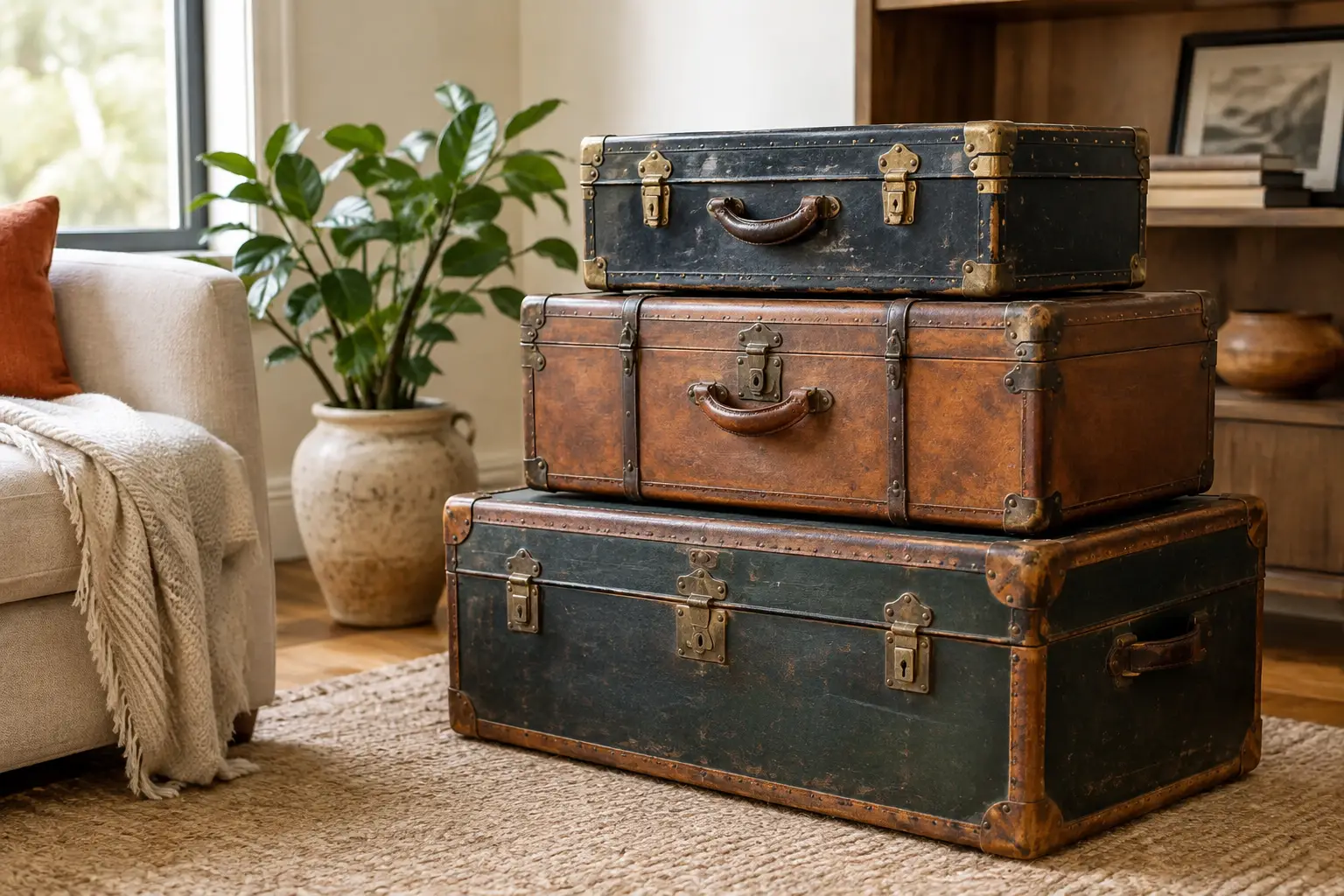
A well-chosen trunk changes the atmosphere of a room before it stores a single object. The best vintage travel trunks carry the marks of departure and arrival: brass corners softened by handling, canvas darkened by time, luggage labels that suggest stations, ports, and hotels now gone. In a collected interior, this is not simply storage. It is an architectural object with a history.
Unlike a new coffee table designed to imitate age, an authentic travel trunk has proportion, material presence, and irregularity built into it. It can ground a quiet Mid-Century living room, lend depth to a contemporary entryway, or introduce an unexpected note of adventure into a refined bedroom. The right example is never chosen on nostalgia alone. Construction, condition, provenance, and scale all shape its decorative value.
What Defines the Best Vintage Travel Trunks
The most compelling trunks were made to endure real journeys. Their appeal begins with utility: hardwood frames, reinforced corners, leather handles, metal locks, and thick canvas or leather coverings. Those practical details create the graphic rhythm that makes a trunk so visually convincing in an interior.
A strong vintage example should retain its original character, even when it shows honest wear. Surface scratches, a worn handle, oxidized hardware, and faded labels can be desirable when they are consistent with the piece’s age and use. What matters is that the trunk remains structurally sound. A dramatic patina cannot compensate for a warped lid, a weak base, severe water damage, or active mold.
The finest pieces also have a clear identity. A compact leather valise has a different role from a large flat-top steamer trunk, while a wardrobe trunk with interior hangers and drawers has a more theatrical presence. Rather than searching for a generic antique trunk, look for a type that belongs naturally in the room and reflects the way you intend to use it.
Flat-top steamers
The flat-top steamer is the most versatile format for interiors. Its level lid allows it to work as a coffee table, end-of-bed bench, or low display surface, while its broad silhouette gives a room visual weight. Models covered in dark canvas, striped fabric, or leather are especially effective against plaster, warm wood, linen, and aged brass.
For a living room, the height deserves close attention. A trunk that is too low can feel stranded beside a substantial sofa. A shallow example may be ideal beneath a window or at the foot of a bed, where it adds storage without interrupting the room’s lines.
Dome-top and rounded trunks
Dome-top trunks are more romantic and less adaptable as tables, but their curved profiles bring movement to spaces dominated by straight-edged furniture. They suit bedrooms, dressing rooms, hallways, and rooms with a more layered, old-world character.
Because the lid cannot hold a tray or a stack of books as easily, these trunks work best as sculptural storage. Place one beneath a gilt mirror, beside an upholstered chair, or under a stair landing where its shape can be appreciated from a distance.
Leather trunks and refined luggage
Leather travel trunks offer a quieter, more tailored expression than painted or canvas-covered models. Their appeal lies in the tonal variation of the hide: cognac, tobacco, oxblood, and deep brown become richer with age. Brass buckles and nailhead details add a measured note of luxury without making the piece feel overly formal.
Smaller leather luggage is particularly useful where a full trunk would overwhelm the room. A pair of cases can be stacked beside a reading chair, used to conceal documents in a study, or arranged on an open shelf with art books and ceramics. Their scale makes them easy to collect, but they should still be selected for construction rather than logo alone.
Best Vintage Travel Trunks by Material and Character
Canvas-covered trunks are among the most recognizable. Their softened surfaces and reinforced edges create an immediate sense of travel, especially when original straps, labels, and lock plates survive. Monogrammed canvas luggage can be highly desirable, but branding should never replace scrutiny. Look carefully at construction, hardware, stitching, lining, and provenance before assigning a maker or date.
Painted trunks bring a different energy. Deep green, navy, black, burgundy, and hand-stenciled finishes can introduce color without the visual density of leather. They are especially appealing in an entryway or children’s room, where a practical storage piece benefits from a more expressive surface. A faded painted finish should be preserved when stable, not stripped away in pursuit of a falsely pristine appearance.
Wooden campaign-style trunks tend to feel more architectural. Often fitted with metal straps, recessed handles, or protective studs, they sit comfortably beside English-inspired furniture, industrial lighting, and objects with military or maritime references. Their restraint also makes them suitable for more minimal interiors, provided the surrounding pieces do not turn the room into a theme.
Finally, there are the exceptional trunks: wardrobe models, hat trunks, cabin trunks, and examples with fitted interiors. These are less about flexible storage and more about presence. Original drawers, hanging compartments, printed linings, and maker’s plaques add considerable interest, though they also require more careful condition assessment.
How to Assess Condition Before Buying
A vintage trunk should be inspected as both furniture and historical object. Start with the frame. The lid should open and close without extreme resistance, the base should sit level, and the corners should be secure. Minor movement in old hardware is expected; major instability is not.
Then examine the surfaces. Dry leather can often be stabilized by a specialist, but leather that is brittle, split across large areas, or heavily flaking may not withstand regular use. Canvas should be checked for tears, previous overpainting, and detached edging. On painted trunks, distinguish between attractive age and neglect that has compromised the underlying wood.
The interior is equally revealing. A clean, lightly worn lining is a strong sign, while sharp mustiness, mildew spotting, insect evidence, or extensive staining should prompt caution. Some collectors prefer untouched interiors, including old labels and paper linings. Others require a restored interior for practical storage. Neither approach is inherently better, but the choice affects both cost and future use.
Locks, keys, straps, and handles add value when original, yet their absence is not always disqualifying. A rare trunk with a missing key can still be an excellent decorative acquisition. Replacement parts should be disclosed and priced accordingly. The essential question is whether restoration supports the trunk’s integrity or disguises damage that should remain visible.
Styling Vintage Trunks Without Turning a Room Into a Set
The most convincing interiors allow a trunk to function while preserving its singularity. A large flat-top example can anchor a seating arrangement with a restrained tray, a single art book, and a sculptural glass object. Avoid covering every inch of the lid. The hardware and surface are part of the composition.
In a bedroom, position a trunk at the foot of the bed and let it balance soft upholstery with a firmer, more traveled material. A dome-top trunk can become a focal point in a guest room, especially when paired with a simple lamp and an unframed artwork rather than a collection of obvious travel memorabilia.
For smaller spaces, stacking is effective when the cases differ slightly in size and finish. Combine a compact leather case with a canvas suitcase or hatbox, leaving enough negative space around them to avoid clutter. The contrast between hard luggage and softer materials such as bouclé, velvet, wool, or washed linen is often more persuasive than matching every period exactly.
A trunk also earns its place in an entryway. It provides a landing spot for gloves, scarves, and seasonal accessories while setting an immediate tone of discernment. Here, a piece with strong hardware or a rich painted surface can be more impactful than a larger but anonymous example.
Authenticity, Attribution, and Decorative Value
Named luxury luggage makers attract understandable attention, but attribution requires rigor. Labels can be missing, replaced, or reproduced. Monograms and exterior patterns may be imitated. A trunk described as being in the style of a famous house is not the same as a verified example by that maker, and the distinction should be reflected in both documentation and price.
For many interiors, however, an unbranded trunk with exceptional materials and honest age is the more interesting choice. It may offer a stronger silhouette, a more unusual finish, or better value than a heavily branded piece in compromised condition. Decorative merit and collector value often overlap, but they are not identical.
At Sound Of Vintage Italy, the most memorable objects are selected for that balance: an authentic material story, a distinctive visual language, and the ability to live naturally among furniture, lighting, and art. A travel trunk should feel discovered, not staged.
Choose the example that gives the room a sense of accumulated life. Whether it is a leather steamer at the foot of a bed or a compact canvas case beside a chair, the right trunk should look as though it has finally arrived where it belongs.