
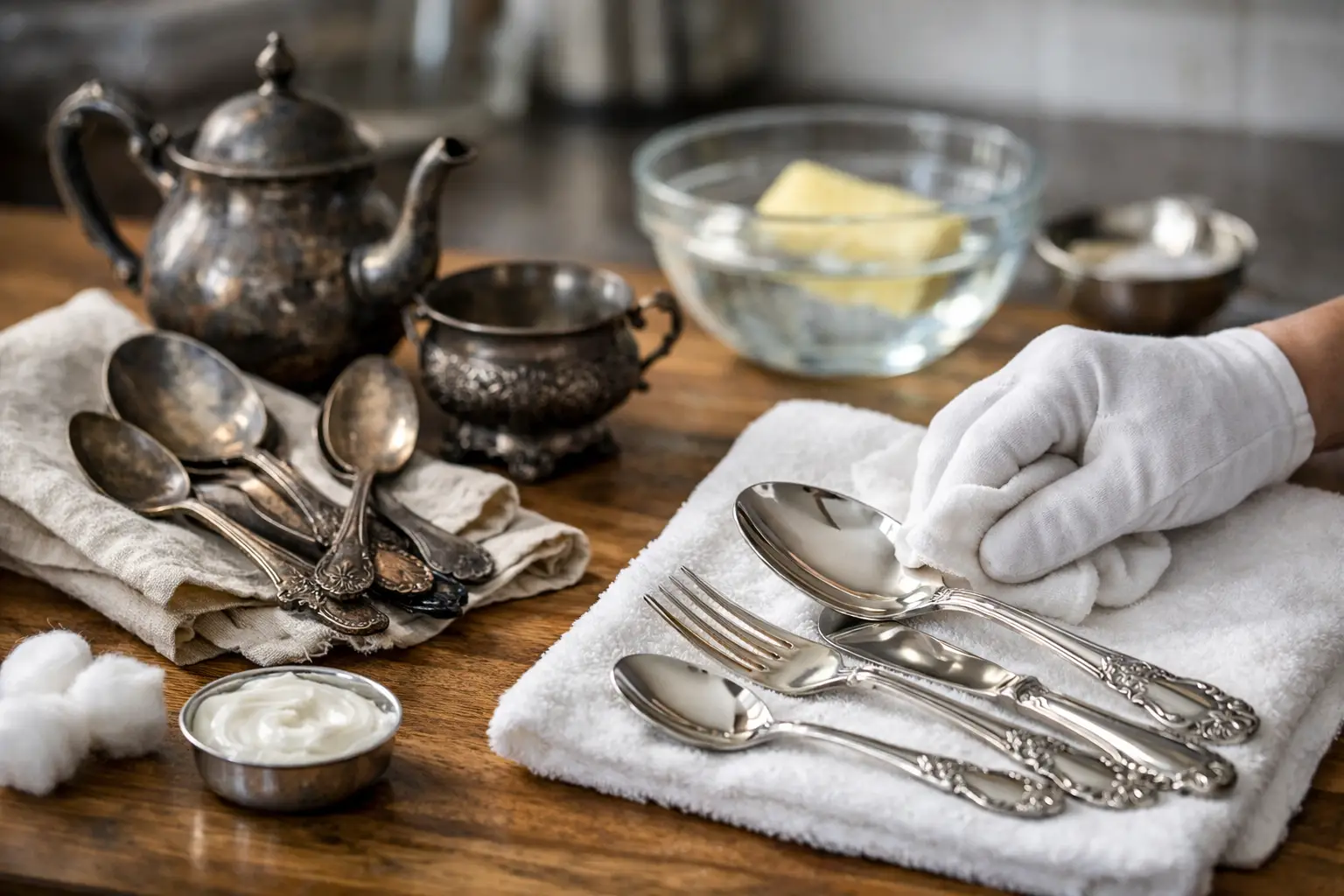
A vintage place setting rarely needs to look factory-new. Its appeal often lies in the soft glow that time creates: a subtle warmth along a spoon bowl, a darker recess in an engraved handle, a quiet contrast that gives the table character. Knowing how to polish vintage silverware means restoring light without erasing that history – and without wearing through delicate silver plate.
The best result is not a hard, mirror-bright surface. It is silverware that looks cared for, proportionate to its age, and ready to sit beside linen, Murano glass, or a well-chosen ceramic service. Start gently, assess the metal before treating it, and let the piece itself determine how far the cleaning should go.
Identify the Silver Before You Polish
The word “silver” can describe several very different materials. Sterling silver is an alloy containing 92.5 percent silver and is often marked “Sterling,” “925,” or, on older European pieces, with a series of maker’s and assay marks. Silver plate is a thin layer of silver applied over a base metal, usually brass, copper, or nickel silver. It may be marked EPNS, A1, EP, or with a manufacturer’s stamp.
This distinction matters. Sterling can tolerate careful, occasional polishing over generations. Silver plate requires much more restraint because every abrasive polish removes a minute amount of its silver surface. When the plate has worn away, a warm yellow brass or reddish copper tone may show through. That wear is not always a defect. On a beautifully shaped early 20th-century service, it can be part of the object’s visual truth.
Look closely at high-contact points before beginning: fork tines, knife blade edges, the tips of handles, and raised decoration. If you see base metal already emerging, avoid commercial polish on those areas. A gentle wash and a soft buff are the more considered choice.
How to Polish Vintage Silverware Without Damaging It
Begin with a simple cleaning step. Wash each piece by hand in lukewarm water with a small amount of mild, phosphate-free dish soap. Use a soft cotton cloth or a very soft natural-bristle brush to lift away grease, old food residue, and dust caught in decorative details. Rinse promptly and dry completely with a clean, absorbent towel.
Never leave vintage silverware soaking. Prolonged contact with water can encourage corrosion in joints, damage old knife handles, and leave mineral marks. This is especially relevant for hollow-handled knives, which may contain a resin or cement core beneath the silver shell.
Once dry, evaluate the tarnish. Light, even tarnish often needs no more than a jeweler’s polishing cloth made for silver. Fold the cloth into a small pad and work with light pressure in straight, controlled motions. Turn to a clean section of the cloth frequently. The dark residue it picks up is normal, but the goal is to remove surface oxidation, not to rub the metal aggressively.
For moderate tarnish, use a reputable non-abrasive cream polish formulated specifically for silver. Apply a very small amount to a soft cloth rather than directly onto the silverware. Work one section at a time, following the length of a handle and the direction of any decorative chasing. Avoid forcing polish into monograms, beaded borders, or engraved ornament. Residue left in those recesses can dry white and flatten the visual depth of the design.
Remove the polish with a separate soft cloth, then buff lightly until the surface develops an even, restrained luster. If a piece still looks dark in the deepest details, leave it. The shadow around a pattern is often what makes antique and vintage silverware legible and elegant on the table.
Treat Knives as a Separate Category
Vintage knives deserve particular care. Their blades may be stainless steel, carbon steel, or silver plate, while their handles may be hollow sterling or plate. Do not immerse them, put them in a dishwasher, or scrub the seam where blade and handle meet.
Wipe the blade with a lightly damp cloth, dry it immediately, and polish the handle separately. If carbon steel has developed dark spotting, a professional conservator is preferable to an improvised treatment. Attempting to brighten the blade with harsh abrasives can alter its finish and compromise its historical character.
What Not to Use on Old Silver
A number of popular household methods promise dramatic results, but they are poorly suited to collectible or plated pieces. The aluminum foil and baking soda method, for example, uses an electrochemical reaction to remove tarnish quickly. It can leave the surface looking unnaturally flat, affect delicate decoration, and remove the darker oxidation that gives old silver dimension.
Avoid toothpaste, baking soda pastes, scouring powders, steel wool, and rough paper towels. All are abrasive to some degree. They may create fine scratches that are almost invisible at first but become increasingly apparent under dining-room light. Lemon juice, vinegar, and other acidic treatments should also stay out of the process. They can react unpredictably with base metals, old repairs, and plated surfaces.
The dishwasher is the most reliable way to shorten the life of vintage silverware. Heat, detergent, and contact with stainless steel can cause staining, pitting, and discoloration. Even sterling pieces in excellent condition are better washed and dried by hand.
Preserve Patina Where It Belongs
Patina is not simply dirt, and tarnish is not always an enemy. In silverware with Art Nouveau curves, Art Deco geometry, or elaborate Victorian engraving, the darker tone within a recessed motif creates contrast. Remove every trace of it and the pattern can appear visually weaker, almost over-restored.
This is where a collector’s eye is more valuable than a quest for uniform shine. Polish the broad, exposed surfaces that catch the light: the bowl of a spoon, the front of a fork handle, the outer edge of a serving piece. Let the deep lines of a monogram or the interior of floral ornament remain gently toned.
There is also a practical consideration. Heavily polished silver attracts attention for its brilliance, while softly polished silver integrates more naturally into an interior or table setting. A set with a quiet patina can feel especially at home beside walnut, marble, textured linen, and period glass.
A Careful Routine for Serving Pieces
Large serving spoons, fish servers, cake knives, and ornate ladles often have greater decorative value than everyday flatware. Their shape makes them susceptible to accidental bending, especially at the neck between bowl and handle. Support the piece on a folded towel while cleaning, and never hold it in midair as you rub.
For pierced servers or pieces with detailed borders, use a soft brush only after washing and only with minimal pressure. If old polish has hardened inside the decoration, do not scrape it out with a toothpick or metal tool. A cotton swab slightly dampened with distilled water can help lift residue, provided the piece is dried immediately afterward.
When a serving piece has a maker’s mark, presentation inscription, or unusually fine hand engraving, restraint protects both its aesthetic and collectible value. The mark does not need to be bright to be meaningful. It needs to remain crisp.
Store Vintage Silverware to Slow Tarnish
Silver tarnishes through contact with sulfur compounds in the air, moisture, rubber, wool, and certain papers. After polishing, make sure every piece is fully dry. Store it in an anti-tarnish cloth roll, a lined flatware chest, or individual soft cloth sleeves.
Avoid rubber bands, plastic wrap pressed tightly against the metal, and ordinary cardboard boxes. If using a chest, an anti-tarnish strip can help, but it should not touch the silver directly. Keep the storage area dry and away from strong heat or fluctuating humidity.
For pieces used regularly, a light hand wash and thorough drying after each use often reduces the need for polishing. Silver that is handled and maintained with care develops a more graceful surface than silver repeatedly stripped back to brightness.
When Professional Conservation Is the Better Choice
Some signs call for expertise rather than more polish. These include flaking plate, deep black or green corrosion, loose knife handles, cracks, bent tines, extensive dents, or a sticky residue around old repairs. A qualified silversmith or conservator can assess whether a repair is appropriate and whether intervention would support or diminish the object’s value.
The same applies to rare sets with documented provenance, unusual maker’s marks, or significant design history. In these cases, cleaning is part of stewardship, not simply preparation for use. Sound Of Vintage Italy approaches objects with that same respect for material, period, and presence: the finish should support the piece’s identity, never overwrite it.
A polished vintage service has its strongest effect when it still looks like it has lived a life. Leave a little depth in the pattern, preserve the softness of the metal, and allow each place setting to bring its own history to the table.