
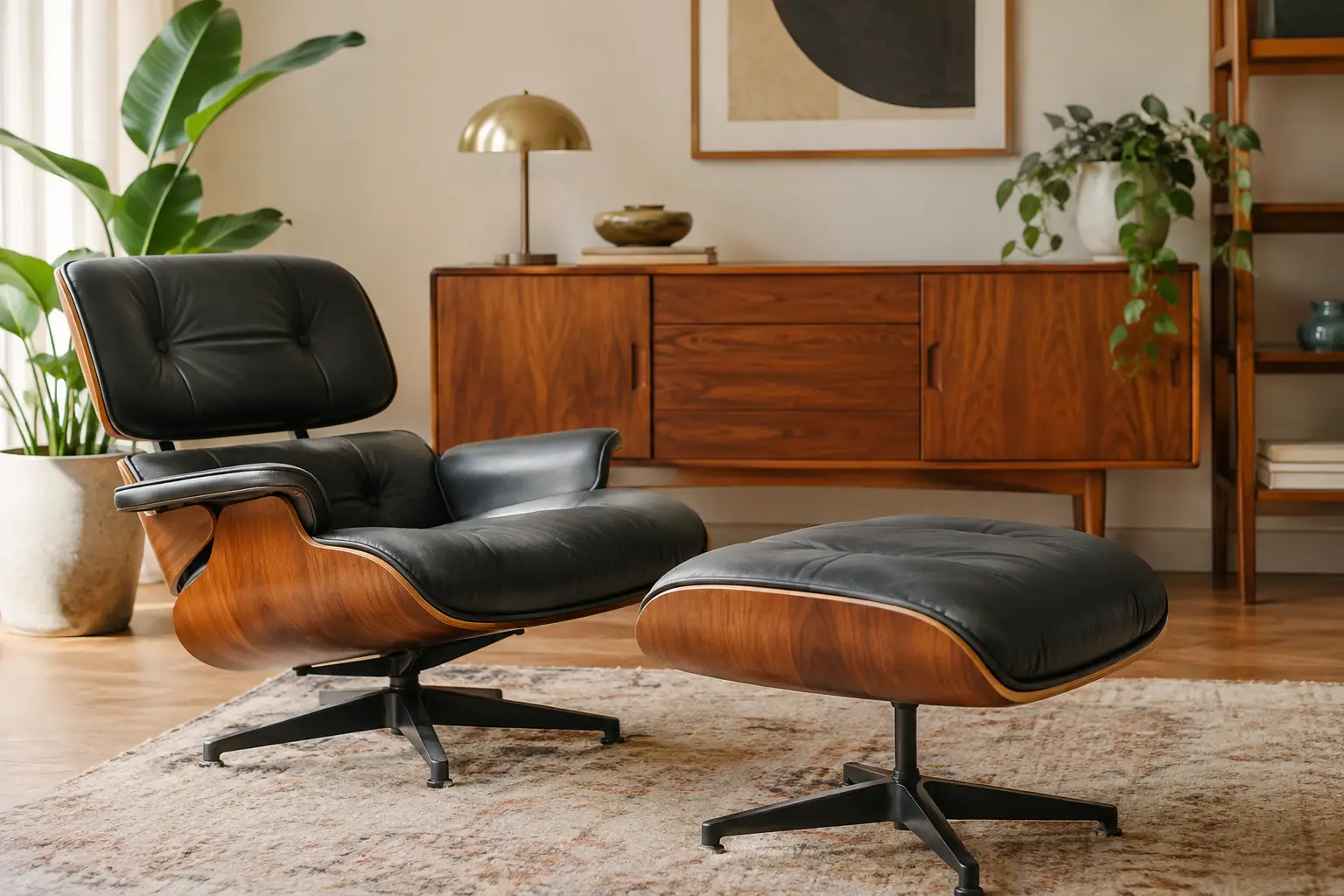
A room can feel fully resolved with a single object: a sculptural Italian floor lamp beside a quiet linen sofa, a walnut sideboard with an impeccably drawn profile, or a Murano glass chandelier that changes character from morning to evening. The most compelling vintage furniture trends are not about recreating a decade. They are about choosing pieces with enough material presence, provenance, and visual intelligence to make an interior feel personal.
For collectors, designers, and homeowners who have grown tired of interchangeable rooms, vintage offers a more considered vocabulary. It introduces texture where new furniture can feel overly polished, variation where uniformity becomes flat, and a sense of time that cannot be manufactured on demand. The direction now is less about period-perfect decoration and more about the confident meeting of eras.
Vintage Furniture Trends Favor the Collected Interior
The shift away from matching furniture sets has been gathering pace for years, but it is now central to sophisticated interiors. A collected room does not look assembled in a single weekend or sourced from one showroom. It allows a 1950s Italian armchair to sit near a contemporary sofa, an Art Deco mirror to bring geometry to a restrained entry, and a handblown glass lamp to soften clean architectural lines.
This approach demands discernment. Mixing eras is not a license to fill a room with unrelated objects. The strongest spaces establish a dialogue through repeated qualities: perhaps warm woods, curving silhouettes, blackened metal, or a shared palette of tobacco, cream, and amber. Scale matters just as much. A monumental mid-century credenza can anchor a room, while a petite 1930s occasional table may be better treated as an accent rather than a focal point.
The appeal is partly emotional, but it is also practical. A carefully chosen vintage piece gives an interior a visual center of gravity. Instead of adding many decorative accessories, one exceptional cabinet, lounge chair, or mirror can create the sense of completion that a room lacks.
Italian Mid-Century Remains a Defining Reference
Italian design from the 1940s through the 1970s continues to command attention because it balances function with theatricality. The period produced furniture that is often rational in construction yet expressive in line: tapered legs, brass details, richly figured woods, parchment surfaces, and silhouettes that feel light even when the pieces are substantial.
Mid-century Italian furniture is not a single style. A streamlined 1950s walnut console and a more exuberant 1970s chrome-and-glass table may belong to the same broad historical category while producing entirely different effects. This is precisely why the label should be a starting point, not the end of the search. Look at proportion, condition, materials, and the relationship a piece will have with its surroundings.
For American homes, where rooms can be more generous in scale than European apartments, larger Italian case goods and statement dining tables can work especially well. In a smaller space, consider a pair of slender nightstands, a compact bar cart, or a well-proportioned desk. These offer the character of the period without overwhelming the architecture.
Curves, Soft Geometry, and the Return of Sensual Form
Hard-edged minimalism has given way to a warmer appreciation for curves. Rounded lounge chairs, bulbous ceramic bases, kidney-shaped tables, scalloped upholstery, and gently arched mirrors bring a sense of ease to interiors dominated by straight walls and rectangular windows. Vintage examples tend to feel more convincing than new imitations because their forms are rooted in a specific design language rather than a passing retail trend.
The key is to resist turning every surface into a curve. A low, rounded 1970s sofa may look extraordinary against a disciplined rectangular rug and a linear bookcase. Conversely, a strong Art Deco cabinet with stepped geometry can benefit from the softness of a curved lamp or a pair of upholstered chairs. Contrast creates clarity.
This preference for softer form has also renewed interest in the 1970s. Burl wood, smoked glass, lacquered finishes, polished chrome, and deeply comfortable seating are reappearing in rooms that want glamour without stiffness. These materials need thoughtful editing. One striking burl cabinet can feel luxurious; a room filled with competing glossy surfaces can quickly become visually heavy.
Craft Materials Are Taking Center Stage
The current appetite for authenticity is visible in the materials people seek out: solid walnut, rosewood, oak, travertine, marble, rattan, brass, leather, and handblown glass. These are not merely finishes. They age, reflect light, and carry traces of making. Their irregularities are often part of their appeal.
Wood furniture deserves close attention. Veneer is not inherently a lesser choice, particularly in fine mid-century design, where expertly selected veneers were used to emphasize grain and create elegant surfaces. What matters is quality of execution and condition. Look for lifting edges, deep scratches, sun fading, water rings, or repairs that compromise the original structure. Honest age is desirable; neglect is not.
Stone is equally persuasive, especially travertine and marble. A vintage stone coffee table offers weight and permanence, but it requires an honest assessment of the setting. It may be impractical in a home with very young children, difficult stair access, or fragile floors. The best purchase is not always the most dramatic object in isolation. It is the one that can be lived with and appreciated every day.
Lighting Is Becoming the Room’s Collectible Element
Furniture establishes the structure of a room, but lighting often gives it atmosphere. This is why vintage lighting has become a major focus for collectors and interior designers. A table lamp can bring color, texture, and sculpture to a side table. A wall sconce can turn a corridor into a deliberate space. A chandelier can define a dining room before any furniture is introduced.
Murano glass is especially relevant to this moment. Its color, translucency, and handmade variation offer an antidote to standardized lighting. A pale amber, opaline, or richly saturated Murano fixture can act as a luminous object even when switched off. In more restrained interiors, it provides a precise note of Italian character without requiring an entire room to follow a Venetian theme.
Vintage electrical pieces should be evaluated with care. Wiring, sockets, mounting hardware, and compatibility with local electrical standards all deserve professional attention. Rewiring can be a sensible part of preserving a fixture, provided it respects the original visual integrity. With lighting, safety and aesthetics should be treated as equally essential.
Art Deco and Decorative Antiques Add Precision
The growing interest in warm, layered interiors has also brought Art Deco and earlier decorative antiques back into focus. Art Deco contributes symmetry, contrast, polished surfaces, and architectural confidence. A mirror with a bold geometric frame, a compact cabinet with a figured veneer, or a pair of period lamps can sharpen a room that might otherwise feel too relaxed.
Antique pieces introduce a different kind of value: patina, craftsmanship, and historical specificity. They work particularly well when used with restraint. A nineteenth-century console under a contemporary artwork, for example, can create more tension and sophistication than an entire room furnished in a single historical style.
Provenance is worth considering, especially for signed design, rare editions, and objects from recognizable workshops. Yet an unsigned piece with excellent proportions and original materials can still be the right choice. Collectibility and decorative impact do not always move together. A room should not become a catalog of names at the expense of atmosphere.
How to Choose Pieces That Will Outlast the Trend
The most durable vintage choices are usually the ones that remain compelling after the initial excitement of discovery. Before buying, consider how a piece is made, how it has aged, and whether its scale serves the room. Ask whether it provides a function that is genuinely needed, whether it relates to something already owned, and whether its beauty depends on novelty alone.
A practical measure is to identify one or two pieces that carry the room’s strongest point of view, then let quieter elements support them. This can mean a 1960s sideboard paired with simple upholstered seating, or a dramatic Murano lamp placed on an otherwise understated console. The result feels intentional rather than over-styled.
At Sound Of Vintage Italy, the most distinctive selections are often those that hold several qualities at once: historical character, decorative force, and the ability to live naturally in a contemporary setting. A well-chosen vintage object should not merely reference the past. It should make the present room feel more exact, more memorable, and unmistakably its own.