
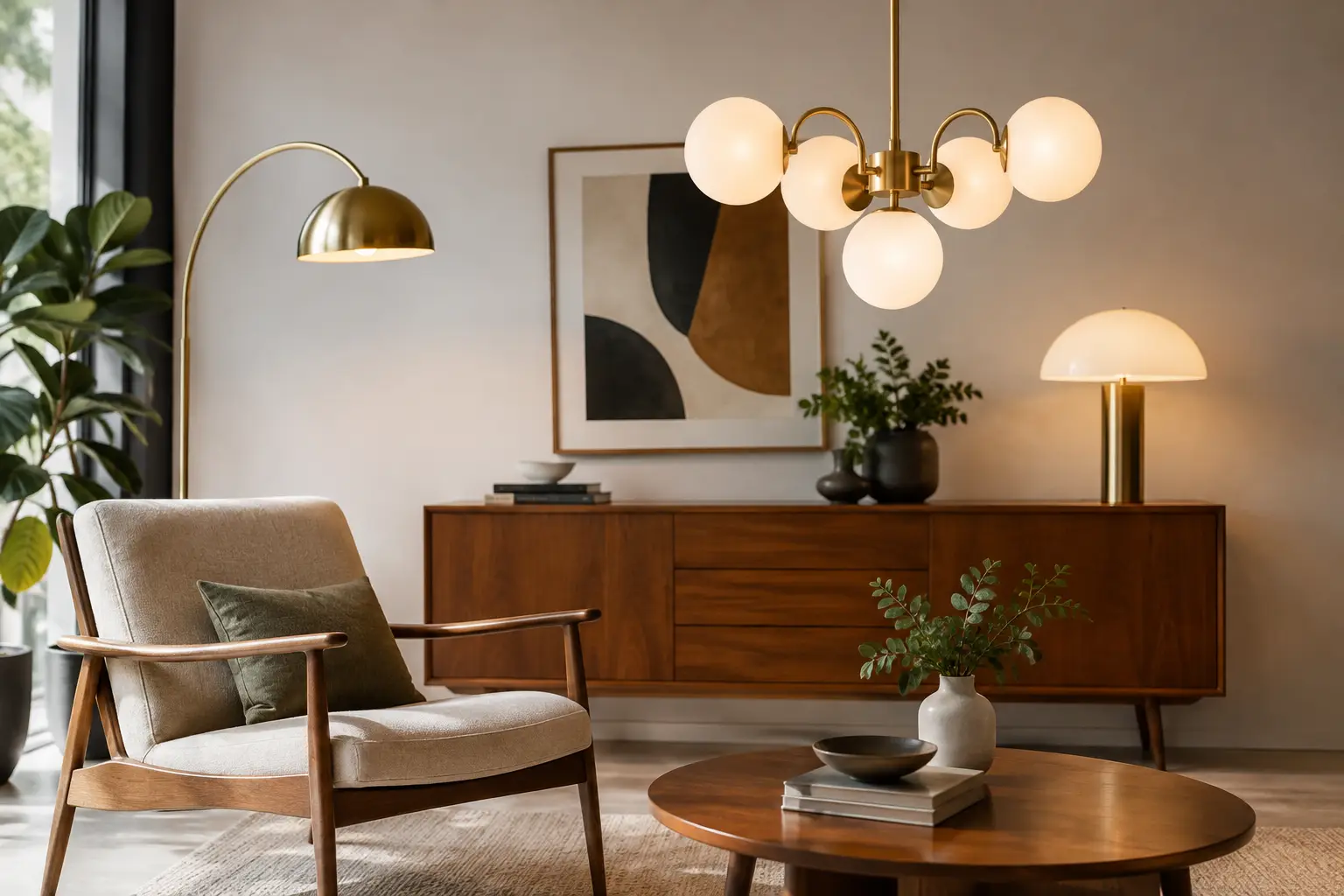
A room can be furnished impeccably and still feel unresolved until the light is right. That is why mid century lighting trends 2026 are less concerned with reproducing a period interior and more interested in the singular authority of a well-chosen object: a Murano glass pendant, a disciplined brass sconce, a floor lamp whose silhouette holds the room even before it is switched on.
The shift is subtle but significant. Mid-century design is no longer treated as a ready-made look of walnut, tapered legs, and anonymous globe lamps. Collectors and design-conscious homeowners are choosing lighting with clearer provenance, stronger material presence, and enough visual distinction to live comfortably among contemporary art, antique furniture, and quieter architectural finishes.
Mid Century Lighting Trends 2026: Fewer, Better Pieces
The defining direction for 2026 is selectivity. Rather than scattering several small decorative fixtures throughout a room, interiors are increasingly organized around one or two lighting pieces with real sculptural weight. A large pendant over a dining table, a pair of articulated sconces framing a bed, or an Italian floor lamp beside a low seating arrangement can establish an entire visual language.
This preference favors original vintage lighting over generic reproductions. An authentic piece carries evidence of a particular design culture: the density of hand-worked glass, the measured patina of brass, the engineering of an adjustable arm, or the slight irregularity that reveals artisanal production. These qualities cannot be replicated simply by borrowing a 1950s outline.
For a collector, originality also creates useful tension. A 1960s chandelier in a room with contemporary plaster walls does not read as nostalgic when it is chosen for scale and material. It reads as intentional. The goal is not to recreate a decade, but to introduce an object with history and visual conviction.
Soft Geometry Replaces Hard Retro
Mid-century forms remain recognizable in 2026, but their expression is becoming softer. Strict starbursts and exaggerated atomic motifs have not disappeared, yet they are giving way to more restrained geometry: discs, domes, cones, elongated cylinders, frosted globes, and gently tiered compositions.
These shapes work particularly well in homes that mix eras. A satin glass globe pendant can converse with a travertine table just as naturally as with a lacquered antique cabinet. A conical metal shade brings definition without the visual noise of an overly decorative fixture. The appeal lies in clarity of line, not in retro theater.
Proportion matters more than motif. A compact ceiling height may call for a shallow Murano glass flush mount rather than a dramatic chandelier. In a double-height entrance, however, a cascading composition can provide the vertical rhythm that architecture alone may lack. The most successful choice is usually the one that acknowledges the volume of the room first, then introduces character.
The Return of the Architectural Sconce
Wall lighting is receiving particular attention because it adds atmosphere without occupying floor or table space. Mid-century sconces are especially relevant here: they can be linear and spare, sculptural and floral, or softly diffused through glass.
In 2026, sconces are often used in pairs or as a deliberate sequence along a hallway, rather than as minor supporting fixtures. Brass, nickel, painted metal, and Murano glass each create a different effect. Brass lends warmth and quiet depth. Nickel feels cooler and more tailored. Colored glass introduces a note of collectibility, especially when daylight reveals its tonal variation.
Placement should be considered as carefully as the fixture itself. A sconce installed too high loses intimacy; one placed too low can interrupt sightlines. Beside a mirror, bed, or reading chair, it should serve the body as well as the composition of the wall.
Murano Glass Moves Beyond the Statement Pendant
Murano glass remains central to Italian decorative lighting, but its use is becoming more nuanced. Rather than relying only on large, ornate chandeliers, designers are incorporating smaller pendants, table lamps, and wall fixtures that let the glass reveal its own character.
Opaline glass, smoked tones, amber, clear textured surfaces, and softly colored shades are especially compelling against materials such as dark wood, stone, linen, and brushed metal. The light they produce is part of the appeal. A vintage glass fixture can soften an interior at night while retaining a jewel-like presence during the day.
There is also a renewed appreciation for the individuality of handmade glass. Small bubbles, subtle variations in density, and slight differences between elements are not flaws to be corrected. They are evidence of process. In a market crowded with perfect, repeatable lighting, these details give a piece its emotional value.
The trade-off is practical: vintage glass requires attention. Confirm the condition of shades and diffusers, inspect metal fittings, and use appropriate bulbs to avoid excessive heat. The reward is a fixture whose atmosphere cannot be reduced to a product image.
Warm Metals, Honest Finishes, and the Value of Patina
Highly polished surfaces are making room for finishes with more depth. Aged brass, burnished bronze, blackened metal, and satin chrome feel especially at home within the current interpretation of mid-century lighting. They complement the warmer palettes now seen in interiors: tobacco brown, oxblood, moss, clay, cream, and deep blue.
Patina is part of this conversation. On an authentic vintage fixture, slight changes in tone can enrich the object and establish its age. Not every mark should be preserved unquestioned, of course. Corrosion that compromises structure, damaged plating, or poorly executed past repairs may need professional intervention. But removing every trace of time can make a distinctive lamp feel strangely anonymous.
For this reason, restoration should aim for function and respect, not sterilization. Rewiring may be necessary for safety and compatibility with contemporary electrical systems. Original shades, glass components, labels, and hardware should be retained whenever possible. Provenance and condition belong to the value of the piece as much as its silhouette does.
Light That Layers Rather Than Dominates
A single central ceiling fixture rarely creates a complete room. The strongest 2026 interiors layer light at several heights: ambient illumination from a pendant or chandelier, directional light from a floor or table lamp, and a softer perimeter glow from wall fixtures.
This is where vintage lighting offers unusual flexibility. An adjustable Italian floor lamp can create a reading zone without visually dividing the room. A compact table lamp can bring intimacy to a console or bedside table. A pair of sconces can frame a painting while keeping the ceiling calm.
Bulb selection deserves equal care. Warm light, generally in the 2200K to 2700K range, is more flattering to wood, brass, fabric, and colored glass than harsh cool-white illumination. Dimmable bulbs and compatible dimmers allow an important vintage fixture to change character from afternoon to evening. A beautiful lamp should not be forced to perform at one fixed intensity.
How to Choose an Authentic Mid-Century Fixture
The most compelling purchase begins with observation, not trend chasing. Consider where the fixture will sit, what it must illuminate, and whether it should blend into the architecture or become a focal point. Then look closely at its materials and construction.
Authentic vintage lighting often has details that reward inspection: substantial metalwork, hand-finished glass, original maker’s marks, carefully formed joints, and a sense of balance that becomes apparent from every angle. Measurements are essential. A chandelier that appears modest in a photograph may overwhelm a narrow dining room; a delicate sconce can disappear on an expansive wall.
It is also wise to distinguish between visual condition and electrical condition. A lamp can be beautifully preserved yet require rewiring, while a recently restored fixture may have lost original details. Neither situation is inherently wrong. It depends on whether the priority is strict collector value, daily use, or a considered balance between the two.
At Sound Of Vintage Italy, the appeal of vintage lighting lies precisely in this balance: pieces selected not as generic décor, but as objects with a recognizable language, material history, and lasting decorative presence.
The most enduring choice for 2026 will not be the fixture that most obviously announces its era. It will be the one that changes the room after dark, reveals its quality in daylight, and still feels impossible to replace once it has found its place.