
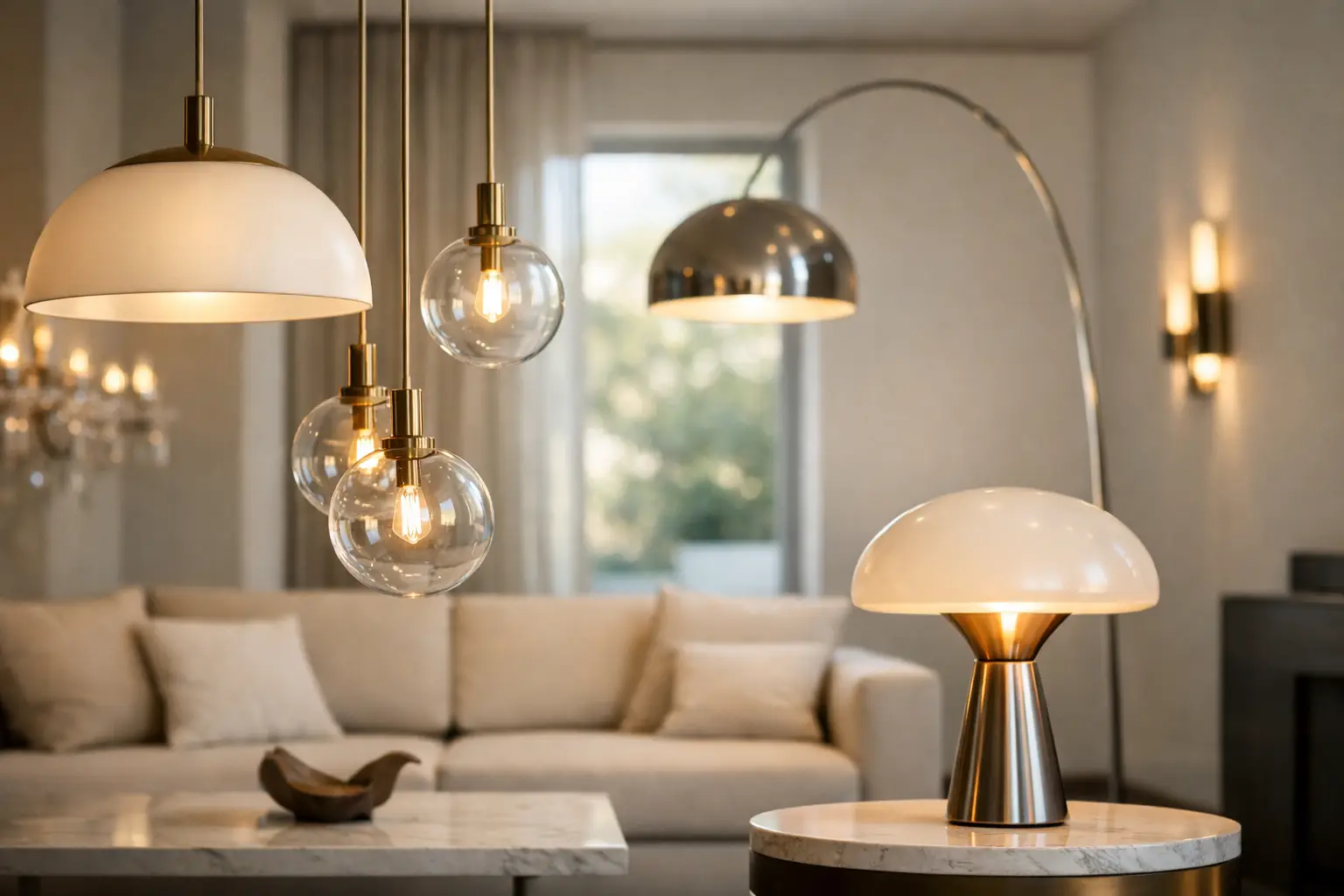
A room can be impeccably furnished and still feel unresolved until the light is right. Italian lighting transformations begin at that precise moment: when illumination stops being a technical afterthought and becomes an object of proportion, material, memory, and atmosphere. A Murano glass chandelier above a dining table, a pair of mid-century sconces beside a bed, or a sculptural floor lamp in a quiet corner can alter not only what a room looks like, but how it is perceived after sunset.
The appeal lies in a distinctly Italian ability to unite function with expressive form. Across the twentieth century, Italian makers treated lighting as a small-scale architecture for the interior. Glass could become weightless and luminous. Brass could be severe, warm, or theatrical. A shade could diffuse light softly while giving the room a decisive silhouette. For collectors and design-conscious homeowners, these are not interchangeable fixtures. They are compositional elements with a presence of their own.
Why Italian Lighting Transformations Feel So Complete
Italian decorative lighting rarely asks to disappear into the ceiling. Even restrained pieces tend to have a clear point of view: the opaline globe, the elongated cone, the perforated metal cylinder, the hand-worked glass leaf, the articulated arm. This visual confidence makes a single authentic vintage fixture capable of changing the hierarchy of an entire room.
The transformation is often less about adding more light than improving its quality and direction. A central chandelier gives a dining room ceremony. Wall sconces create rhythm along a hallway or soften the architecture of a bedroom. A table lamp draws attention to a console, library, or bar cabinet while creating a more intimate field of light than an overhead source can offer.
Italian design also carries a useful tension between refinement and personality. A 1950s brass and glass chandelier can sit comfortably above a contemporary marble table, while a 1970s chromed floor lamp can sharpen a room with antique wood furniture. The strongest interiors do not recreate a period set. They establish a conversation between eras, materials, and volumes.
Murano Glass: Light as Material
Murano glass remains one of the most compelling routes to a more distinctive interior. Its value is not simply decorative. Handblown glass changes the character of light itself, introducing transparency, opacity, iridescence, texture, or a delicately tinted glow that mass-produced shades struggle to reproduce.
A chandelier with Murano leaves, flowers, discs, or sculptural arms has an animated quality even when unlit. Once illuminated, the glass catches and distributes light in layers. It can make a formal dining room feel more alive, give an entry hall an immediate sense of arrival, or bring softness to a space dominated by stone, plaster, and dark wood.
Scale matters greatly here. An elaborate Murano chandelier needs visual breathing room. It may be ideal in a room with high ceilings, a generous stairwell, or a dining area where it can remain the central gesture. In a compact apartment, a smaller pendant, a pair of Murano sconces, or a table lamp with a glass base may deliver the same craftsmanship without crowding the composition.
There is also a practical consideration. Vintage glass is precious, and its condition should be understood before purchase. Minor signs of age can be part of an object’s history, but chips, cracks, mismatched elements, and later substitutions affect both appearance and collectibility. Provenance, construction, and the consistency of individual glass components matter as much as the overall impression.
Choosing the Right Era for the Room
Italian lighting transformations become more convincing when the fixture’s era supports the atmosphere of the interior. This does not require strict historical purity. It does require an awareness of visual language.
Mid-Century Modern: Graphic and Architectural
Mid-century Italian lighting often works through line, balance, and material contrast. Think of brass details against white glass, black lacquered metal, adjustable shades, or carefully spaced globes. These pieces suit interiors that favor clean furniture profiles, walnut, travertine, leather, and abstract art.
Their advantage is versatility. A mid-century chandelier can bring discipline to an eclectic room, while an articulated reading lamp can make a modern lounge feel more considered. The trade-off is that highly graphic forms can look too severe when every other element is equally angular. Introduce a textile, a rounded chair, or an organic ceramic to keep the room from becoming overly rigid.
Art Deco: Glamour with Structure
Art Deco lighting favors geometry, symmetry, polished surfaces, and a measured sense of luxury. Frosted glass, chrome, brass, stepped forms, and stylized motifs bring a room into sharper focus. An Art Deco pendant above a round dining table can create a compelling center without requiring an abundance of ornament elsewhere.
This style rewards restraint. One exceptional Deco fixture can elevate a room of quiet finishes. Several ornate pieces in the same sightline can compete, especially in a smaller space. Let the light provide the drama, then support it with mirrors, lacquer, velvet, or dark timber in controlled quantities.
1970s Italian Design: Sculptural and Expressive
The 1970s introduced a more experimental vocabulary: oversized domes, layered metal, smoked glass, chromed surfaces, unusual color, and forms that feel almost cinematic. These pieces can give neutral contemporary interiors the irreverence they often lack.
A seventies lamp is especially effective where a room needs one unexpected note. It may not suit every setting, however. In a historic apartment full of delicate antique details, a large chrome piece can feel intrusive unless it is deliberately framed as contrast. The question is not whether styles match, but whether they create a deliberate visual rhythm.
Placement Is What Turns a Fixture into a Transformation
The most beautiful lamp can underperform if it is installed at the wrong height or asked to do the wrong job. Before selecting a statement fixture, consider what kind of light the room needs at different hours.
Over a dining table, a chandelier should relate to the table rather than float vaguely in the room. Its width should feel generous but not overpowering, and its lowest point should preserve clear sightlines across the table. Above a coffee table, a lower pendant can work beautifully, provided circulation remains comfortable and the fixture does not interrupt conversation.
Wall lights are often underestimated. Positioned on either side of a mirror, headboard, fireplace, or hallway artwork, they create depth that ceiling fixtures alone cannot achieve. They are also a practical answer for rooms with low ceilings, where a dramatic hanging light may be impossible. Matching pairs create formality; deliberately different vintage sconces can feel more collected, but only when they share a material, scale, or period language.
Floor and table lamps deserve equal attention. They are the most adaptable way to change the evening mood of a room, particularly in rental spaces or interiors where hardwired installation is limited. Place them to illuminate an activity or an object: beside a reading chair, behind a sofa, near a sculpture, or on a console that needs a more intimate focal point.
Authenticity, Wiring, and the Value of Patina
Vintage lighting should be appreciated with both aesthetic and practical judgment. Original finishes, labels, period hardware, and well-preserved glass all contribute to a piece’s character and value. Patina on brass or light wear to painted metal is often desirable because it confirms age and gives the object visual depth. Aggressive polishing can erase this quality.
Electrical components are a separate matter. A vintage fixture may need professional rewiring to meet local safety requirements and accommodate contemporary bulbs. This is not a flaw in the object. It is responsible stewardship. Ask about sockets, wiring, mounting hardware, voltage compatibility, and whether the fixture has been tested or restored.
The same distinction applies to restoration more broadly. Cleaning, rewiring, and replacing an unsuitable modern cord can preserve usability without compromising identity. Replacing original glass, repainting a rare finish, or altering the proportions of a fixture is a more consequential decision. For collectible pieces, preservation should generally guide intervention.
Building a Room Around One Exceptional Light
A notable Italian fixture does not require a room full of vintage design. Often, it is strongest when surrounded by fewer competing statements. Let a chandelier establish the room’s metal finish, then repeat that tone quietly in a frame, a side table, or cabinet hardware. Echo the milkiness of opaline glass in a ceramic vase or an upholstered chair. These small connections make the scheme feel intentional without becoming overly coordinated.
For a more layered interior, combine periods through material rather than chronology. A Murano lamp can sit beside a contemporary sofa if the room also includes warm wood and tactile textiles. An Art Deco wall light can work with modern art if the composition respects its symmetry and scale. The aim is not nostalgia. It is a home with a visual memory.
At Sound Of Vintage Italy, the most resonant lighting pieces are selected for exactly this capacity: to bring form, provenance, and a memorable atmosphere into daily life. Choose the fixture that changes the room after dark, not merely the one that fills an empty spot. That is where lasting character begins.