

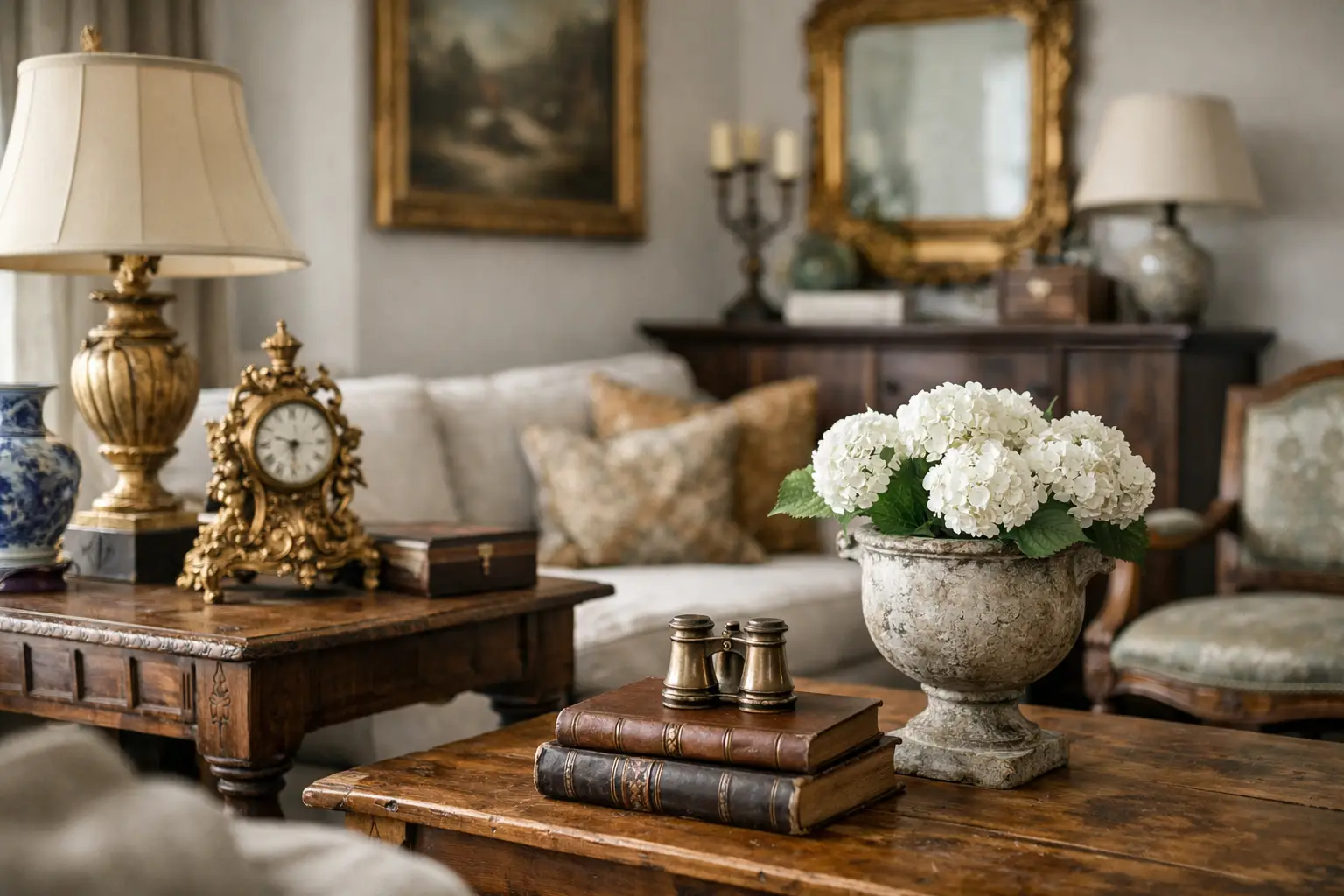
A room changes the moment one real piece enters it. Not a reproduction trying to look older than it is, but an object with age, material weight, and visual memory – a walnut chest with softened edges, a Murano lamp that catches evening light differently every hour, a gilt mirror that brings architecture to a plain wall. That is where how to decorate with antiques becomes less about nostalgia and more about composition.
Antiques do not need a period house or a formal interior to make sense. In many cases, they perform better in cleaner, more edited spaces because their silhouette, craftsmanship, and patina have room to register. The mistake is not mixing old with new. The mistake is treating antiques as isolated trophies, or at the other extreme, filling a room with so much historical language that nothing can breathe.
How to decorate with antiques without making a room feel dated
The first principle is balance. A strong antique gives a room depth, but several pieces with the same visual weight can quickly push an interior into costume. If you are working with a contemporary envelope – white walls, simple upholstery, restrained finishes – one or two antiques often have more impact than ten. A sculptural sideboard, a pair of wall sconces, or an Art Deco mirror can establish character faster than an entire matched suite.
This is why contrast matters. Antiques are most persuasive when they interrupt predictability. A seventies chrome floor lamp beside an older console, a Louis-style mirror above a minimal fireplace, or Sicilian ceramics in a sharply modern kitchen can all work because the room gains tension. Good decoration depends on relationships, not strict historical purity.
Scale is equally important. Many antique objects carry visual density because of carving, bronze detail, figured wood, or richly worked glass. If the room is small, choose one substantial piece and let the rest remain quiet. In a larger room, antiques can be grouped more generously, but they still need intervals of calm around them. Empty wall, plain linen, matte plaster, and unfussy flooring are not absences. They are what allow a piece to be seen.
Start with one anchor piece
The easiest way to decorate with antiques is to begin with a single anchor and build the room around it. Trying to assemble an entire antique interior at once often leads to buying by category rather than by conviction. A better approach is to choose the piece that carries the room’s identity.
In a living room, that may be a cabinet, chest, coffee table, or lighting fixture. In a bedroom, it might be a pair of nightstands with exceptional lines or a mirror with enough presence to organize the wall around it. In an entry, even one antique console can establish mood immediately.
Once the anchor is in place, look at what the room still needs functionally. Seating, storage, and lighting should answer real use, not only visual ambition. An antique should never force the room into inconvenience. If a chair is too delicate for daily sitting, let it hold a folded textile or stand as an accent. If a writing table is beautiful but precious, use it where contact is lighter. Decoration works best when admiration and practicality are in agreement.
Choose for silhouette before ornament
Buy the line first, then the detail. A piece with a clean, memorable silhouette will remain relevant across interiors and decades. Ornament can be compelling, but if the shape is clumsy, no amount of carving will save it.
This is particularly true for mirrors, lighting, and occasional furniture. A refined contour reads from across the room. The decorative detail reveals itself later, which is exactly how a layered interior should work.
Use antiques where they create atmosphere fastest
Certain categories have disproportionate power. Lighting is one of them. A vintage chandelier, pair of sconces, or Murano table lamp can transform a room more quickly than replacing larger furniture. Light is emotional, and antique lighting tends to cast atmosphere rather than simply illumination.
Mirrors are another category with immediate effect. They add reflection, scale, and a sense of finish, especially in rooms that risk feeling architecturally flat. An antique mirror can also soften a modern interior that feels a little too exact.
Smaller decorative objects should be used with more discretion. A few well-chosen pieces – glass, ceramics, boxes, candlesticks, or sculptural accessories – create punctuation. Too many turn into visual noise. Collecting and decorating are related, but they are not the same discipline.
Mix periods with intention
The most convincing interiors rarely belong to one date. They feel assembled, not installed. Mixing periods gives a room intelligence, but only if there is a common thread holding the pieces together.
That thread may be material. Dark wood can connect a nineteenth-century chest to a mid-century chair. It may be finish, such as brass details repeated across lighting and hardware. It may be shape – curved profiles across mirror, lamp, and sofa – or even temperament, where each piece shares a certain restraint or theatricality.
If you love Art Nouveau, Art Deco, Murano, and mid-century modern, you do not need separate rooms for each language. You need editing. Let one style lead and allow the others to enter as accents. If everything insists at the same volume, the room loses its hierarchy.
What to avoid when mixing old and new
Avoid matching all your antiques to one wood tone unless the room truly benefits from formality. Variation usually feels more collected.
Avoid pushing every antique against a wall as if it were in a showroom. Pull pieces into the room when scale allows. Antiques gain dignity when they participate in the plan, not when they merely decorate the perimeter.
Avoid filling every surface. Patina has more authority when it is not crowded by excess.
Let patina work, but keep the room crisp
One reason antiques can feel heavy in the wrong setting is that they are surrounded by too much additional visual texture. If the piece already carries age, sheen, craquelure, carved detail, or worn leather, the room does not need more historical simulation.
This is where crisp upholstery, tailored drapery, simple rugs, and disciplined color palettes become useful. Cream, tobacco, charcoal, oxblood, deep green, and muted blue often support antiques well because they allow material richness to emerge without competition. Bright color can also work, but it should feel chosen, not scattered.
Patina should never be confused with damage. Wear can be beautiful; instability is another matter. When selecting antiques for active rooms, look closely at structural integrity, wiring, joinery, and surface condition. The most decorative choice is not always the right functional one, and sometimes restoration is what allows a piece to live properly in a contemporary home.
How to decorate with antiques in different rooms
In the living room, focus on contrast and conversation. One substantial antique table or case piece paired with contemporary seating usually creates enough tension. Add one or two smaller accents, then stop before the room becomes themed.
In the dining room, antiques can tolerate more ceremony. A chandelier, sideboard, and mirror can coexist comfortably because the room already accepts a certain degree of formality. Still, keep the table setting and surrounding textiles relatively restrained.
In the bedroom, antiques should bring intimacy rather than weight. Bedside lighting, a vanity, a bench, or a softly aged mirror often works better than too many large case pieces. The room should still feel restful.
In the entry, be bolder. This is where a singular object can define the house in seconds. A marble-top console, a dramatic lamp, or a decorative mirror introduces the sensibility of the interior without asking for much.
Buy fewer pieces, but buy with clarity
Decorating with antiques rewards selectivity. A room with three excellent pieces will usually outlast a room with fifteen merely acceptable ones. Quality is not only about rarity or price. It is about proportion, condition, material, and whether the object actually contributes to the whole.
This is where a curated eye matters. Boutiques such as Sound Of Vintage Italy are compelling precisely because selection reduces noise. For buyers who already know the difference between generic vintage and a piece with real decorative authority, the value lies in finding objects that arrive with identity already intact.
The final measure is simple. An antique should not make a room feel older. It should make it feel deeper, more specific, and harder to forget. If a piece brings presence, sharpens the surrounding furniture, and makes the space look more like itself, you have chosen well.
Sorry, the comment form is closed at this time.