

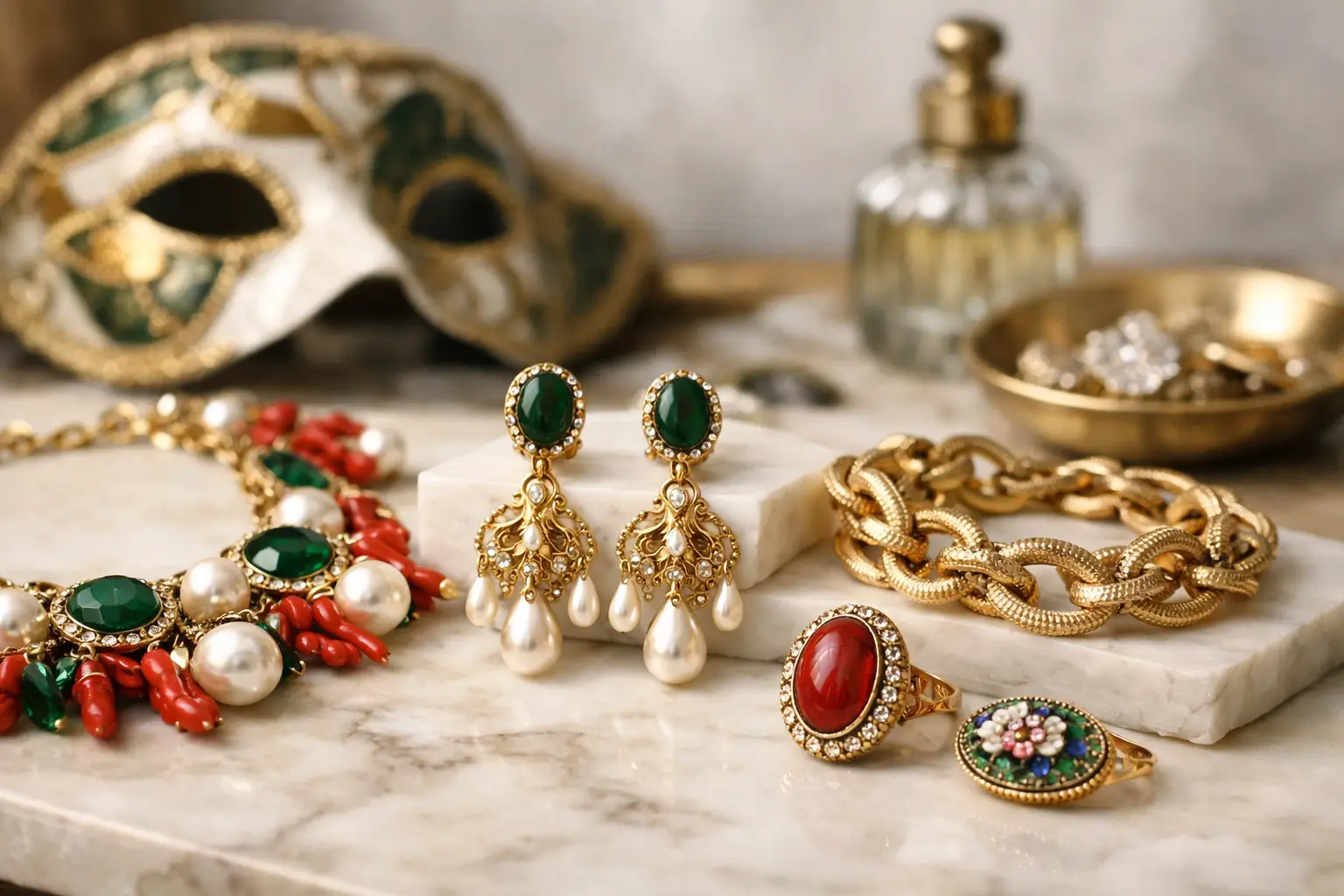
A great Italian brooch rarely behaves like an accessory alone. It changes the line of a black jacket, sharpens a silk blouse, and gives a room its own point of view the moment it rests on a vanity or dressing table. That is the appeal behind the best Italian costume jewelry – it carries the same visual authority that defines Italian decorative arts at their best.
Italian costume jewelry occupies a distinctive place between fashion, craftsmanship, and collectible design. It is not fine jewelry in the strict sense, yet the strongest pieces often have the same compositional intelligence found in better-known Italian categories such as Murano glass, postwar lighting, and decorative metalwork. For collectors and design-minded buyers, that distinction matters. You are not simply buying adornment. You are selecting an object with proportion, material character, and a clear stylistic language.
What makes the best Italian costume jewelry stand out
The first marker is design clarity. Italian costume jewelry tends to avoid the timid middle ground. Whether the piece leans glamorous, sculptural, romantic, or boldly modern, it usually declares its intent immediately. Curved gilt metal, faceted glass, hand-worked surfaces, enamel accents, and dramatic scale are all common, but what matters most is how these elements are composed.
The second marker is finish. Even in costume jewelry, Italian makers often brought a notable level of care to plating, stone setting, glass selection, and clasp construction. The piece does not need to be made with precious materials to feel substantial. Weight, balance, and tactile quality often separate an ordinary vintage jewel from one with lasting decorative value.
The third marker is cultural fluency. Italian jewelry design has long absorbed influences from architecture, cinema, couture, and regional craft traditions. You can see echoes of Venetian opulence, Milanese modernism, Roman glamour, and Sicilian exuberance in different decades and makers. The best examples feel rooted in that visual culture rather than generically retro.
The styles that define Italian costume jewelry
If you are refining your eye, it helps to think in stylistic families rather than broad price bands. Some collectors are drawn to mid-century pieces with clean geometry and restrained sparkle. Others want maximalism – oversized earrings, poured glass cabochons, textured gold-tone metal, and statement necklaces with clear runway energy.
Murano glass jewelry deserves special attention. Not every Italian costume jewel with glass is Murano, but authentic Venetian glass work adds a different level of artistry. Color depth, gold flecks, lampworked details, and irregular hand-formed surfaces create jewelry that feels closer to a miniature decorative object than a standard fashion accessory. These pieces appeal especially to buyers who already appreciate Italian glass in lighting and tabletop objects.
Then there is the gilt-metal tradition – rich, warm, and often sculptural. Some of the best Italian costume jewelry from the postwar decades uses textured or braided metalwork in ways that recall couture accessories. These designs age well visually because they rely less on trend-based novelty and more on silhouette and finish.
Enamel also plays an important role. Floral motifs, abstract color blocking, and jewel-toned accents can shift a piece from merely decorative to highly collectible. The strongest enamel work retains vividness and precision, even when the overall design is playful.
Best Italian costume jewelry by era
1950s and 1960s
For many collectors, this is the sweet spot. Pieces from the 1950s and 1960s often balance glamour and discipline beautifully. You see floral sprays, voluminous earrings, rhinestone compositions, and refined gold-tone finishes, but rarely without structure. Even ornate pieces usually have a controlled outline.
This period works particularly well for those who want jewelry with presence but not excess. It pairs easily with tailored clothing, eveningwear, and interiors where dressing accessories are displayed as part of the overall decorative scheme.
1970s
The 1970s bring more freedom in scale and texture. Resin, bold chain forms, larger pendants, and more expressive color combinations start to appear. This is often the right decade for buyers who like jewelry that reads as fashion-forward even now.
Trade-offs exist here. Some 1970s pieces are brilliant and sculptural. Others can feel overly costume-driven in a disposable sense. The difference usually comes down to material quality and how confidently the design is resolved.
1980s and 1990s
This era can be surprisingly strong, especially if you appreciate Italian fashion houses and statement dressing. Earrings grow bolder, surfaces become more polished or graphic, and the jewelry often feels made to be seen from across a room.
The best examples from these decades have a kind of unapologetic elegance. The weaker ones can tip into excess without refinement. If you collect from this period, look for pieces that still have tension and proportion, not just size.
Materials worth paying attention to
When evaluating the best Italian costume jewelry, materials matter less for intrinsic value than for visual performance. Glass should have depth and life. Metal should show intentional finish rather than flat shine. Faux pearls should sit convincingly within the design, not as filler. Rhinestones should reflect cleanly and be set with care.
Signed pieces often attract the most attention, but unsigned jewelry should not be dismissed. Italy produced many excellent boutique and workshop-made items whose quality is evident in hand-feel and construction rather than in a famous mark. For that reason, the back of the piece is often as revealing as the front. Clasps, pin stems, soldering quality, and plating wear tell you a great deal.
Condition is naturally part of value, but perfection is not always necessary. Light wear can be acceptable in vintage costume jewelry, particularly on older gilt surfaces. What matters is whether the piece retains its visual coherence. A slight softening of finish may be forgivable. Missing stones, unstable settings, or heavy discoloration usually are not.
How to choose the best Italian costume jewelry for your collection
The most successful purchases begin with context. Are you buying to wear regularly, to style with specific garments, or to collect as design objects? A dramatic collar necklace may be extraordinary, but if your wardrobe is built around minimal daywear, a sculptural pair of clip earrings or a refined brooch may serve you better.
Scale is another deciding factor. Italian costume jewelry often excels at statement proportions, but proportion should still relate to the wearer. Large earrings can look magnificent, yet comfort matters. Heavier necklaces can have exceptional visual impact, though they are better suited to occasional wear. Beauty and usability do not always align perfectly, and that is worth deciding before you buy.
It also helps to think the way an interior designer thinks. Certain pieces act like accent lighting – small but transformative. Others behave more like a centerpiece. If your taste leans quiet and architectural, choose jewelry with strong form and limited embellishment. If you favor layered rooms, velvet, lacquer, and reflective surfaces, richer pieces with glass, enamel, or gilt texture may feel more natural.
Where taste matters more than branding
Brand recognition can add value, but it is not the whole story. Some collectors focus on signed Italian fashion jewelry from known houses or makers, and there is logic in that. Signed pieces can be easier to place historically and easier to resell. But the market also contains many superb unsigned examples that offer stronger design at a more attractive level.
This is where a curated eye becomes more important than a logo. Sound Of Vintage Italy approaches vintage categories through that exact principle: not accumulation, but selection. In jewelry as in lighting or decorative accessories, the most compelling piece is often the one with immediate character, material intelligence, and a clear sense of origin.
Best Italian costume jewelry for collectors and interiors
Not every buyer thinks of jewelry as part of an interior, but the connection is natural. Italian costume jewelry is deeply compatible with curated spaces because it is object-based design at a small scale. A remarkable brooch placed near a Murano dish, a pair of sculptural earrings beside a perfume tray, or a dramatic necklace arranged within a dressing room vignette can contribute to the atmosphere of a room even when unworn.
For collectors, that dual function is part of the appeal. A good piece can be lived with visually and then worn for dinner the same evening. Few design categories move so easily between personal style and decorative presence.
The finest pieces are memorable not because they imitate precious jewelry, but because they do something else entirely. They offer Italian style in concentrated form – expressive, composed, and visually assured. If you choose carefully, the best Italian costume jewelry will not just complete an outfit. It will hold its own among the other objects you have chosen to live with, which is usually the clearest sign that it deserves a place in your collection.
Sorry, the comment form is closed at this time.