

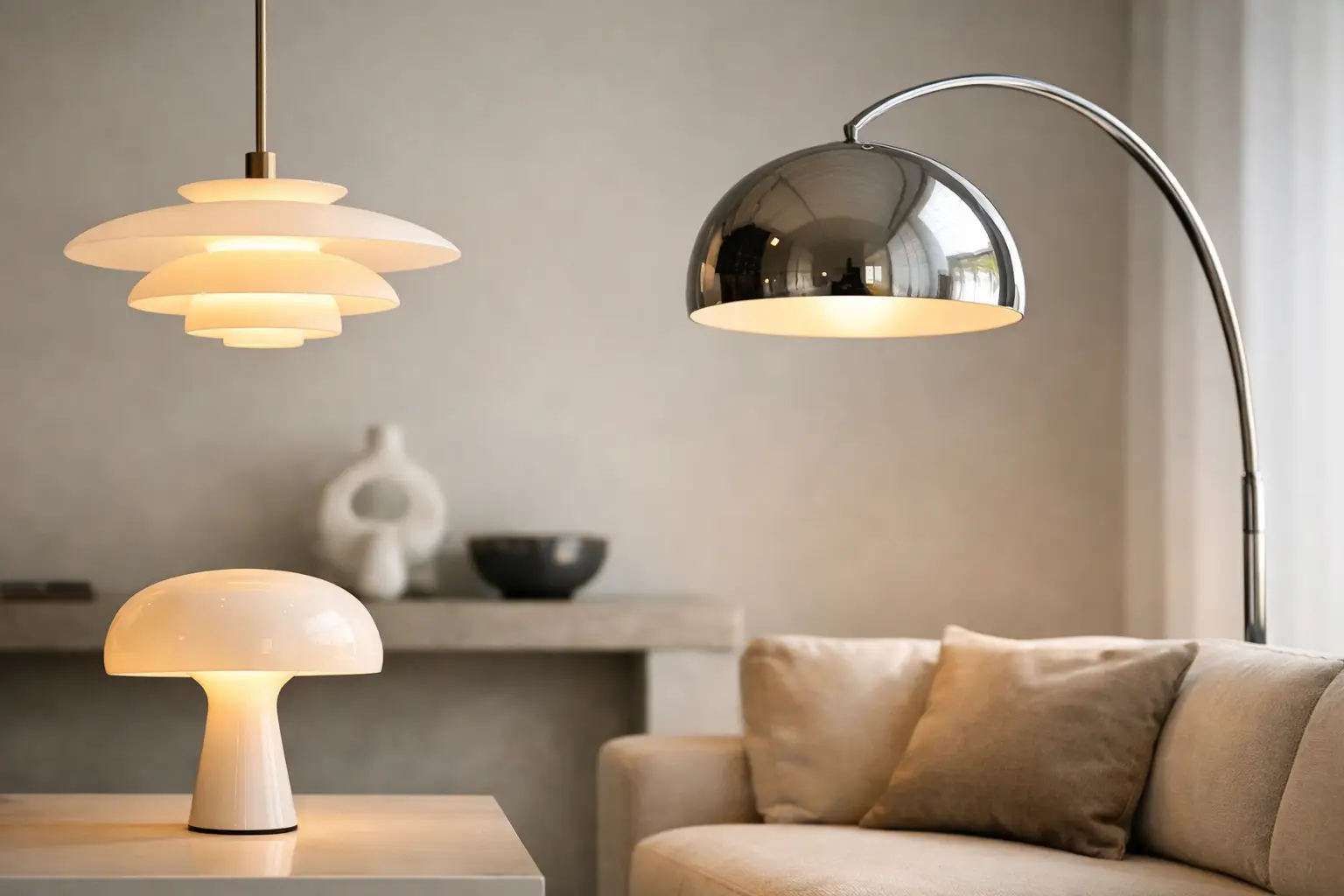
The wrong light can flatten a beautiful room in seconds. The right one can give it authorship. That is why a true guide to Italian design lighting begins not with wattage or placement, but with presence: the way a chandelier anchors a dining room, how a Murano table lamp softens a console, or why a sculptural floor lamp can carry an entire corner without asking for anything else.
Italian lighting has long occupied a distinct place in the language of interiors. It is rarely just functional, and rarely anonymous. Even at its most restrained, it tends to hold form, material, and atmosphere in careful balance. For collectors, designers, and discerning homeowners, this is precisely the appeal. Italian lighting does not merely illuminate a room. It edits it.
What sets Italian design lighting apart
The enduring strength of Italian design lighting lies in its dual heritage. On one side, there is craftsmanship: hand-blown glass, worked brass, carved wood, lacquered metal, and the artisanal discipline associated with regions and workshops that developed their own visual signatures. On the other, there is a modern design culture that has never treated utility as separate from style.
This combination created objects with unusual staying power. A mid-century Italian wall sconce may feel architectural and decorative at once. A Murano chandelier can read as opulent or contemporary depending on the room around it. A 1970s table lamp in smoked glass and chrome still feels deliberate rather than nostalgic if chosen with a clear eye.
There is also a particular Italian confidence in silhouette. French lighting often leans toward ornament, and Scandinavian lighting toward restraint. Italian pieces frequently occupy the more difficult middle ground: expressive without excess, elegant without caution. That balance is part of what makes them so adaptable across interiors.
A guide to Italian design lighting by era
If you are building a room or a collection, the easiest way to choose well is to understand the major visual families.
Art Nouveau and early decorative lighting
Early Italian decorative lighting often carries sinuous lines, floral references, and a handcrafted softness. These pieces suit interiors that welcome ornament, but they can also work as a deliberate contrast in stricter spaces. The trade-off is scale and specificity. A highly decorative antique fixture may dominate a minimal room unless the rest of the composition gives it context.
Art Deco and geometric glamour
Art Deco lighting brings stronger geometry, richer contrast, and a sharper decorative rhythm. Think etched glass, polished metals, stepped forms, and symmetry. These fixtures are ideal when a room needs definition and polish. They tend to work especially well in entryways, dining areas, and formal living rooms where the fixture is meant to read immediately.
Mid-century Italian modern
This is often the point where interest becomes obsession. Mid-century Italian design lighting introduced cleaner lines, more experimental forms, and a richer conversation between industry and craft. Brass, opaline glass, painted metal, and teak or rosewood details appear frequently. The best examples feel intelligent rather than loud.
For many interiors, this era offers the easiest entry point. A mid-century pendant or floor lamp can sit comfortably within contemporary architecture while adding warmth and character. It is also one of the broadest categories, which means quality varies. Proportion, finish, and originality matter.
1960s and 1970s sculptural lighting
Italian lighting from the 1960s and 1970s often pushes further into theatrical form. Smoked glass, chrome, modular compositions, and bolder silhouettes become more common. These pieces can be extraordinary focal points, especially in rooms that need tension or personality.
They are not always the safest choice. A dramatic 1970s chandelier may be exactly right above a spare dining table, but too assertive in an already layered room. With these pieces, restraint elsewhere becomes part of the styling.
Materials that define the category
No guide to Italian design lighting is complete without materials, because much of the category’s identity lives there.
Murano glass remains one of the most recognizable and desirable expressions of Italian lighting. Its appeal is not simply prestige. It is the way hand-worked glass catches light with variation, softness, and depth that industrial production cannot fully replicate. Clear, amber, milk white, smoky, and jewel-toned Murano each alter the mood of a room differently. A transparent form can feel airy and architectural; denser or colored glass often reads more decorative and atmospheric.
Brass is equally important, especially in mid-century and Deco-influenced pieces. It adds warmth, but its effect depends on finish and condition. A softly aged brass surface can bring depth and authenticity. Overpolished brass sometimes loses the quiet authority that vintage pieces should retain.
Chrome, lacquered metal, and steel appear more frequently in later modernist and 1970s designs. They lend crispness and reflectivity, though they can feel colder if not balanced with textiles, wood, or warmer surfaces nearby.
Then there is the less discussed but equally relevant role of scale in material. A large Murano chandelier may look visually light because of transparency, while a smaller metal fixture can read heavier because of mass and opacity. Material is never only about finish. It changes visual weight.
How to choose the right Italian light for a room
The first question is not style. It is role. Is the fixture meant to provide ambient light, define an architectural axis, frame a piece of furniture, or act as an independent decorative object? When buyers skip this question, they often select beautiful pieces that feel unresolved once installed.
A chandelier or pendant usually carries the strongest formal responsibility. It is best chosen in relation to ceiling height, table size, and sightlines. Italian pieces with strong sculptural identity often need physical and visual breathing room. In a compact room, a refined flush mount or a pair of wall sconces may produce a more convincing result than a chandelier chosen for impact alone.
Table lamps offer another kind of freedom. They can introduce Murano, brass, or sculptural form in a more controlled way. This makes them ideal for collectors who want to build a layered lighting scheme rather than rely on one dominant piece. Bedside tables, consoles, and sideboards all benefit from lamps that function as objects even when switched off.
Floor lamps work best when they solve two needs at once: light and composition. A well-placed Italian floor lamp can complete an empty corner, balance a low seating arrangement, or introduce a vertical line in a room full of horizontal furniture. The most successful examples feel structural, not incidental.
Wall sconces are often underestimated. In reality, they are among the most effective ways to bring Italian design character into hallways, powder rooms, bedrooms, and transitional spaces. They also create a more intimate atmosphere than overhead light alone.
Authenticity, condition, and the value of selection
For buyers in the vintage and modernist market, authenticity is not a secondary concern. It directly affects aesthetic quality, collectability, and long-term value. Original components, period-consistent materials, quality of glass, proportions, and fabrication details all contribute to whether a piece feels convincing.
Condition deserves a nuanced view. Patina is not damage, and restoration is not automatically a flaw. It depends on the object. A lightly aged brass structure may be more desirable than one stripped of character. Rewiring, by contrast, is often necessary and practical. The key is whether intervention respects the integrity of the piece.
This is where curatorial selection matters. In a market crowded with reproductions, altered fixtures, and decorative pieces presented as design icons, a specialized source saves more than time. It preserves judgment. A selective eye filters not only for style, but for coherence, provenance, and presence.
Styling Italian lighting without making the room feel staged
Italian lighting is expressive, but that does not mean every room should perform. Often the strongest interiors allow one or two lighting elements to carry the visual signature while other furnishings remain disciplined.
A Murano chandelier above a restrained dining table creates clarity. A pair of brass sconces in a quiet bedroom gives the room a cultivated rhythm. A single sculptural lamp on a modern console can say more than multiple decorative objects competing for attention.
Mixing periods is usually more interesting than matching everything too closely. A 1950s Italian lamp can sit beautifully with contemporary upholstery, antique mirrors, or even rustic architectural surfaces. The room becomes memorable when it feels collected rather than assembled from one date stamp.
For those drawn to rare and expressive interiors, Sound Of Vintage Italy reflects this approach well: a boutique perspective where lighting is treated not as accessory, but as a category of objects with form, history, and decorative authority.
The best Italian light is rarely the one that shouts first. It is the one that keeps shaping the room after dark, when materials soften, reflections emerge, and the space finally reveals its character.
Sorry, the comment form is closed at this time.