

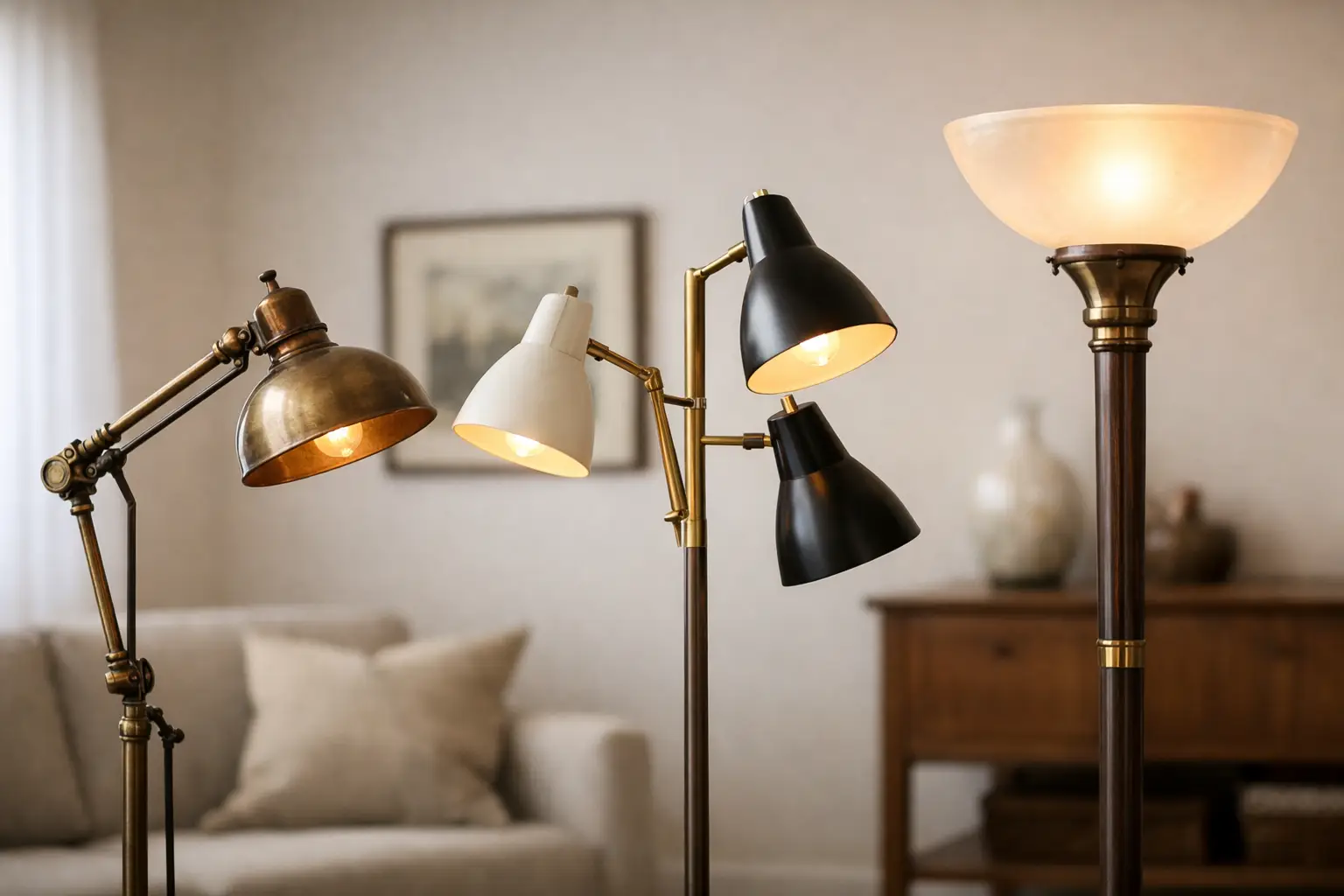
A vintage floor lamp rarely behaves like a background object. It claims a corner, shifts the mood of a room, and often says more about taste than a larger piece of furniture. That is exactly why knowing how to choose vintage floor lamps matters: the right one adds character and atmosphere, while the wrong one can feel oversized, anonymous, or simply disconnected from the space around it.
Unlike contemporary lighting bought for pure utility, vintage floor lamps ask for a more selective eye. They carry proportion, period language, materials, and sometimes the small irregularities that make older design convincing. A good choice is not just about whether the lamp is beautiful on its own. It is about whether it belongs in the room, whether its light is useful, and whether its presence feels intentional.
How to choose vintage floor lamps for the room
The first decision is not style. It is placement. Before looking at brass stems, Murano details, tripod bases, or articulated arms, consider what the lamp needs to do in the room.
In a living room, a vintage floor lamp may serve as ambient lighting near a sofa, a reading light beside an armchair, or a sculptural vertical element that balances low furniture. In a bedroom, it may replace a table lamp when surface space is limited. In an entryway or study, it often works more as atmosphere than task lighting. These are different roles, and each one favors a different form.
An arc lamp can elegantly reach over a seating area, but it needs visual and physical space. A slim torchère offers a lighter footprint, though the illumination tends to be more diffuse. A reading lamp with an adjustable head is practical, but it may not deliver the same decorative presence as a larger mid-century statement piece. Vintage lighting is full of strong silhouettes, so function and shape should be aligned from the start.
Room size also matters more than many buyers expect. A lamp that looks refined in a gallery-like setting can feel compressed in a smaller apartment. Conversely, a delicate floor lamp may disappear in a room with high ceilings, large rugs, and substantial seating. Vintage pieces often have more personality than modern minimalist lighting, which means scale errors are easier to notice.
Start with period, then refine the silhouette
One of the most effective ways to choose well is to begin with design language. Not every vintage floor lamp speaks the same visual dialect.
Mid-century models tend to favor clean geometry, tapered forms, teak or walnut accents, lacquered metal, and practical elegance. They work particularly well in interiors where restraint matters and where every object is expected to hold its line without excess decoration.
Art Deco floor lamps introduce a different rhythm. You may find richer materials, more dramatic symmetry, polished metal, smoked glass, alabaster, or forms that lean toward glamour. These pieces can transform a room, but they need the right context. In a space already filled with highly expressive furniture, a Deco lamp can be perfect or too much. It depends on the balance.
Italian modernist examples often stand out for their sculptural intelligence. The best ones feel resolved from every angle, with bases, stems, diffusers, and materials in conversation. This is where a curated eye becomes essential. A lamp can be rare yet visually awkward, or simple yet deeply sophisticated.
If your room already contains strong historical signals, choose a lamp that supports them without turning the space into a set piece. If your interior is more contemporary, a single vintage floor lamp can act as a point of tension and refinement. That contrast often works beautifully, especially when the piece has a clear silhouette and excellent materials.
Proportion is what makes a lamp feel expensive
A common mistake is focusing on finish before proportion. In reality, scale is what gives a vintage floor lamp authority.
Height should relate to the seating around it and to the ceiling line. A lamp placed beside a lounge chair must cast light at a comfortable level without exposing the bulb harshly to the eye. A taller piece intended as ambient lighting can rise more freely, but it should still connect visually to the architecture of the room.
Base size is equally important. Many vintage floor lamps have beautiful stems and shades but a base that is either too heavy or too slight for the setting. A substantial marble or metal base can be an advantage in larger interiors because it grounds the piece. In tighter rooms, that same base may feel cumbersome.
Shade diameter, diffuser shape, and arm extension also affect proportion. An arc lamp with an exaggerated reach may look dramatic in photographs but dominate a modest room. A narrow shade can keep the profile elegant, though sometimes at the cost of softer ambient light. This is where trade-offs matter. The most sculptural lamp is not always the most livable.
Materials tell you what kind of presence the lamp will have
When considering how to choose vintage floor lamps, material is never a secondary detail. It determines how the lamp reflects light, how it ages, and how formal or relaxed it appears.
Brass introduces warmth and depth, especially when it has developed a natural patina rather than an overly polished finish. Chrome feels sharper, cooler, and often more architectural. Wood adds softness and is especially effective in mid-century interiors where natural grain is part of the language. Marble, travertine, and stone bases bring permanence and visual weight.
Glass deserves special attention. Frosted diffusers soften light and reduce glare. Smoked or colored glass can add atmosphere, though it may slightly alter the clarity of illumination. Murano elements, when well chosen, elevate a floor lamp beyond function into decorative art. They are especially compelling in interiors that appreciate artisanal detail and a more distinctly Italian sensibility.
Material mix is often what distinguishes an ordinary vintage lamp from a memorable one. Metal with glass, wood with brass, or lacquer with stone creates visual complexity without requiring ornament. The key is coherence. If every finish competes, the lamp becomes restless.
Light quality matters as much as aesthetics
Collectors sometimes forgive poor lighting performance for the sake of beauty. That may be reasonable for a rare piece in a formal setting, but in everyday rooms, light quality matters.
Ask whether the lamp throws upward light, downward light, or directional light. A torchère can create a gentle glow that flatters a room in the evening, yet it may be useless for reading. A pharmacy or articulated floor lamp is more functional, but its beam can feel narrow. A bowl shade or diffused glass element usually gives a softer result, especially in living spaces designed for conversation.
Bulb compatibility should also be considered carefully. Many vintage lamps have been rewired or adapted over time, and the type of bulb they accept will affect both ambiance and practicality. Warm bulbs generally suit vintage materials better than cool ones, which can flatten brass, wood, and textured glass.
There is no single correct choice here. If the lamp is primarily decorative, softer and more atmospheric light may be enough. If it needs to work hard every evening, practicality should win.
Condition, authenticity, and restoration
A vintage floor lamp should show age with dignity, not apology. Small signs of time can be desirable. Heavy corrosion, unstable structure, cracked electrical components, or poorly replaced parts are another matter.
Original finishes are usually preferable to aggressive refinishing, especially when the patina contributes to the object’s identity. Rewiring, by contrast, is often a sensible and necessary intervention. A professionally restored electrical system improves safety without compromising character.
Authenticity can be subtle. Labels, maker’s marks, construction details, hardware, and materials all help establish whether a lamp belongs to its claimed period. Even when attribution is uncertain, quality tends to reveal itself through proportion, fabrication, and the way components meet. The base should feel resolved, the joints deliberate, the shade or diffuser compatible with the design rather than added as an afterthought.
This is one reason many buyers prefer a highly selective source such as Sound Of Vintage Italy. When the editing is strong, the search becomes less about filtering noise and more about recognizing the right piece when it appears.
How to choose vintage floor lamps that last stylistically
The best vintage floor lamp is not always the rarest or the most dramatic. It is the one you will still want in the room five years from now.
Try to distinguish between novelty and presence. A lamp with an unusual shape may attract immediate attention, but if its form overwhelms the room, the effect can fade quickly. A well-proportioned piece in excellent materials often has more staying power than a louder design with less discipline.
It also helps to think in terms of collection, not isolation. The lamp should speak to the room’s other objects: the curve of a chair, the line of a console, the finish of a mirror, the texture of a rug. Vintage interiors rarely succeed because every piece is from the same decade. They succeed because each piece contributes to a clear visual intelligence.
If you are choosing for a residential project, aim for a lamp that brings both usefulness and identity. If you are selecting for a hospitality or professional setting, consider how the piece reads at a distance as well as up close. Some lamps reward intimate viewing; others define an entire room with one silhouette.
A vintage floor lamp should feel discovered, not merely purchased. When scale is right, materials are convincing, and the light suits the way you live, the piece stops being an accessory and starts becoming part of the room’s memory. That is usually the clearest sign you chose well.
Sorry, the comment form is closed at this time.