

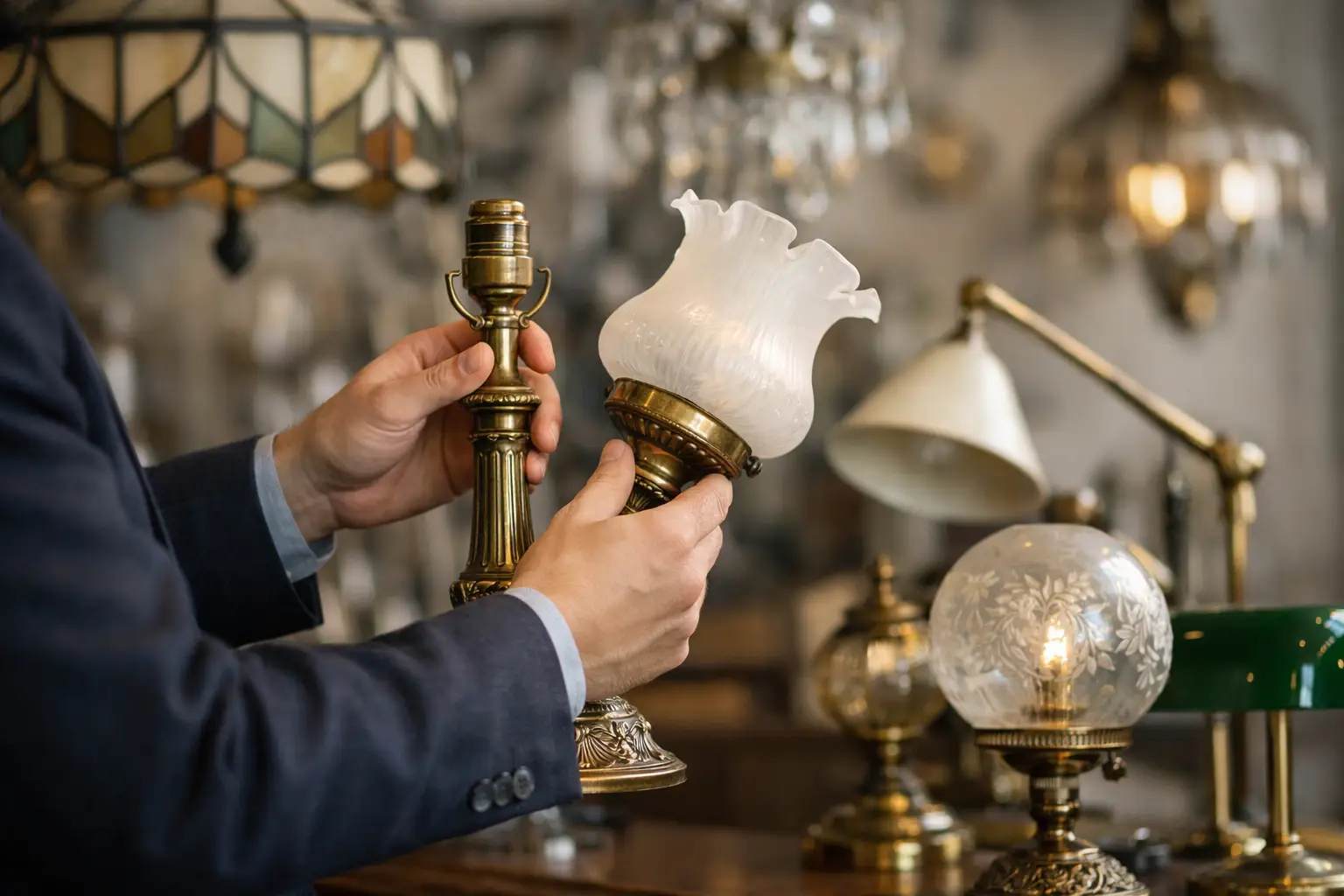
A chandelier can look extraordinary in a listing and feel completely wrong the moment it enters a room. Scale shifts. Glass reads colder than expected. Patina turns out to be wear, not character. That is why knowing how to buy vintage lighting matters – not only for style, but for proportion, authenticity, and long-term satisfaction.
Vintage lighting is rarely a neutral purchase. It defines atmosphere, directs the eye, and often becomes the piece that gives a room its memory. A Murano pendant, an Italian brass sconce, or a sculptural mid-century table lamp does more than illuminate. It introduces period language, material depth, and a point of view. Buying well means looking beyond charm and understanding what gives a piece presence and value.
How to buy vintage lighting without buying only with your eyes
The first test is simple: ask whether you are buying light, sculpture, or both. Some vintage fixtures are decorative first and functional second. Others are strong workhorses with restrained visual impact. A pair of wall sconces in textured glass may create beautiful evening light but offer little practical illumination in a hallway. A large floor lamp may perform brilliantly for reading but dominate a room that needs visual quiet.
This distinction matters because disappointment often begins with mismatched expectations. If the fixture is meant to anchor a dining room, drama may be the priority. If it is intended for a bedside table or a study, light quality and shade direction become more important. The most successful purchase usually starts with the room, then the mood, then the object.
A good vintage lighting choice should answer three questions at once. Does it suit the architecture? Does it support the way the space is used? Does it still hold visual interest when switched off? If the answer is yes to only one of these, keep looking.
Start with period, but buy for coherence
Buyers are often drawn to a named style – Art Deco, mid-century modern, 1970s Italian, Art Nouveau – because categories make the search easier. That is useful, but style labels can also flatten important differences. A 1950s brass ceiling fixture with restrained geometry behaves very differently in a room than a 1970s Murano chandelier with layered glass and theatrical volume, even if both are technically vintage.
The better approach is to think in terms of coherence. Look at the room’s existing materials first: wood tone, hardware finish, wall color, upholstery, and the overall rhythm of shapes. Vintage lighting works best when it introduces tension with control. A highly sculptural lamp can elevate a minimal interior. A clean-lined fixture can sharpen a richly layered room. But when every element demands attention, the result feels staged rather than collected.
This is especially true for buyers mixing periods. A Deco sconce can sit beautifully in a contemporary interior, and a 1960s Italian pendant can transform a traditional room. What matters is not strict historical consistency, but visual intelligence. Repetition of one material, one curve, or one finish is often enough to make an unexpected piece feel inevitable.
Materials tell you more than labels
When evaluating vintage lighting, materials usually reveal more than seller language. Solid brass ages differently from plated metal. Hand-blown Murano glass has variation that machine-made pieces lack. Marble, alabaster, lacquered metal, chrome, and carved wood each carry their own visual weight and maintenance demands.
Patina should be read carefully. On brass and bronze, soft oxidation can add depth and authenticity. On chrome, pitting may weaken the elegance of the piece. On painted metal, minor wear can be charming, while extensive flaking may suggest neglect or unstable restoration. There is no universal rule here. It depends on the fixture, the finish, and your tolerance for imperfection.
If you are buying for a refined interior, materials need to remain convincing at close range. Vintage lighting is often admired from nearby, especially table lamps, sconces, and low-hanging pendants. Surface quality matters.
Authenticity, rewiring, and condition
A beautiful fixture that is difficult to install or unsafe to use quickly loses its appeal. Condition is where emotion should slow down and practical judgment should take over.
Originality is valuable, but not every original detail is an advantage. Old wiring, deteriorated sockets, brittle insulation, and non-compliant electrical components should not be romanticized. Rewiring is often necessary and, in many cases, desirable. A professionally rewired vintage lamp preserves the character of the object while making it suitable for contemporary use.
That said, restoration should be proportionate. Over-restored pieces can lose the subtle age that gives them authority. Under-restored pieces can become expensive projects. Ask what has been replaced, what remains original, and whether any intervention affects the visual integrity of the fixture. A new cord on a table lamp is rarely a problem. Poorly replaced glass elements on a chandelier are another matter entirely.
What to inspect before you commit
Photos should show more than the hero angle. You want to see the canopy, sockets, chain or stem, mounting hardware, glass details, underside, and close-ups of wear. If shades are included, look for cracks, chips, repairs, or slight color inconsistencies. In Murano glass especially, variation can be natural, but damage should not be mistaken for artisanal irregularity.
Dimensions are not a formality. They are often the difference between a successful purchase and a return-worthy one. Ceiling height, drop length, width, projection from the wall, base diameter, and weight all matter. A fixture may be visually perfect and still impossible for the intended location.
For American buyers, compatibility also deserves attention. Voltage standards, bulb fittings, and installation methods can vary. Vintage European lighting often requires adaptation. That is not necessarily a drawback, but it should be understood before purchase rather than discovered during installation.
Scale is where many buyers get it wrong
People tend to underestimate how much visual volume vintage lighting occupies. This is particularly true of chandeliers and glass fixtures, which reflect surrounding space and appear to expand once installed.
A common mistake is choosing a piece that is individually beautiful but too small for the room. Underscaled lighting rarely reads as elegant. It reads as hesitant. The reverse can also happen: an oversized fixture overwhelms circulation or competes with architecture that should remain visible.
Use measurements, but also think compositionally. Over a dining table, the fixture should feel centered and deliberate. In an entry, it should set a tone without obstructing movement. Beside a sofa or armchair, a floor lamp should shape the seating area rather than float at its edge. Vintage pieces often have stronger silhouettes than contemporary ones, so their presence is felt even before the light is on.
Light quality is not secondary
Many buyers focus on form and postpone thinking about the actual light. That is backwards. Frosted glass diffuses softly. Clear glass creates sparkle and shadow. Directional shades concentrate light downward. Multi-arm chandeliers can brighten a room broadly, but their effect depends on bulb choice and ceiling reflection.
If the goal is mood, a fixture with dimmable capability or softer diffusion may be ideal. If the goal is task lighting, decorative complexity matters less than control and output. The best vintage lighting purchases understand this balance. They deliver atmosphere without sacrificing usability, or they declare clearly that they are decorative objects first.
Where value really comes from
Price in vintage lighting is shaped by more than age. Designer attribution, rarity, workmanship, material quality, provenance, and condition all affect value. So does market appetite. Some categories – Murano glass, Italian mid-century brass, sculptural 1970s pieces – command attention because they combine decorative impact with collectible status.
But expensive does not always mean better for your interior. A rare fixture may be museum-worthy and still wrong for your home. Conversely, a less famous lamp with excellent form and honest materials can be the smarter purchase. Taste and context should lead; prestige should confirm, not decide.
This is where a specialized curatorial eye becomes useful. A selective dealer does more than source objects. They reduce noise. They help distinguish between pieces that are merely old and pieces that still hold aesthetic authority. For buyers who want authenticity without spending weeks comparing inconsistent listings, that filter has real value.
How to buy vintage lighting online with fewer surprises
Buying online requires discipline. Read descriptions slowly. Compare measurements with your room. Request additional images if anything is unclear. Ask whether the fixture has been tested, rewired, or adapted for the US market. Clarify if mounting hardware is included and whether any elements are later replacements.
Also pay attention to shipping reality. Vintage lighting can be fragile, heavy, and technically complex to pack. Glass leaves, prisms, shades, and sculptural elements may need to travel separately. A serious seller understands this and explains the process clearly.
For many collectors and design-led buyers, the advantage of a focused boutique such as Sound Of Vintage Italy is not quantity. It is edit. The best online vintage lighting selection feels considered, with pieces chosen for identity rather than volume.
The right fixture should still feel right after the first impression fades. Buy the piece that holds the room, respects its use, and keeps its intrigue in daylight as much as after dark.
Sorry, the comment form is closed at this time.