

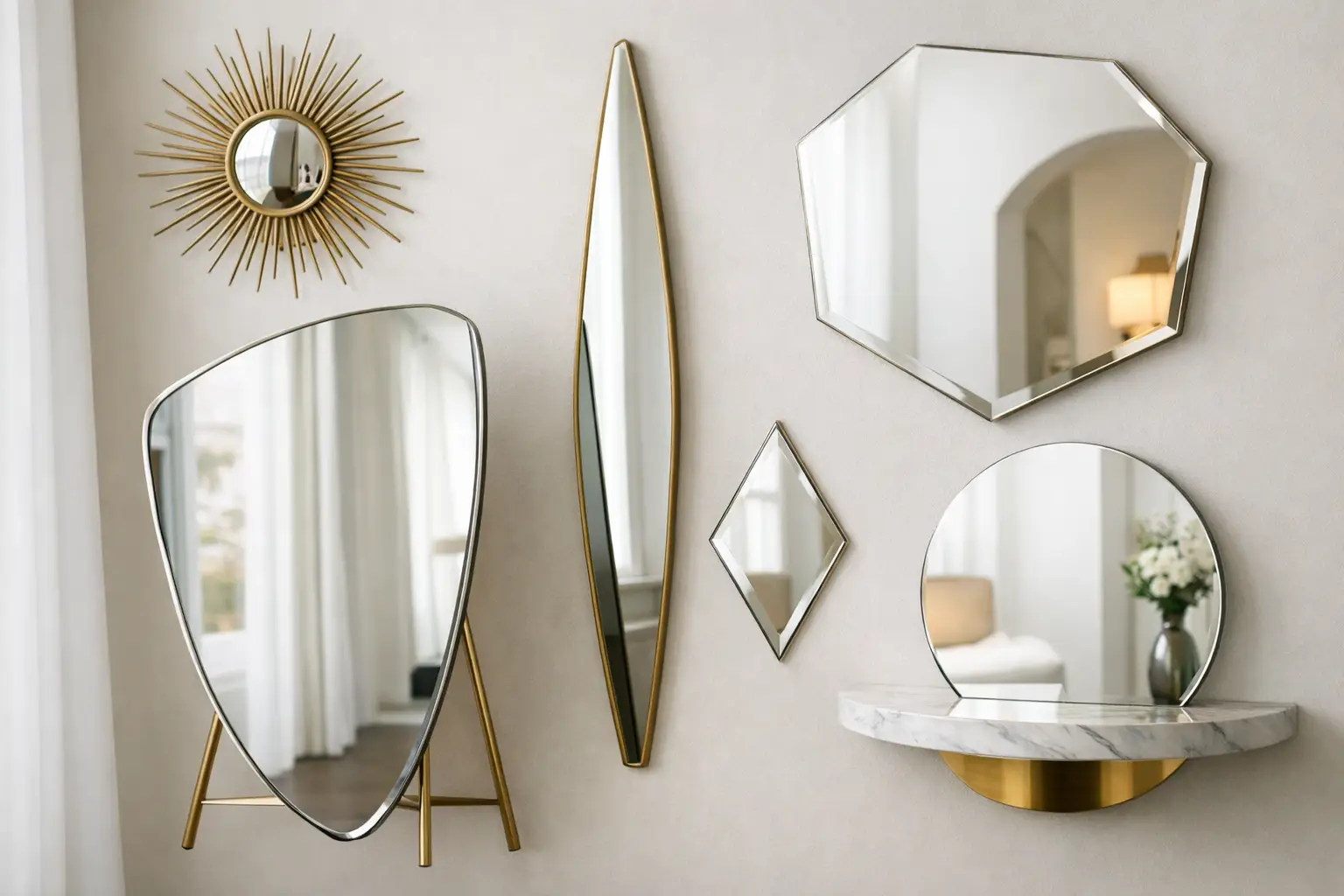
A Gio Ponti mirror rarely behaves like a secondary object. It catches the eye the way a well-drawn chair or a sculptural lamp does, because Ponti never treated reflection as mere function. When people search for the best Gio Ponti mirrors, they are usually looking for more than decoration. They are looking for line, proportion, wit, and that distinctly Italian ability to make elegance feel light.
For collectors and design-conscious interiors, Ponti’s mirrors occupy a singular position. They sit at the meeting point of architecture, furniture, and ornament. Some are sharply geometric, some feel almost playful, and others have the restraint that makes a room look edited rather than styled. The real question is not simply which examples are most famous. It is which mirrors best express his language, and which ones still hold visual authority in a contemporary interior.
What makes the best Gio Ponti mirrors stand out
Ponti had a rare sense of line. Even in a small domestic object, he could make a profile feel airy, decisive, and unmistakably refined. His mirrors tend to work through silhouette first. You notice the shape before the material, and then the material sharpens the effect.
That is why the best Gio Ponti mirrors are often those with a strong perimeter – diamond points, faceted outlines, curved corners, or brass frameworks that read almost like jewelry for the wall. They do not need excessive scale to command attention. In fact, many of the most convincing examples are modest in size but exact in proportion.
Another reason they remain desirable is versatility. Ponti’s work belongs to the Italian mid-century world, yet it avoids heaviness. A mirror by him can live comfortably with neoclassical architecture, with cleaner contemporary interiors, or with layered vintage rooms that include Murano glass, walnut case pieces, or sculptural lighting. Few designers manage that range without losing authorship.
10 best Gio Ponti mirrors to know
1. The diamond-point wall mirror
If one model has become shorthand for Ponti’s mirror design, it is the diamond or lozenge-shaped wall mirror. The form feels precise but never severe. Hung alone, it acts almost like a drawing on the wall. Grouped in a pair, it creates a rhythm that is both decorative and architectural.
This is often the first piece collectors pursue because it is immediately legible as Ponti. It has enough character to anchor a room, but not so much that it overwhelms adjacent furniture. In entryways, powder rooms, and narrow passages, it can be especially effective.
2. The brass-framed oval mirror
Ponti’s ovals are quieter, which is exactly their strength. A thin brass frame around an elongated oval gives a softness that balances stricter interiors. These mirrors often appeal to buyers who admire Ponti but want something less graphic than the pointed silhouettes.
The trade-off is that condition matters more. With a restrained design, every detail counts. If the brass has been over-polished or the glass has been replaced carelessly, much of the charm disappears.
3. The faceted mirror with cut glass detailing
Certain Ponti mirrors are prized for their faceted treatment, where the edge itself becomes part of the composition. This is where his sense of surface becomes evident. The mirror is no longer just a reflective plane. It has a crystalline character that catches light with subtle movement.
These examples sit beautifully near windows or opposite chandeliers, where natural or artificial light can animate the edges. They tend to feel more decorative than the stricter brass-framed models, but in the right room that added brilliance is precisely the point.
4. The sunburst-adjacent geometric mirror
Ponti was not a conventional sunburst designer, but some of his geometric mirror forms carry that same sense of radiance without slipping into excess. Think of frames or outlines that project energy through pointed geometry rather than ornate ornament.
These are among the best Gio Ponti mirrors for collectors who want statement value while staying firmly within an Italian modernist vocabulary. They work particularly well above a console or fireplace where a central focal point is needed.
5. The shield-shaped mirror
The shield form gives Ponti room to play with historic reference while keeping the final result light and modern. It has a certain nobility, but the line remains crisp. That balance is difficult to achieve, which is why the best examples feel so resolved.
In interiors with antique or neoclassical elements, a shield-shaped Ponti mirror can bridge periods with remarkable ease. It introduces authority without stiffness.
6. The small vanity or dressing mirror
Not every important Ponti mirror is intended as a dramatic wall presence. Smaller vanity mirrors and tabletop examples can be just as revealing of his design intelligence. They often carry the same clean geometry, but at a more intimate scale.
These pieces appeal to collectors who value usability as much as display. On a dressing table, desk, or bedroom chest, they add refinement without asking for a dedicated architectural moment.
7. The mirror with integrated shelf or console logic
Some of the most interesting Ponti-related mirror designs are those that engage furniture directly, either through integrated shelves or compositions that feel tied to an entry console. This is where his architectural thinking becomes especially visible.
Such pieces are highly desirable because they solve a room. They are not just decorative additions. They organize a wall, create function, and establish a visual hierarchy. In smaller apartments or city interiors, this hybrid quality can be more useful than a purely sculptural mirror.
8. The asymmetrical mirror
Ponti understood that asymmetry, when disciplined, can feel more elegant than strict balance. His asymmetrical mirror forms have a sense of movement that keeps a wall from becoming static. They can also soften interiors that are otherwise too composed.
These are not the easiest pieces to place. They require more attention to surrounding volumes, ceiling height, and sight lines. But for collectors with confidence, they can be among the most rewarding choices.
9. The mirror with painted or colored detailing
Although brass and glass are central to Ponti’s visual language, some examples become more distinctive through painted accents or subtle color interventions. These versions are less universal, but they can be exceptionally strong in interiors that already embrace layered materiality.
The key is restraint. When the color reads as part of Ponti’s line rather than an added flourish, the effect is sophisticated. When it dominates, the mirror can feel period-bound in a narrower way.
10. The rare custom or attribution-level piece
At the top end of the market, the most compelling finds are often not the most reproduced forms, but the rarer pieces tied to specific commissions, interiors, or limited production histories. These are the mirrors that serious collectors watch closely.
They also require the most caution. Attribution, provenance, later alterations, and restoration quality all matter. A rare piece is only as convincing as the scholarship and physical integrity behind it.
How to choose among the best Gio Ponti mirrors
The first filter is not rarity. It is placement. A pointed geometric mirror can electrify a small wall, but in a room already full of angular furniture it may feel too insistent. An oval or shield form can bring relief. Conversely, in a space that lacks definition, a softer mirror may disappear.
Material presence matters too. Brass-framed Ponti mirrors have warmth and a certain jewelry-like precision. Frameless or faceted examples tend to feel lighter and more architectural. Neither is inherently better. It depends on whether the room needs contour or reflection.
Scale deserves more attention than many buyers give it. Ponti’s designs often rely on exact proportion. An authentic small mirror can outperform a larger, more generic piece because its line is right. In a curated interior, that precision reads immediately.
What collectors should look for before buying
With Ponti, authenticity is inseparable from condition. Mirror plates are often replaced, and sometimes they have to be. The issue is whether the replacement respects the original design. Poor beveling, incorrect thickness, or clumsy backing can flatten the entire piece.
Frames deserve equal scrutiny. Brass should not look aggressively refinished. Patina, when consistent and honest, supports the object’s age and character. Over-restoration tends to erase the quiet sophistication that makes these mirrors valuable in the first place.
Documentation is another dividing line. Established provenance, period references, and credible attribution all strengthen long-term value. This is especially true in a market where Gio Ponti’s name is frequently used too loosely. A mirror that is merely reminiscent of Ponti is not the same thing as a documented design by him.
Why Gio Ponti mirrors still feel current
Many historic mirrors read as period pieces. Ponti’s best examples do not. They still make sense because they combine discipline and charm. They can be formal without looking stiff, decorative without becoming crowded, and expressive without theatricality.
That is why they continue to attract collectors, designers, and buyers who want more than a name. In a carefully selected vintage setting – the kind of environment shaped by pieces with real identity, like those curated by Sound Of Vintage Italy – a Ponti mirror does not simply fill a wall. It sets the tone for everything around it.
The best choice is usually the one that holds the room with the least effort. When a Gio Ponti mirror feels inevitable in its placement, you are probably looking at the right one.
Sorry, the comment form is closed at this time.