

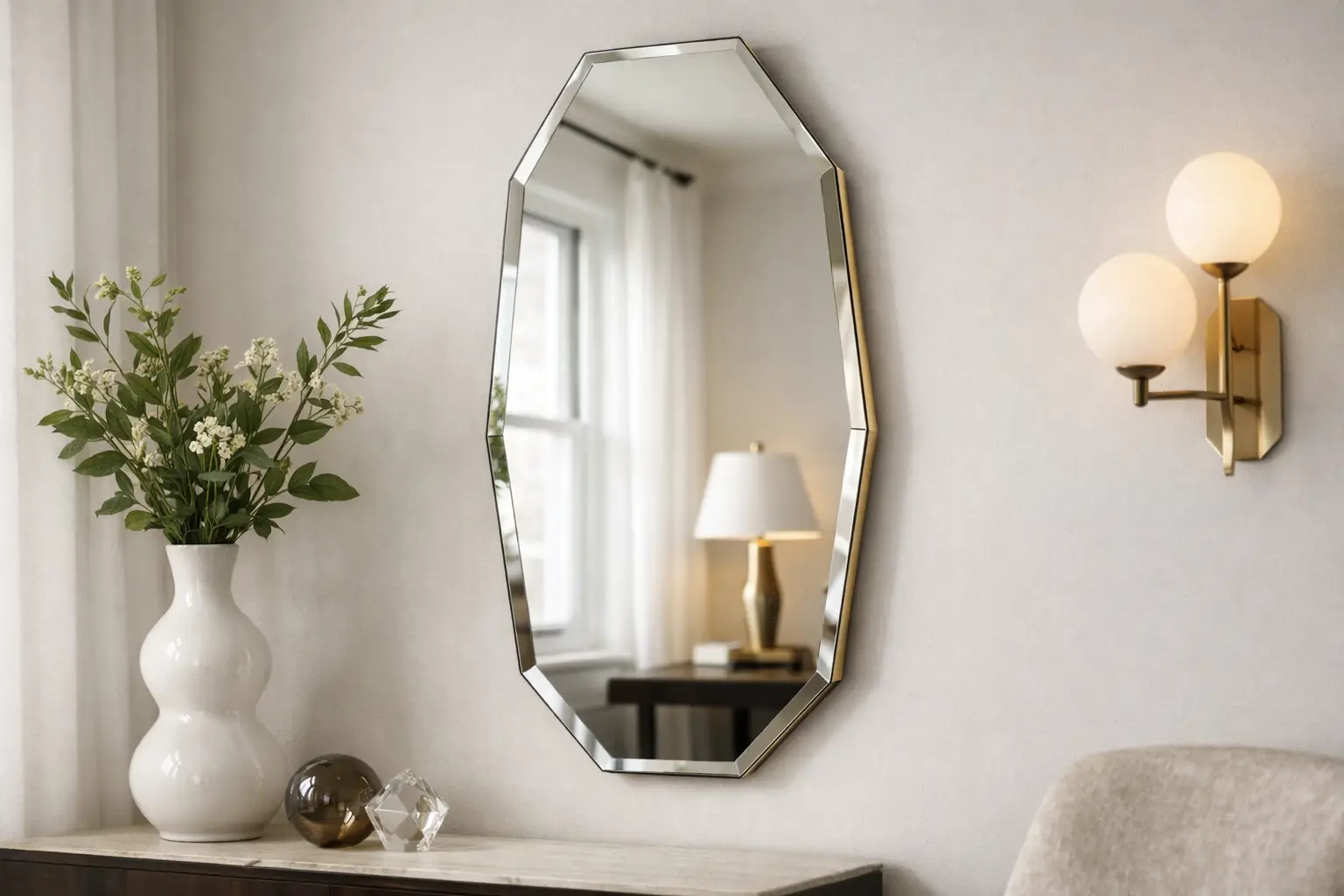
A Gio Ponti mirror can elevate a room in seconds, but it can also expose every weak decision around it. That is the real question behind how to style Gio Ponti mirrors: not how to fill a wall, but how to place a highly graphic, historically charged object so it keeps its tension, elegance, and architectural clarity.
Ponti’s mirrors are rarely passive accessories. Even when delicate in profile, they carry a distinct line, a disciplined sense of proportion, and a lightness that feels intentional rather than decorative for its own sake. Styling them well means resisting two common mistakes: treating them like generic vintage mirrors, or overprotecting them to the point that the room becomes stiff.
How to style Gio Ponti mirrors in a room
The first decision is not height or wall color. It is role. A Gio Ponti mirror can act as an anchor, a visual interruption, or a refined bridge between stronger pieces. Which one it becomes depends on the room and on the specific design.
If the mirror has the classic angular or gently sculptural silhouette associated with Ponti, let it hold a primary position. Over a console, sideboard, or fireplace, it should read as a focal point with breathing room around it. If the room already has a dramatic chandelier, heavily patterned upholstery, or a large artwork grouping, the mirror may work better as a counterpoint on a quieter wall.
This is where many interiors go wrong. They rely on the prestige of the name, then place the mirror in visual traffic. Ponti’s work benefits from deliberate spacing. A mirror like this wants adjacency, not crowding.
Start with line, not decoration
Gio Ponti mirrors are often best understood through line. Their charm comes from outline, profile, and proportion more than applied ornament. Because of that, the furniture beneath or near them should support that linear intelligence.
A slim Italian console in walnut, brass, or lacquer often works better than a bulky case piece. A sideboard with tapered legs, a desk with clean geometry, or a marble-topped cabinet with disciplined proportions will feel aligned. If the base piece is too rustic, too overcarved, or too heavy in mass, the mirror loses its precision.
That does not mean the room must become a strict mid-century set. In fact, Ponti mirrors often look more convincing in collected interiors than in rooms that try too hard to recreate one decade. The key is to repeat a sense of elegance through silhouette rather than matching every material.
Scale matters more than style labels
When people ask how to style Gio Ponti mirrors, they often focus on whether the surrounding room is modern, classic, or eclectic. Scale is usually the more decisive factor.
A small Ponti mirror on an oversized blank wall can look timid unless it is intentionally framed by a console, sconces, or a disciplined composition below. A substantial mirror above a narrow chest can make the entire vignette feel top-heavy. The relationship between mirror width, wall width, and furniture width needs to be resolved before any decorative layer is added.
As a rule, the mirror should feel slightly contained by the furniture below it, not adrift above it. If it sits over a console or credenza, aim for a width that is visually balanced with the piece beneath. Symmetry can work, but it is not mandatory. Ponti’s language often tolerates asymmetry beautifully, provided the room still feels composed.
Ceiling height also changes the reading. In rooms with tall ceilings, a Gio Ponti mirror can hold vertical space elegantly, especially if paired with slender lighting. In lower-ceilinged rooms, the same mirror should not be forced too high. Let it relate to eye level and furnishing height first.
The right wall is usually quieter than you think
A Ponti mirror does not need a theatrical backdrop to be noticed. More often, it needs restraint. Painted walls in warm white, soft ivory, mineral gray, muted greige, or dusty plaster tones allow the form to register clearly. Strong wall color can work, but only if it sharpens the mirror’s outline rather than swallowing it.
Wallpaper is more complicated. Fine textures, subtle vertical rhythms, or very controlled geometric patterns may support the mirror. Busy florals or large-scale motifs usually compete with it. Since many Gio Ponti pieces are already graphic, layering another dominant graphic field behind them tends to flatten both.
If you are working with wood-paneled walls or richly detailed boiserie, the result depends on contrast. Sometimes the mirror becomes more exquisite because the architectural background is restrained and tonal. Sometimes it disappears. This is one of those cases where rarity alone does not guarantee visual success.
Pairing Gio Ponti mirrors with lighting and furniture
Lighting can transform the mirror from object to atmosphere. Wall sconces are often the most natural companions, especially Italian or French examples with brass, opaline glass, or understated sculptural forms. The pairing should feel dialogic, not competitive.
Avoid flanking a refined Ponti mirror with oversized fixtures that steal all the attention. Equally, avoid tiny lights that make the composition look accidental. The best pairings echo the mirror’s sophistication through material and proportion. Murano glass can be exceptional here, especially when the glass has clarity and shape without excessive flourish.
Furniture should support the mirror’s vertical rhythm. A chest with elegant drawer fronts, a writing desk with slim legs, or a console with architectural restraint will all preserve the mirror’s authority. If the room needs softness, add it through upholstery, a curved chair, or a textile nearby rather than through overdecorating the mirror wall itself.
What to place beneath the mirror
The surface below a Gio Ponti mirror should never be cluttered. A pair of lamps, a single sculptural ceramic, a stack of art books, or one strong decorative object is usually enough. The mirror is already an active visual element.
Fresh branches can work beautifully because they introduce irregularity against the mirror’s geometry. So can a low bronze sculpture or a quiet marble box. But if every object is trying to prove its pedigree, the arrangement starts to feel staged rather than lived-in.
This is especially true in entry halls. A Ponti mirror above a console in an entry should create a memorable first impression, but it still needs utility. Leave enough surface open for keys, a tray, or a small personal object. Good styling should support life, not interrupt it.
Mixing Gio Ponti with contemporary interiors
One of the pleasures of Ponti is that his work rarely feels trapped in period rooms. A Gio Ponti mirror can look remarkably current in a contemporary apartment, provided the surrounding palette and forms are edited with care.
In minimalist interiors, the mirror can supply exactly the right amount of historical depth. Here, warm metals, natural stone, boucle, parchment tones, and dark wood accents help avoid a cold result. In more layered homes, the mirror can temper eclecticism by introducing formal discipline.
The trade-off is clear. In a very minimal room, a Ponti mirror risks looking like the only expressive gesture, which can feel isolated. In a highly eclectic room, it risks becoming one more beautiful object in a sea of beautiful objects. The best result usually sits between those extremes.
For collectors and designers, this is where a curated approach matters. At Sound Of Vintage Italy, pieces from Italian modernism often reveal their full power when they are allowed to converse across categories – lighting, furniture, glass, and accessories – without collapsing into theme dressing.
How to style Gio Ponti mirrors without making them look precious
There is a difference between respect and hesitation. Because Ponti mirrors carry design authority, some interiors become overly careful around them. Everything gets slim, beige, sparse, and quietly expensive. The room is tasteful, but lifeless.
A better approach is to let the mirror remain elegant while the room around it keeps some friction. That might mean a more tactile rug, a sharper modern artwork nearby, a sculptural chair in a contrasting material, or a deeper wall tone in the adjacent room. Ponti’s work can handle tension. It often benefits from it.
What usually does not work is false grandeur. Heavy drapery, oversized faux-classical furniture, or too many gilded accents can turn a refined mirror into a decorative relic. Ponti’s sophistication is nimble. It likes rooms that feel composed, not overperformed.
The final test is simple. Step back and ask whether the mirror is clarifying the room or merely decorating it. The right placement gives architecture to the wall, rhythm to the furnishings, and light to the atmosphere. When that happens, the mirror no longer feels like an isolated collectible. It becomes the line that holds the room together.
And that is often the best way to style any exceptional vintage piece: not by asking it to do more, but by giving it exactly the company it deserves.
Sorry, the comment form is closed at this time.