

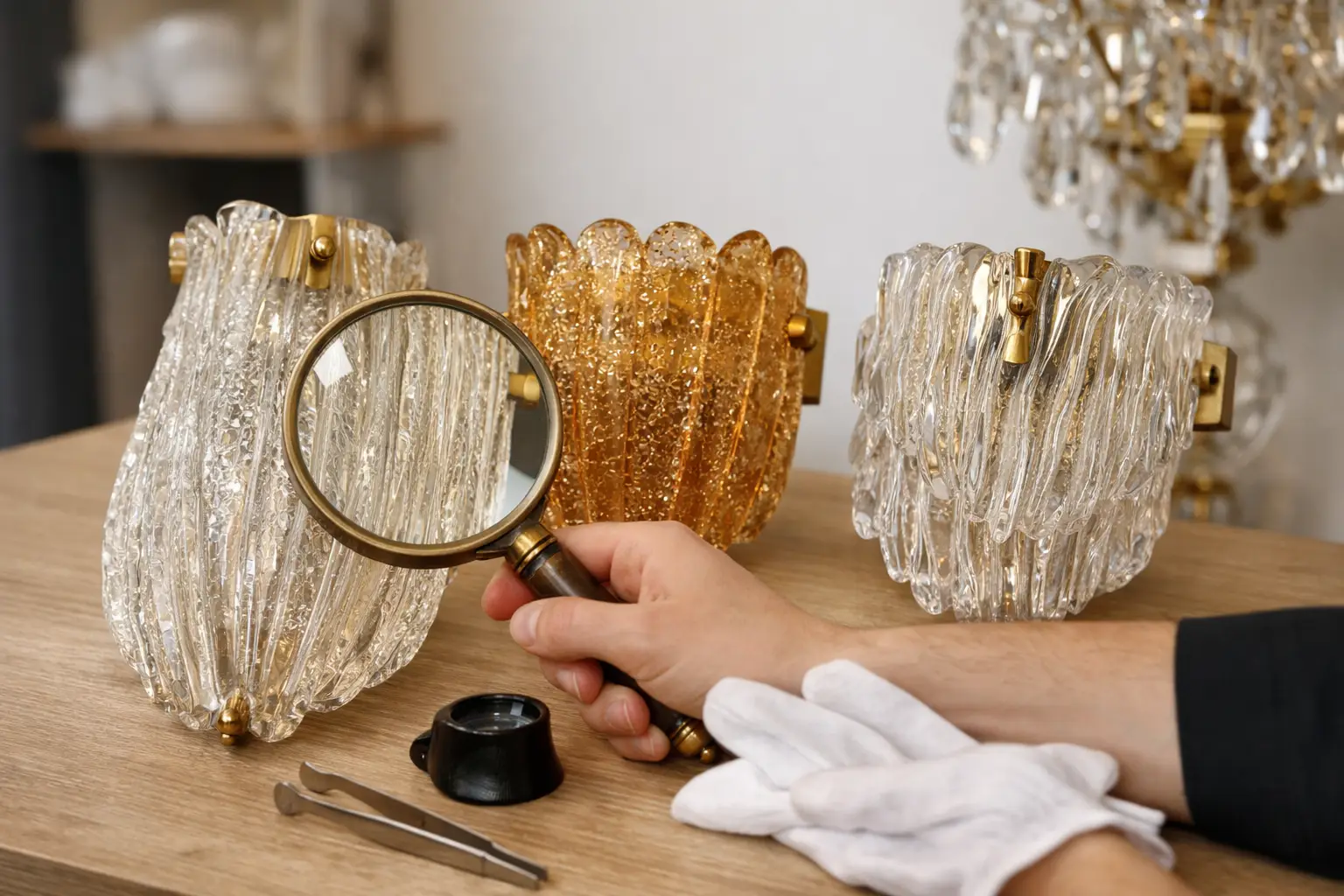
A pair of wall lights can change an entire room, but with Murano sconces, the difference between decorative glass and a true Venetian piece is not subtle. It affects value, period accuracy, craftsmanship, and the visual authority the object brings to an interior. If you are wondering how to authenticate Murano sconces, the answer is never a single label or a quick glance at a sticker. It is a matter of reading the piece as a whole.
Murano glass has been copied for decades, sometimes openly, sometimes with enough skill to confuse even experienced buyers. The most convincing reproductions usually imitate the surface language of Murano – dramatic color, curving forms, gold flecks, floral arms, textured prisms – but miss the deeper signs of origin. Authentication begins when you stop asking whether a sconce looks Italian and start asking whether it behaves like a real Murano object in its materials, construction, and design logic.
How to authenticate Murano sconces by reading the glass
The glass is the first test, but it should be approached with discipline. Authentic Murano sconces often show a level of control that feels effortless even when the form is exuberant. Petals, leaves, cups, and decorative elements tend to have a deliberate rhythm. Curves are fluid rather than clumsy, and thickness usually varies in ways that reveal handmaking rather than poor finishing.
That does not mean Murano glass is always perfectly symmetrical. In fact, slight differences between arms or petals can support authenticity, especially in handmade mid-century and earlier examples. What matters is whether those variations feel intentional and alive. Factory copies often look either too stiff or too approximate, with unevenness that reads as careless rather than artisanal.
Color also matters. Murano makers developed a sophisticated relationship with opacity, translucency, and layered tone. Milk glass, pulegoso with its fine bubbles, smoky amber, ruby, amethyst, and soft opaline shades often have depth rather than flatness. Gold inclusion should appear integrated into the body of the glass, not sprinkled in a way that looks decorative but superficial.
Surface finish offers further clues. Fire-polished edges, clean transitions, and a certain tactile density are common in quality Murano work. By contrast, many reproductions reveal overly sharp rims, muddy molding lines, or a generic gloss that lacks the richer visual movement of hand-finished glass.
Labels, signatures, and why they are not enough
One of the most common mistakes in learning how to authenticate Murano sconces is relying too heavily on a label. Original labels can be helpful, especially when tied to known makers or export periods, but labels fall off, get replaced, or are added later to support a convenient story.
A paper sticker reading Murano, Made in Italy, or Venetian Glass is not, by itself, proof of origin. The same goes for acid marks or etched signatures. Some authentic pieces are unsigned. Some signed pieces are misattributed. And some signatures have been added after production, particularly on decorative lighting that became more collectible years later.
What a signature can do is strengthen an existing case. If the form, glass quality, age, and mount all align with a documented maker or workshop, the signature becomes meaningful. If the object feels inconsistent and the label is doing all the work, caution is warranted.
Makers and attribution
Attributing a sconce to Venini, Barovier and Toso, Mazzega, Seguso, AVEM, or another Murano house requires more than recognizing a famous name. Each maker had recurring formal languages, preferred techniques, and period-specific hardware solutions. A floral sconce from the 1940s asks different questions than a sculptural textured-glass piece from the 1960s or a dramatic triedri composition from the 1970s.
The more precise the attribution, the higher the standard of proof should be. “Murano” is one thing. “Venini, circa 1955” is another.
Hardware tells the truth very quickly
Glass draws attention, but the metal structure often reveals whether a piece is period, later assembled, or entirely recent. Original Murano sconces typically have mounting plates, armatures, screws, and bulb holders consistent with their era. Patina should make sense across the whole object. If the glass appears mid-century but the backplate is conspicuously new, the piece may have been rewired, rebuilt, or recomposed.
Rewiring alone is not a problem. In fact, professional rewiring is often necessary for safe use. The issue is coherence. A sconce can retain original Murano glass and still have updated electrical components. That is different from a piece built from unrelated vintage glass parts on a modern frame, then presented as fully original.
Look closely at how the glass attaches to the mount. Handmade Venetian lighting often has elegant structural logic, even when complex. Fastenings should feel integrated rather than improvised. Oversized washers, crude adhesives, poorly fitted arms, or generic mass-market backplates can indicate later assembly.
Signs of age versus staged aging
Authentic age usually appears unevenly and convincingly. Minor oxidation on screws, wear on interior mounts, and soft rubbing on gilded elements are common. Artificial aging tends to be more theatrical – uniform darkening, abrasive distressing, or patina applied where normal handling would not produce it.
A very clean piece is not automatically suspect, especially if it has been carefully restored or preserved in a private collection. But when a seller insists on age while every metal component looks recently fabricated, the object deserves a harder look.
Provenance matters more than romantic storytelling
Murano sconces are often sold with atmospheric language: Venetian elegance, rare craftsmanship, old-world artistry. None of that is useful unless it is supported by provenance. The most reliable sellers can explain where the piece came from, when it was acquired, whether it has been restored, and how the attribution was formed.
That provenance may be formal, such as an invoice, gallery record, or documented estate history. It may also be practical and informed – for example, a clear statement that the sconces were sourced in Italy, date to the 1960s, retain original glass, and have been professionally rewired. Specificity inspires confidence. Vague superlatives do not.
Photographs are part of provenance too. Serious listings show front, side, back, mounting details, sockets, labels if present, and close views of the glass. A seller who avoids the back of the fixture is leaving out one of the most important chapters of the story.
How to evaluate Murano sconces online
Buying online is often the only way to access rare lighting, but it requires a sharper method. Start by resisting the first seduction, which is often scale. Murano sconces photograph beautifully, and dramatic styling can hide weak craftsmanship. Ask for dimensions and compare them to the visual mass of the glass. Some reproductions look substantial in photos but feel surprisingly light or thin in person.
Then study repetition. In many copied models, identical decorative elements appear too standardized, as if cast from the same mold without the subtle variation of handwork. That does not make every repeated form inauthentic – some production lines in Murano were intentionally consistent – but perfect sameness in organic elements should prompt questions.
If you are serious about collecting, request additional images. Ask to see the interior structure, the attachment points, and any wear consistent with age. Ask whether the glass components are original to the frame. Ask whether any parts have been replaced. These are ordinary questions in the vintage lighting trade, and the quality of the answer often matters as much as the answer itself.
What fakes get right, and what they usually miss
The better reproductions understand the visual vocabulary of Murano. They know buyers are drawn to translucent flowers, lattimo petals, amber curls, gold dust, and sculptural silhouettes. What they usually miss is restraint. Authentic Murano pieces, even at their most theatrical, tend to maintain proportion and compositional intelligence.
Copies often push every effect at once. Too much color, too much glitter, too many flourishes, not enough structure. The result can still be decorative, but it lacks the confidence of a piece made within a mature glassmaking culture.
There is also the issue of weight and presence. Real Murano glass often has a density that reads immediately when handled. It catches light with complexity, not just brightness. That is difficult to fake well.
When certainty is possible, and when it is not
Not every sconce can be authenticated to the same degree. Some pieces can be confidently identified by maker, period, and model. Others can be honestly described as Murano, mid-century, with attribution unresolved. That distinction matters.
Collectors sometimes want a definitive answer where the market only supports a probable one. A good dealer will know the difference. At Sound Of Vintage Italy, this kind of selectivity is part of the value: not just offering decorative vintage lighting, but reading objects with enough precision to separate confident attribution from attractive assumption.
If you are choosing between certainty and charm, it depends on why you are buying. For a design-led interior, a beautiful authentic Murano sconce with partial attribution may be the right piece. For a collection built on historical rigor, provenance and documented authorship should carry more weight.
The best Murano sconces do not need exaggerated claims. Their authority is already there – in the glass, in the mount, in the period language, and in the quiet coherence that only a real piece tends to hold over time. Buy with your eye, but confirm with your standards.
Sorry, the comment form is closed at this time.