

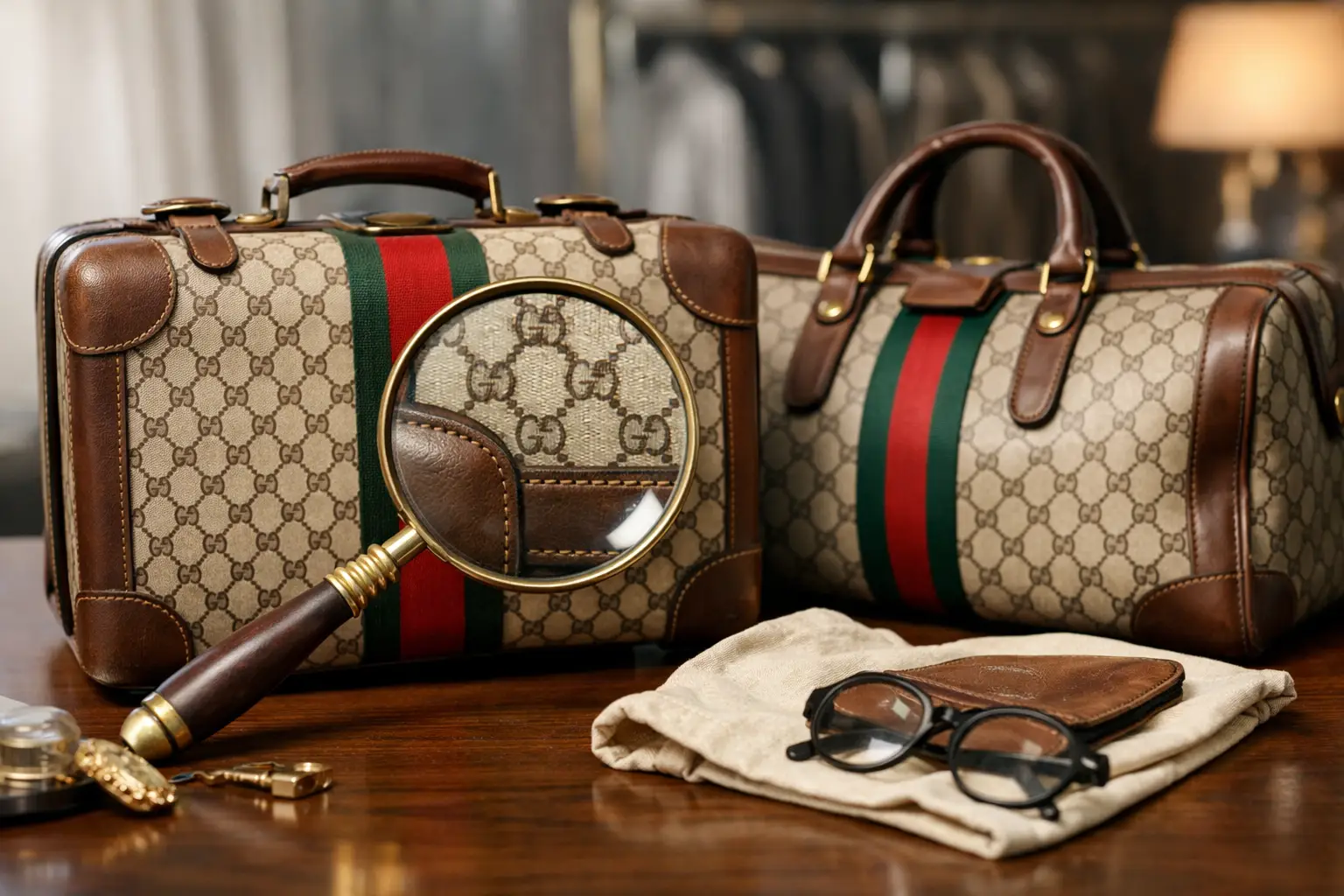
A Gucci suitcase can look convincing from across the room. The difference reveals itself when you slow down – at the canvas edge, in the weight of the hardware, in the way the leather has aged, and in the small construction choices that counterfeit pieces usually miss. If you are learning how to identify vintage Gucci luggage, the process is less about one magic detail and more about reading the object as a whole.
For collectors and design-led buyers, that distinction matters. Vintage Gucci luggage occupies a particular place between travel object, fashion history, and decorative presence. A well-chosen piece can function as storage, as a sculptural accent in an interior, or as a collectible with lasting value. But only if it is authentic, period-appropriate, and honestly preserved.
How to identify vintage Gucci luggage by era
The first useful question is not “Is it Gucci?” but “From when does this appear to be Gucci?” Vintage Gucci luggage changed across decades, and a piece should feel coherent with its era. Early and mid-century examples often present a more restrained elegance, with practical proportions, rich leather trim, and discreet branding. By the 1970s and 1980s, monogram canvas became more visible, silhouettes broadened, and details such as web stripes or bolder logo treatments appeared with greater frequency.
A suitcase that combines features from very different periods should prompt caution. For example, aggressively modern branding paired with construction methods associated with earlier luggage can suggest later alteration or outright reproduction. Authentic vintage pieces tend to carry a visual logic. Materials, typography, stitching, and hardware usually belong to the same historical moment.
This is where experience helps, but even a newer buyer can train the eye. Compare the shape, trim style, and logo application to known vintage luxury luggage from the same broad decade. Gucci rarely looks accidental. Even worn examples usually retain proportion and discipline.
Start with materials and construction
The body of vintage Gucci luggage often tells the truth before the logo does. Many classic pieces use coated canvas with the GG monogram, sometimes paired with pigskin or leather trim. The canvas should not feel flimsy or plasticky. It usually has body, a certain density, and a finish that reflects age in a gradual way rather than peeling like cheap synthetic coating.
Leather trim is equally revealing. On older Gucci luggage, leather corners, handles, piping, and straps generally show refined workmanship. The cut edges should feel considered, and the aging should make sense. Natural wear on handles, softened corners, and slight darkening where the hand repeatedly touched the surface are all consistent with time. Uniform distressing, by contrast, can look staged.
Stitching should be neat and steady. It does not need to look machine-perfect in a contemporary sense, but it should look intentional. Uneven tension, skipped stitches, or awkward repair-like construction on a supposedly untouched piece is a warning sign. Vintage luxury luggage was made to travel, so authentic examples often show durability in the structure even when the surface carries wear.
Read the GG canvas carefully
One of the fastest ways to misread a piece is to rely on the presence of monogram alone. Counterfeit luggage has long used Gucci-inspired patterns, and many reproductions get the canvas wrong in subtle ways.
On authentic vintage GG canvas, the motif is usually balanced and consistent. The spacing should feel orderly, not cramped or overly loose. The print or weave should align sensibly across major panels, especially on a higher-quality hard or semi-structured case. Some variation can occur depending on age and model, but a sloppy, drifting pattern is not a good sign.
Color also matters. Vintage monogram canvas often appears in classic neutral combinations such as beige and brown, though other variations exist. The tones should feel rich rather than flat. Fakes often miss this and produce either a muddy surface or a high-contrast pattern with little depth.
Look closely at wear. Genuine old canvas tends to mellow. It may show abrasion at edges, softening at folds, and a patina that sits naturally within the material. Printed surfaces that crack in a superficial way or look recently “aged” deserve skepticism.
Logos, stamps, and interior labels
When considering how to identify vintage Gucci luggage, many buyers go straight to the interior stamp. That is sensible, but it should never be the only test. Gucci used different label and stamp formats over time, and older pieces do not always match the expectations built from newer bags.
You may find leather tabs stamped with Gucci, Gucci Made in Italy, or period-specific branding treatments. The typography should be crisp, centered, and proportionate. On authentic pieces, even a small stamp usually has a composed appearance. Letters that look too thick, unevenly spaced, or poorly pressed can indicate trouble.
Some vintage pieces include serial numbers, while others may not present them in the way modern buyers expect. Absence alone does not prove inauthenticity, especially on older luggage. What matters more is whether the interior details, stamp style, and construction are consistent with the piece as a whole.
Interior linings should also make sense. Depending on the model and era, Gucci luggage may feature clean textile linings, leather-trimmed compartments, straps, or practical travel-focused interiors. A flashy synthetic lining in a piece that otherwise suggests mid-century refinement can be a red flag.
Hardware should feel substantial
Zippers, locks, buckles, handle brackets, and protective feet are some of the most persuasive indicators of quality. Authentic vintage Gucci luggage tends to use hardware with presence. Even when small, it usually feels weighty, finished, and integrated into the design.
Check whether the metal has aged naturally. Brass-tone hardware may develop soft tarnish or darkening in recessed areas. That kind of oxidation can be convincing because it follows use and exposure. Bright plating that flakes badly or feels extremely light can suggest later replacement or inferior manufacture.
Branding on hardware should be approached with care. Some authentic pieces include branded zipper pulls or lock plates, while others are more discreet. A suitcase covered in logos where restraint would be more plausible is worth questioning. Luxury travel goods often relied on material quality and construction more than constant overt marking.
Operational feel matters too. A vintage zipper may not glide like a new one, but it should not feel disposable. Locks and clasps should show engineering, not just decoration.
Wear patterns tell a story
A real vintage travel piece usually carries honest evidence of movement through time. The key is whether the wear is believable and evenly related to how luggage is actually used. Corners take impact. Handles darken and soften. Base edges scuff. Interior pockets gather fine marks. Leather straps may curve from repeated fastening.
What you do not want is random aging applied for effect. If the corners are heavily distressed but the handle remains suspiciously untouched, something is off. If one side of the canvas is dramatically faded while protected areas look identical, that can also feel manufactured.
Restoration complicates this, and not always negatively. A professionally restored vintage Gucci suitcase can still be desirable, especially if the work respects the original form and materials. Replaced handles, refreshed stitching, or cleaned interiors are not necessarily disqualifying. The issue is disclosure and quality. Restoration should support the object, not rewrite it.
Common mistakes buyers make
The most common mistake is trusting a single feature. A serial number, a lock, or a monogram pattern on its own is never enough. Authenticity comes from agreement across many details.
The second mistake is confusing age with value. Some vintage Gucci luggage is highly collectible; some is primarily decorative; some is simply too compromised to justify a premium. Heavy odor, warped structure, extensive moisture damage, or failing coating can affect both value and usability.
The third is ignoring proportion and presence. Authentic Gucci luggage often has an elegance that is difficult to fake. Even practical cases feel resolved. If a piece looks clumsy, overbuilt, or oddly generic, trust that instinct and inspect further.
How to identify vintage Gucci luggage before buying
Photographs can help, but they rarely replace close inspection. Ask for clear images of corners, handles, zipper areas, interior labels, lining, and base wear. Request close-ups of the stamp and hardware. If a seller avoids detailed views, that is useful information in itself.
Provenance adds confidence when available. Original keys, luggage tags, dust covers, retailer marks, or documented estate origin can support authenticity, though none are definitive on their own. The best pieces are the ones where provenance, material quality, and period consistency all point in the same direction.
It also helps to buy with a curator’s mindset rather than a bargain hunter’s reflex. A genuine vintage Gucci suitcase with graceful wear and strong decorative presence will almost always outlive a cheaper piece that only imitates the look. For buyers drawn to objects with identity, that difference is not minor. It is the entire point.
A vintage Gucci luggage piece should reward attention. The more carefully you look, the more its quality, era, and authenticity should come into focus – not through one dramatic proof, but through a collection of details that belong together.
Sorry, the comment form is closed at this time.