

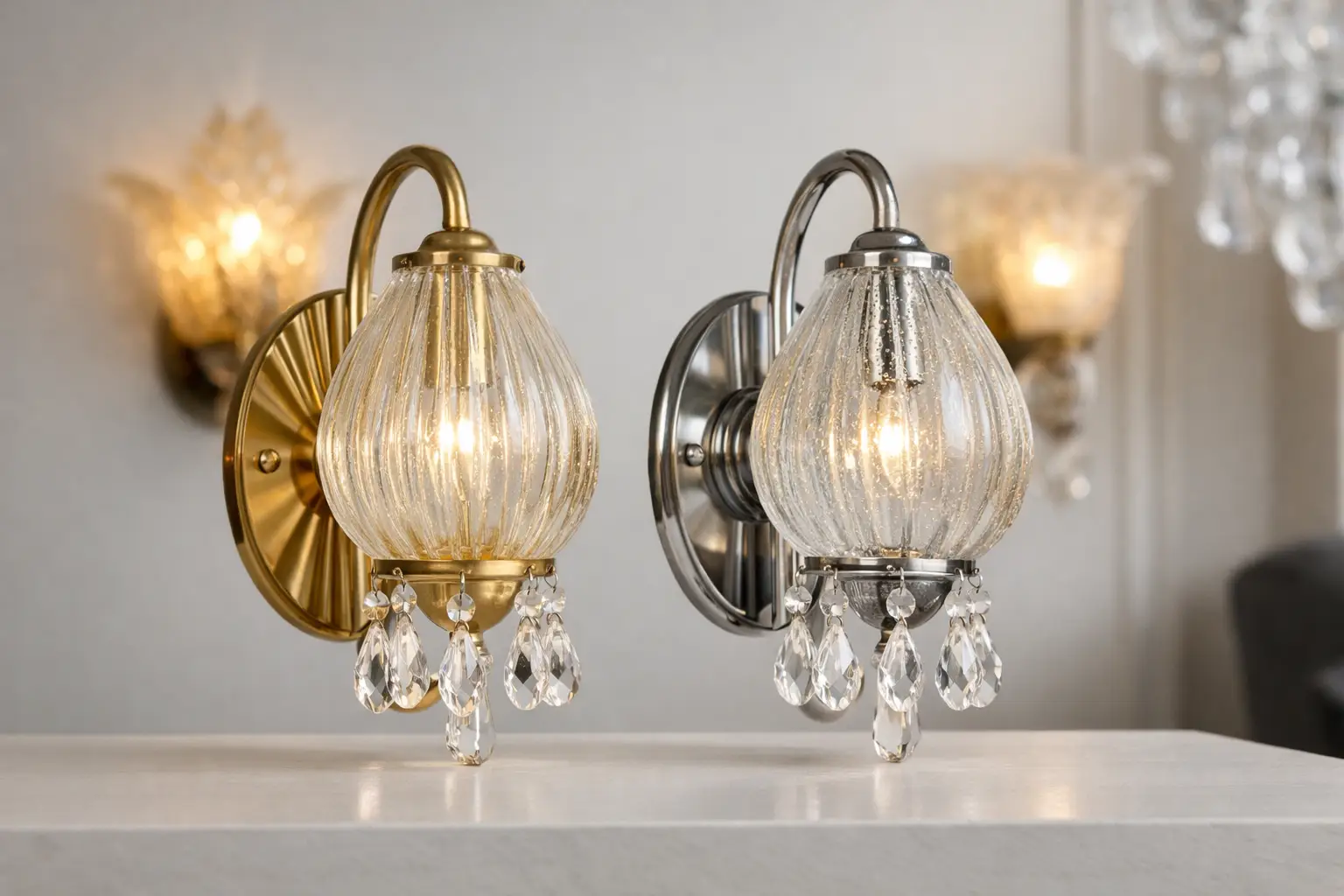
A Murano wall sconce can look convincing at first glance and still be entirely wrong. The silhouette may echo a Venetian model, the glass may shimmer beautifully, and the proportions may feel period-correct. Yet authenticity in this category rarely lives in one dramatic clue. It lives in a cluster of signals. That is why looking at Murano sconce authenticity examples is more useful than memorizing a single rule.
For collectors, decorators, and buyers furnishing rooms with real character, the difference matters. An authentic Murano sconce carries not only decorative value but also technical intention, workshop culture, and a specific relationship between glass, metalwork, and light. A reproduction may still be attractive, but it belongs to a different conversation.
What Murano authenticity actually looks like
Murano is not a style in the broad sense. It is a place, a glassmaking tradition, and often a chain of attribution questions. A sconce may be Murano-made but unsigned. It may be attributed to a known furnace but altered later. It may also be vintage Italian glass inspired by Murano aesthetics without being a true Murano production. Serious evaluation begins by accepting that authenticity is rarely binary in the simplistic way online marketplaces suggest.
With wall sconces, the reading becomes even more precise because they combine decorative glass with functional structure. You are judging the glass itself, the mounting system, the backplate, the wiring history, and the coherence of all components. If one part speaks 1950s Venetian craftsmanship and another speaks recent factory hardware, the piece deserves a closer look.
Murano sconce authenticity examples collectors should know
One of the clearest examples is the mid-century hand-blown sconce with visible variation between paired elements. In authentic production, especially in vintage models made in small batches, two sconces sold as a pair often mirror each other in spirit rather than matching with industrial exactness. The curves of the arms, the thickness of applied leaves, the slight difference in the spread of a flower cup, or the irregularity in gold flecks can all support authenticity. Handmade Murano glass has discipline, but not sterile repetition.
A second strong example is the Pulegoso sconce. True pulegoso glass contains a dense field of controlled bubbles suspended within the body of the glass. On an authentic vintage Murano example, those bubbles tend to feel integrated into the mass rather than printed onto the surface effect or scattered without rhythm. The glass often has a depth that changes under warm light. If the bubble pattern looks too uniform, too shallow, or oddly synthetic, caution is reasonable.
Another useful case is the triedri or prism-based sconce from the 1960s and 1970s. Authentic pieces often use individual glass prisms with substantial weight and a crisp geometry that catches light with restraint rather than excessive sparkle. The metal frame usually shows age in a believable way, and the joinery tends to make sense structurally. In many later reproductions, the prisms are lighter, thinner, and less nuanced in tone, while the frame may rely on generic hardware that feels disconnected from the elegance of the design.
Then there is the floral sconce, one of the most copied categories. Authentic examples with petals, leaves, and blossoms in Murano glass usually reveal highly skilled lampworking or hot-applied decoration. Petals should have life in their edges. Leaves often show subtle veining, curvature, or tonal transition. The composition feels composed from glass first, not assembled from standardized decorative parts. When every flower is too identical and every leaf has the same stamped character, the piece often moves away from true Murano workmanship.
Details that support attribution
Labels help, but they do not settle everything. A paper label from a known Murano furnace can be reassuring, especially when age, wear, typography, and adhesion are coherent with the object. At the same time, labels are among the easiest elements to lose, replace, or fake. An absent label does not make a sconce inauthentic, and a present one does not automatically make it right.
Signatures can be more persuasive, particularly acid marks, engraved names, or original furnace stickers tied to documented models. Still, many authentic vintage sconces were never signed in a visible way. In the market, attribution often rests on a combination of form, material behavior, known design language, and construction logic.
Metalwork is often underestimated. On authentic Murano sconces, the backplate and arms usually belong aesthetically to the glass. They may be discreet, but they are rarely careless. Brass with natural aging, hand-finished iron, or period chrome details can reinforce the date and origin. If the glass appears sophisticated but the mounting hardware feels recent, flimsy, or stylistically generic, something may have been altered or replaced.
Murano sconce authenticity examples versus decorative reproductions
The most telling contrast is usually not beauty but intention. Authentic Murano lighting tends to have a sense of authorship, even when the maker is not firmly identified. The piece feels designed as an object of light, not merely ornament that happens to hold a bulb.
A decorative reproduction often leans too hard on surface cues. It may emphasize gold, heavy curvature, or flamboyant floral language without the refinement that makes Murano glass persuasive. The result can be visually pleasing but slightly overplayed. Authentic examples, even the dramatic ones, generally show control. The glass is expressive, yet balanced.
Weight is another differentiator. Vintage Murano components often have substance. The glass petals, cups, or prisms feel denser and more resolved in the hand. Reproductions can be lighter than expected, with a thinner body and less optical complexity. This is not a universal rule, but it is a recurring one.
Color also deserves attention. Authentic Murano glass can be vivid, opaline, smoky, translucent, lattimo, amber-toned, or infused with gold leaf, but the color usually has depth. In lower-grade reproductions, tones may appear flat or too uniform, as though selected from a decorative palette rather than developed through a glassmaking process.
Where buyers get misled
One common mistake is treating age alone as proof. A sconce can be old and still not be Murano. Italy produced many decorative glass fixtures outside Murano, and other European manufacturers borrowed Venetian vocabulary freely. The phrase “Murano style” appears so often in the market because the visual language became influential far beyond the island itself.
Another mistake is overtrusting online descriptions. Terms such as “attributed to,” “Murano manner,” and “Venetian type” all mean different things, and some sellers use them loosely. A careful listing should describe what is known, what is inferred, and what remains uncertain. Precision in language usually reflects seriousness in sourcing.
Condition can mislead as well. Rewired sconces, replaced screws, later sockets, and refreshed finishes are common in vintage lighting. These interventions do not necessarily harm authenticity. In fact, sensible restoration is often part of a collectible piece’s life. What matters is whether the core object remains coherent and whether modifications are disclosed clearly.
How to assess a piece with confidence
Start with the glass before the story. Look at surface, transparency, thickness, applied elements, and the internal life of the material under light. Then move to structure. Ask whether the frame, arms, backplate, and glass belong to the same design logic. After that, consider attribution evidence such as labels, signatures, provenance, and comparison with documented models.
It also helps to compare categories rather than isolated objects. A buyer who has studied a handful of authentic triedri sconces, floral appliques, and pulegoso wall lights will recognize patterns more quickly than someone relying on one image from one seller. The eye becomes educated through repetition.
For collectors with a strong decorative point of view, authenticity should not flatten taste into paperwork. The right Murano sconce has presence before it has documentation. But in a serious selection, presence and evidence should support each other. That is where curated sourcing makes a meaningful difference, especially in a category where beauty can easily disguise approximation.
At Sound Of Vintage Italy, this distinction is central to the way vintage lighting is read and presented. A Murano sconce is never just a wall fixture. It is a composition of craftsmanship, period language, and atmosphere.
The best approach is measured rather than anxious. Learn the recurring signs, accept that some cases require nuance, and choose pieces whose quality is visible even before the label enters the conversation. When authenticity is real, it tends to reveal itself quietly – in the glass, in the balance, and in the certainty of the object on the wall.
Sorry, the comment form is closed at this time.